

The app development landscape in 2026 is evolving faster than ever before. With advancements in AI, automation, cross-platform technologies, and enhanced security standards, companies are under increasing pressure to build high-performance, scalable, and user-centric applications. This rapid shift has changed the way organizations approach talent acquisition.
Hiring developers is no longer simply about choosing someone with coding skills—it now requires a deeper understanding of emerging technologies, industry expectations, and global talent trends. As businesses continue to expand their digital presence, the need for highly skilled developers has become more critical than in any previous decade.
Another major factor shaping the hiring ecosystem in 2026 is the rising demand for product quality. Whether you’re creating a complex enterprise application, a startup MVP, or a consumer-focused mobile app, user expectations have reached new heights. People expect smarter apps, faster performance, tighter security, and highly personalized experiences. This has created an environment where companies must compete not only in the market but also in the global talent pool.
The best mobile app developers are in extremely high demand, making the hiring process more competitive and strategic than ever. Businesses must adopt modern evaluation methods, flexible hiring models, and future-ready recruitment processes to secure the right talent.
Moreover, technological trends such as AI-enhanced development workflows, cloud-native architectures, low-code platforms, and decentralized digital systems are reshaping developer responsibilities. This means companies can no longer rely on outdated hiring practices. Instead, they must identify talent who can adapt quickly, understand evolving frameworks, and build products with long-term scalability in mind.
In 2026, hiring the right developers is not merely an operational task—it is a decisive factor that directly influences product success, business growth, and competitive positioning. This guide will help you navigate this complex landscape and understand the best way to hire app developers in 2026 with confidence.
We have listed! Top Mobile App Development Trends To Watch In 2026
Why Hiring the Right App Developers Matters More Than Ever

In 2026, the decision to hire the right app developers carries more weight than ever before, as their skills, experience, and adaptability directly shape the quality, performance, and long-term success of your digital product.
The Direct Impact on Product Quality and User Experience
User expectations have evolved dramatically. Today’s audience demands fast, intuitive, secure, and flawlessly designed applications. A single bug or slow screen can cause users to uninstall instantly.
This makes skilled developers essential—they not only write code but engineer seamless experiences, prioritize usability, and build stable features that retain customers. The right developers know how to align technical development with user behavior and market expectations.
The Competitive Nature of Modern Markets
Every business—large or small—is racing to release innovative digital solutions. Whether it’s a fintech app, healthcare platform, e-commerce marketplace, or productivity tool, competition is fierce. Companies with superior developers launch better products, implement features faster, and maintain higher user satisfaction.
Hiring strong developers gives your organization a competitive edge by enabling rapid innovation, continuous improvement, and long-term market relevance.
Growing Complexity of Modern Technology Stacks
Applications in 2026 rely on advanced technologies like cloud-native infrastructure, AI-driven automations, real-time synchronization, blockchain integrations, and zero-trust security models. These complex systems require developers who understand modern frameworks, scalable architectures, and cross-platform ecosystems.
Without skilled talent, projects face issues like poor scalability, integration failures, and security vulnerabilities—problems that can become extremely costly over time.
Reduced Risk and Long-Term Stability
Poorly structured development teams often lead to messy codebases, technical debt, and unstable applications. These issues increase maintenance costs and slow down future updates. Skilled developers reduce these risks by following best practices, applying clean coding standards, implementing robust security protocols, and planning architectures with growth in mind. This ensures that your app remains stable, secure, and future-ready.
Better Collaboration and Faster Delivery
Modern development cycles depend on clear communication, agile methodologies, rapid feedback loops, and multi-disciplinary collaboration. Swiss Developers who understand these workflows contribute significantly to smoother project execution.
They communicate effectively with designers, testers, product managers, and stakeholders, ensuring that the final product aligns with business goals. As a result, projects move faster, quality improves, and time-to-market is significantly reduced.
Read once! How Custom Software in Business Drives Innovation and Growth
Key Trends That Will Influence How You Hire App Developers in 2026
The year 2026 introduces a completely new hiring environment shaped by technological advancements, global workforce shifts, and evolving user expectations. Understanding these trends is essential because they directly affect the type of developers you need, where you find them, and how you evaluate their skills in a rapidly changing digital world.
1) AI-driven development workflows
Artificial intelligence is no longer an optional enhancement in software development. In 2026, it plays a central role in coding, debugging, security testing, and project management. Developers are expected to work alongside AI systems that automate repetitive tasks, generate boilerplate code, and optimize development pipelines.
This shifts the hiring focus toward developers who understand AI-assisted programming tools, know how to validate AI-generated outputs, and can use machine intelligence to improve productivity without compromising quality. Companies must now look for talent that not only writes excellent code but also knows how to leverage AI to accelerate delivery.
2) Evolution of cross-platform and multi-experience development
Cross-platform frameworks have matured significantly by 2026, making it possible to create high-performance apps for mobile, web, desktop, smart wearables, and IoT devices using a single codebase. This means that companies must hire developers who are skilled in modern frameworks like Flutter, React Native, and emerging unified development environments.
Multi-experience development, which involves building consistent interactions across different devices, also requires developers who understand UX continuity, device behavior patterns, and integration between platforms. This trend pushes businesses to evaluate developers based on how well they can build versatile, multi-device applications.
3) Rise of hyper-specialized developer roles
As technology becomes more complex, developers are specializing in narrow yet highly valuable skill sets. Rather than generalist mobile developers, companies now need experts such as cloud-native architects, backend microservices engineers, AI automation specialists, AR/VR developers, and cybersecurity-focused mobile engineers.
This trend demands a deeper and more focused hiring strategy, where businesses must understand exactly what expertise their project needs. Hyper-specialization also means that interview processes, evaluation tasks, and skill assessments must be tailored for each niche role because one-size-fits-all hiring approaches no longer work.
4) Remote-first global hiring becomes the norm
Remote work is now a mature and accepted standard across the tech world. Companies in 2026 routinely hire developers from across continents, forming distributed teams that collaborate through digital platforms. This shift impacts hiring in several ways: businesses can access larger global talent pools, evaluate developers based on ability rather than geography, and reduce operational costs by hiring skilled remote professionals.
However, it also means companies must prioritize communication skills, time zone compatibility, and proven experience working in remote environments. The focus now extends beyond technical skills to reliability, collaboration, and adaptability.
5) Increasing reliance on cloud-native and serverless architecture
Modern apps are built on cloud-native platforms and serverless systems that demand specialized technical knowledge. Developers must understand microservices architecture, containerization, CI/CD processes, observability tools, and scalable cloud infrastructure.
Hiring in 2026 requires companies to evaluate whether developers can build applications that scale seamlessly, integrate multiple cloud services, and maintain strong performance under heavy load. This trend raises the bar for backend, DevOps, and full-stack developers, making knowledge of cloud ecosystems a major hiring priority.
6) Security-focused development becomes essential
Cybersecurity threats are more advanced and frequent in 2026. Applications must comply with stricter privacy laws, follow zero-trust principles, and support advanced authentication systems. As a result, companies must hire developers who understand secure coding practices, threat modeling, encryption standards, and vulnerability prevention.
Security is no longer the responsibility of a separate team—it is a core skill expected from every developer. This trend influences hiring patterns by prioritizing applicants with proven security knowledge and experience in building compliant applications.
7) Demand for rapid prototyping and agile iteration
The market in 2026 moves fast, requiring companies to launch MVPs quickly, gather user feedback, and iterate rapidly. Businesses now prioritize developers who can work within agile frameworks, adapt quickly to changes, and build prototypes efficiently without sacrificing quality.
This trend changes how companies assess candidates: instead of long theoretical tests, practical tasks, portfolio reviews, and real-world problem-solving challenges have become more important. Developers who excel in iterative development and fast-paced environments are in higher demand than ever.
Step-by-Step Guide: What Is the Best Way to Hire App Developers in 2026?
Finding and hiring the right developers in 2026 requires a structured and strategic approach. The hiring process is no longer just about checking technical skills; it involves understanding your project needs, evaluating cultural fit, assessing adaptability to new technologies, and ensuring long-term compatibility.
This step-by-step guide will help you navigate the process effectively and build a strong foundation for successful app development.
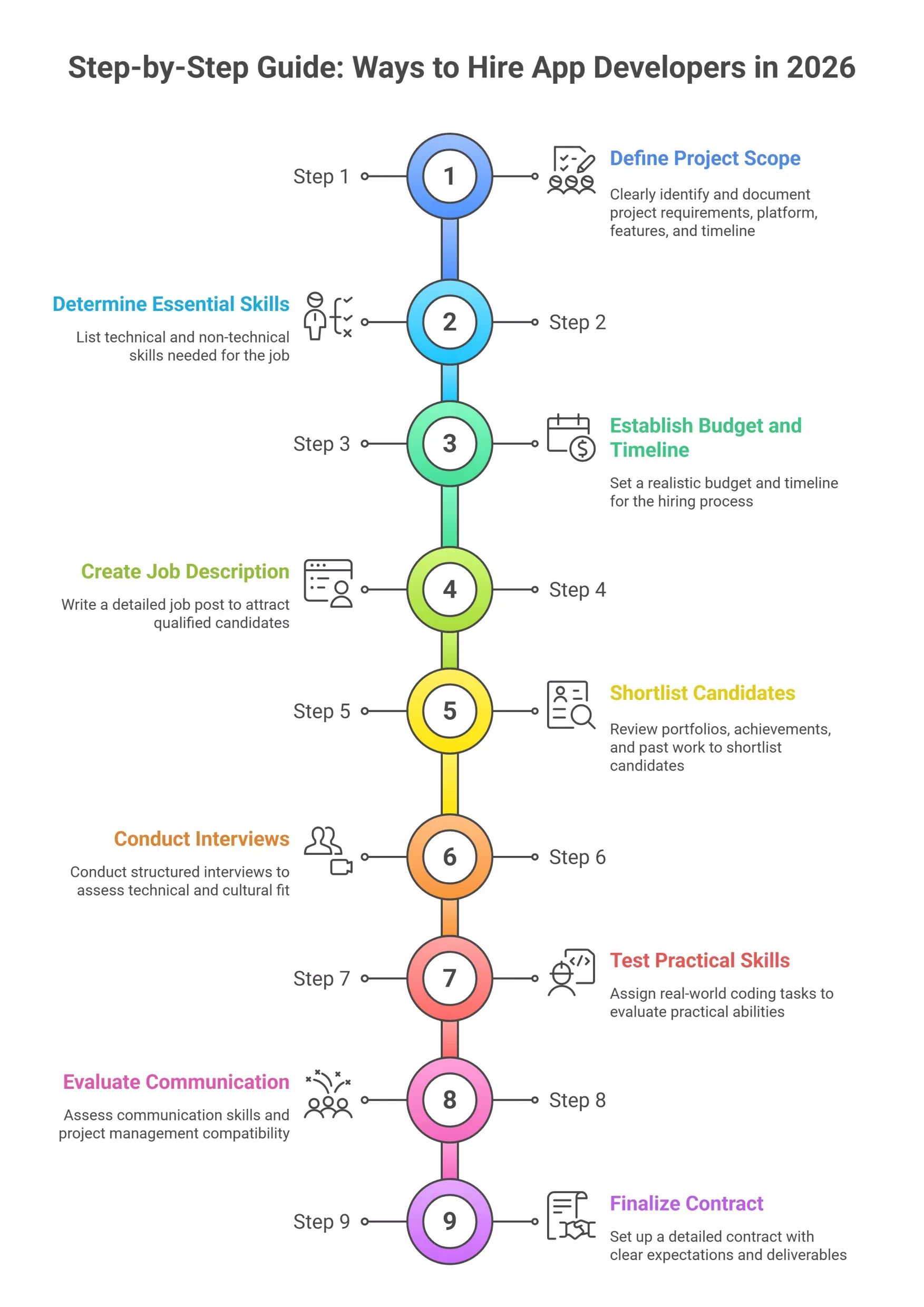
1) Identify and define your project scope clearly
The first step in hiring developers is gaining absolute clarity on your project requirements. Before searching for talent, you must determine what type of application you want to build, the platform you are targeting, the features you need, and the timeline you expect.
A clear project scope helps you understand whether you need iOS developers, Android developers, cross-platform experts, backend specialists, or a complete full-stack team. This clarity prevents confusion, speeds up hiring, and ensures that you attract the right candidates with the right skills.
2) Determine the essential technical and non-technical skills
Once the project scope is defined, identify the exact skills required for the job. This includes programming languages, frameworks, architectural experience, cloud knowledge, and familiarity with security standards. Equally important are non-technical skills such as communication, teamwork, time management, and adaptability.
Developers in 2026 must collaborate effectively in remote and hybrid environments, understand user behavior, and make informed technical decisions. Evaluating both skill sets ensures you hire developers who are not just coders but complete contributors to your digital product.
3) Establish your budget and realistic timeline
Budgeting plays a crucial role in determining your hiring strategy. App Development costs vary widely depending on developer location, experience, and specialization. Setting a realistic budget helps you decide whether to hire freelancers, full-time employees, or a dedicated development agency.
Similarly, defining a clear timeline ensures that you choose a developer who can work at the pace your project requires. A well-planned budget and timeline create transparency during the hiring process and help avoid delays, misunderstandings, and cost overruns.
4) Create a detailed job description to attract qualified talent
A structured job post is essential for attracting the right applicants. It should include project goals, required skills, expected responsibilities, tools and technologies, experience level, and any additional expectations such as familiarity with remote work or agile workflows.
In 2026, Mobile app developers prefer clarity and transparency in job descriptions. A well-written job post also filters out unqualified candidates and increases your chances of receiving applications from highly suitable professionals.
5) Shortlist candidates by assessing portfolios, achievements, and past work
Portfolios are one of the most reliable indicators of a developer’s practical ability. Reviewing previous apps, code samples, UI/UX style, architecture patterns, and performance levels gives you a realistic picture of their capabilities.
Instead of focusing solely on big-name projects, analyze how they solved technical problems and the quality of their contributions. This is especially important because modern applications involve advanced technologies, and past experience shows how well a developer can manage complexity.
6) Conduct structured and relevant interviews
Interviews in 2026 must be designed to reveal real-world capabilities rather than memorized answers. Use a mix of technical questions, scenario-based challenges, and project discussions to understand how a developer approaches problem-solving.
Include conversations about architecture choices, security practices, integrations, and scalability. It is also essential to assess communication skills and cultural fit, as developers must collaborate across distributed teams and align with your organization’s goals.
7) Test their practical skills through real-world assessments
A short, focused, practical assignment offers deep insight into how a developer works. Unlike traditional tests, these tasks should mirror actual project requirements—such as building a small feature, fixing existing code, or designing an API.
The goal is not speed alone but quality, logic flow, structure, and maintainability. In 2026, coding tests must reflect the complexity of modern applications, making this assessment phase vital for identifying genuine talent.
8) Evaluate communication skills and project management compatibility
Modern development relies heavily on communication tools, remote collaboration platforms, agile methodologies, and frequent updates. Developers must understand how to work in sprints, manage tasks in project management tools, and communicate progress effectively.
Poor communication often leads to missed deadlines, misunderstandings, and quality issues. This stage helps you identify developers who can work smoothly with your team and align with your workflow.
9) Finalize the contract with clear expectations and deliverables
Once you select the right developer, set up a detailed contract outlining responsibilities, timelines, payment terms, intellectual property rights, security guidelines, and delivery milestones. Clear documentation prevents conflicts, builds trust, and ensures that both parties understand their obligations.
In 2026, clarity in contracts is more important than ever due to the global nature of development teams and the complexity of modern digital products.
Choosing Between In-House, Freelance, and Offshore Teams
Selecting the right hiring model is one of the most important decisions you will make when building an app in 2026. Each approach—in-house, freelance, and offshore—comes with its own strengths, limitations, and ideal use cases. Understanding these differences helps ensure that your project gets the right talent, within the right budget, and in the right timeframe.
In-house teams: best for long-term and complex development
In-house development teams are ideal for companies that require long-term product growth, continuous iterations, and deep organizational alignment. Full-time developers work exclusively on your project, enabling complete control over quality, security, and development pace. This model also enhances collaboration, as developers are embedded directly into your company culture and workflows.
However, building an in-house team demands significant investment. Salaries, benefits, office infrastructure, training, and long-term commitments can make this the most expensive model. Additionally, hiring full-time employees takes time, and finding highly specialized talent locally can be challenging. Despite the costs, this model is best suited for organizations with ongoing product needs and long-term vision.
Freelance developers: ideal for small tasks, short-term needs, or specialized expertise
Freelancers play a crucial role in modern development, especially when you need quick assistance or niche technical expertise. In 2026, freelance platforms offer access to a global pool of skilled developers who can handle anything from fixing bugs to building complete features. The flexibility, cost-effectiveness, and speed of hiring make freelancers an excellent choice for short-term or low-risk tasks.
The downside of freelance hiring is inconsistency. Not all freelancers are equally reliable, and some may handle multiple projects simultaneously. Communication challenges, time zone differences, and limited accountability may also affect project outcomes. This model works well for smaller projects, prototypes, or tasks that do not require full-time involvement, but it may not be suitable for complex, long-term applications.
Read once! Dedicated Developers vs. Freelancers: Which One Should Your Hire?
Offshore development teams: ideal for scaling, reducing cost, and accessing global skills
Offshore teams have become one of the most popular models in 2026 due to their ability to offer high-quality development at significantly lower cost. By hiring teams from regions with strong technical talent, companies can quickly scale up, accelerate development, and access diverse skill sets that may not be available locally. Offshore teams usually operate as dedicated partners, ensuring consistency, structured workflows, and long-term cooperation.
While this model is highly efficient, it comes with its own considerations. Time zone differences can affect communication if not managed correctly, and companies must ensure that the offshore team follows strict security and compliance standards.
Proper onboarding, clear documentation, and well-defined processes are essential for success. When managed well, offshore development delivers both quality and cost efficiency, making it an excellent option for startups and enterprises alike.
The ideal hiring model depends greatly on project complexity, budget, timeline, and long-term goals. If you are building a large-scale platform with continuous updates, an in-house team is the strongest choice. If you need flexibility, speed, or temporary assistance, freelancers are highly effective. If your goal is to scale rapidly while optimizing costs, offshore teams offer the best balance of expertise and affordability.

Evaluating Developers: Skills, Tech Stacks, and Portfolios
Evaluating app developers in 2026 requires a structured approach that considers technical depth, practical experience, adaptability, and the ability to align with your product vision.
Core technical skills to look for
Every app developer should possess strong foundational skills that ensure they can build, test, and optimize applications efficiently. This includes proficiency in programming languages, understanding of mobile platforms, and familiarity with modern development principles. Developers must demonstrate a clear understanding of concepts like APIs, database management, UI frameworks, application lifecycle, and performance optimization.
They should also be knowledgeable about writing clean code, following best practices, and maintaining security protocols. These technical fundamentals determine whether a developer can handle complex tasks without compromising on quality.
Proficiency in relevant technology stacks
Choosing developers with the right tech stack expertise is essential for ensuring compatibility with your product’s architecture. A tech stack includes the set of tools, frameworks, libraries, and programming languages used to build the application.
Developers should have specialized experience in the stack your project demands, whether it involves native technologies like Swift or Kotlin, cross-platform frameworks like Flutter or React Native, or backend tools such as Node.js, Django, Laravel, or cloud services. Evaluating proficiency ensures that the developer can work efficiently within your selected environment and reduce any risk related to slow delivery or technical misalignment.
Ability to evaluate portfolios effectively
A developer’s portfolio is one of the most reliable indicators of real-world experience. It shows their coding capabilities, project exposure, and problem-solving style. When assessing portfolios, focus on the complexity of the applications they have built, the industries they have worked in, and the features they have implemented.
Pay close attention to app performance, UI design quality, platform consistency, and technical innovations used in their past work. Developers with strong portfolios can demonstrate how they transform ideas into functional applications with measurable outcomes.
Testing practical capabilities through assignments
Technical assessments and coding assignments remain one of the best ways to verify practical expertise. These tests reveal how the developer approaches problem solving, writes code, handles edge cases, and manages timelines.
Assignments can include debugging tasks, API integrations, UI building exercises, or small feature implementations. This process helps you understand whether the developer works logically, communicates challenges, and contributes to reliable code quality. In many cases, a practical test provides more insight than resumes or interviews alone.
Assessing specialization and domain expertise
Many app developers specialize in specific industries or types of applications. Some may excel in fintech, others in e-commerce, healthcare, social networking, AI-driven products, or gaming. Understanding their domain experience helps determine whether they can anticipate challenges and integrate relevant features.
Developers with domain expertise bring valuable insights, faster decision-making, and more accurate estimations. This specialization can significantly speed up development and reduce technical risks.
Understanding communication and collaborative skills
Technical knowledge alone is not enough. Developers must communicate clearly, understand product requirements, and collaborate effectively with designers, analysts, managers, and testers. Strong communication ensures fewer misunderstandings, smoother development cycles, and better alignment with the project vision.
Evaluating communication skills helps you determine whether the developer can adapt to your workflows, participate in planning discussions, and deliver consistent updates.
Evaluating problem-solving and critical thinking
App development involves continuous problem-solving. Developers must identify bugs, design efficient solutions, and make informed decisions when dealing with complexities. Evaluating problem-solving skills can reveal how developers think under pressure, how creatively they approach challenges, and how well they optimize systems.
Developers with strong analytical skills can reduce development delays, avoid messy code, and build maintainable solutions that scale effectively.
Understanding Costs, Pricing Models, and Budget Planning
Budget planning is one of the most crucial steps when preparing to hire developers in 2026, and understanding pricing structures allows you to make financially sound decisions.
Factors influencing app development cost
Several key factors impact the total cost of hiring developers and building an application. The complexity of the app is one of the primary cost drivers, as advanced features like real-time tracking, payment integration, AI capabilities, or multi-device compatibility require more development hours.
Platform choice also plays a major role; developing for both iOS and Android can increase costs significantly compared to building for a single platform. The level of experience required from the development team influences cost as well, because senior developers command higher rates. Design quality, third-party integrations, data security standards, and backend infrastructure requirements also contribute to the final budget.
Common pricing models used in 2026
Different pricing models exist to match different types of development needs. The fixed-price model is suitable for projects with well-defined requirements where the scope is unlikely to change. This model ensures predictable costs but may restrict flexibility. Time-and-materials pricing is more suitable for evolving projects, allowing changes in scope while paying for actual work hours.
Dedicated team models offer full-time experts who work exclusively on your project, ideal for long-term development or scaling. Subscription-based development models are also emerging, offering continuous app maintenance and updates at a monthly fee. Understanding these models helps you pick the one that aligns with your project’s stability and flexibility.
Budget differences between regions
Developer rates vary significantly depending on geographical regions due to differences in living costs, market demand, and the maturity of the tech ecosystem. Developers in North America and Western Europe typically charge the highest rates, while Eastern Europe, Asia, and Latin America offer high-quality development at more competitive prices.
Offshore teams provide access to skilled developers at reduced costs without sacrificing quality. Understanding regional price variations helps you create a realistic budget and choose locations that provide the right balance between affordability and technical expertise.
Planning long-term development and maintenance costs
App development does not end after the launch. Long-term maintenance is essential for bug fixes, feature updates, performance improvements, and security upgrades. You must also consider costs associated with cloud servers, databases, APIs, third-party services, and ongoing design enhancements.
Allocating at least 15 to 20 percent of the initial development cost annually for maintenance ensures the app stays updated, secure, and competitive. Planning upfront protects your budget from unexpected expenses and ensures long-term stability.
Avoiding hidden and unexpected charges
Many businesses face hidden costs because they fail to plan for elements that arise later in development. These may include licensing fees for premium tools, additional design revisions, unexpected API charges, or extra backend requirements. Feature changes during development can also increase costs, especially in fixed-price models.
Working with transparent developers who provide detailed breakdowns and clear contracts helps you avoid financial surprises. Proper communication and requirement documentation minimize the risk of hidden fees.
Creating a realistic and flexible budget
A successful budget considers both expected and unforeseen expenses. Start with a clear estimation of your app’s complexity, required technologies, timeline, and team structure. Maintain flexibility by setting aside a buffer for unexpected tasks or scope changes.
Using phased development strategies, such as building an MVP first, can help manage costs efficiently. A well-planned budget ensures that your project progresses smoothly without compromising quality or facing sudden financial strain.

Interviewing Developers: Questions, Red Flags, and Screening Tips
Interviewing app developers in 2026 requires a well-structured approach that evaluates technical expertise, communication skills, attitude, and real-world problem-solving capabilities.
Importance of structured interviews
Structured interviews ensure fairness, consistency, and better comparison between multiple candidates. A defined system helps you evaluate how developers think, how they work under pressure, and how effectively they can contribute to your project. This eliminates guesswork and reduces the risk of hiring someone who lacks critical skills or cannot collaborate with your team.
Key technical questions to ask
Technical questions allow you to assess whether the developer has the right depth of knowledge for your project. Ask about their experience with mobile app architecture, API integration, UI frameworks, backend systems, security standards, and optimization methods. These questions help uncover whether the developer only follows instructions or truly understands how to build scalable, reliable applications from the ground up.
Questions about real project experience
Real-world experience is an essential evaluation factor. Ask candidates to describe the most challenging app they have built, the technical hurdles they faced, and the strategies they used to overcome them. Their answers reveal how they handle complexity, how they approach problem solving, and how involved they were in the overall development process. This helps you determine their ability to work on your project’s unique requirements.
Behavioral and communication questions
Communication is critical for smooth collaboration, especially in distributed teams or long-term development cycles. Ask candidates how they respond to feedback, manage misunderstandings, or handle changes in project scope. These questions identify their adaptability, patience, teamwork skills, and ability to maintain clarity in fast-moving development environments.
Live coding or technical test evaluation
Live coding sessions and practical assignments help reveal how developers think in real time. These tests show their coding style, ability to debug, understanding of logic, and efficiency in building small components or features. A practical test allows you to evaluate their actual performance rather than relying solely on theoretical knowledge or resume claims.
Red flags to watch during interviews
Certain warning signs indicate potential risks. These include vague explanations of past work, inconsistent project details, difficulty answering basic technical questions, or inability to discuss how they collaborate in teams. Other red flags include a lack of portfolio, defensive behavior during feedback, exaggerated claims, or unrealistic timelines. Identifying these early helps avoid problematic hires.
Signs of strong and reliable developers
Reliable developers show clarity of thought, confidence grounded in real experience, and an organized portfolio that demonstrates measurable work. They ask thoughtful questions about your project, show interest in long-term goals, and provide logical explanations for their development decisions. These indicators suggest strong professionalism, technical maturity, and consistent work habits.
Screening tips for better decision-making
Effective screening includes reviewing their portfolio, checking code samples, analyzing past client feedback, and verifying GitHub activity. It is also important to observe their responsiveness, clarity in communication, and ability to understand your technical environment. A multi-step screening process reduces risk and helps you select developers who consistently deliver high-quality work.
Importance of cultural and workflow alignment
Developers must align with your preferred workflow, whether it is Agile, Scrum, Kanban, or a customized methodology. Ask about their experience with sprints, stand-ups, planning meetings, and collaboration tools. Cultural alignment also includes transparency, adaptability, accountability, and respect for deadlines. These qualities ensure smooth teamwork and reduce future conflicts.
Where to Find Skilled Developers in 2026?
Finding skilled app developers in 2026 has become easier, but choosing the right talent still requires knowing where professionals actually showcase their work and what platforms reliably vet technical expertise. As mobile and AI-powered apps continue to grow across industries, businesses need developers who understand modern frameworks, cloud infrastructure, security, and scalable architecture.
Below are the most trusted places to find qualified app developers in 2026:
1. AppsInsight — Best for Finding Verified App Experts

AppsInsight has emerged as one of the most reliable platforms for discovering industry-tested app development companies and individual experts. Every listing is reviewed based on technical capability, past work, pricing transparency, and client feedback. Whether you need iOS, Android, cross-platform, AI, or custom software development, AppsInsight helps you compare verified teams and connect directly with the right partner.
If you want a curated list instead of sifting through thousands of profiles, AppsInsight is the best place to start.
2. Clutch
Clutch is widely used for researching software development firms. It offers in-depth company reviews, service breakdowns, project portfolios, and pricing ranges. Businesses use it to evaluate agencies based on verified client reviews and market reputation.
3. Upwork

Upwork remains a popular option for hiring individual freelancers or small development teams. It’s ideal when you need short-term work or smaller projects. The platform includes ratings, job success scores, and hourly rates to help you filter candidates.
4. Toptal

Toptal is known for vetting only the top 3% of tech talent. It’s a premium option suited for companies that need highly skilled developers for complex or large-scale projects.
5. LinkedIn

LinkedIn continues to be a strong platform for sourcing experienced developers, especially when you need direct communication, professional history, and portfolio visibility. It’s also useful for referrals from trusted connections.
6. GitHub
GitHub allows you to see real coding activity—repositories, commit history, contributions, and project involvement. It’s one of the most powerful ways to review a developer’s hands-on skill level.
7. Developer Conferences & Hackathons
Events like Google I/O, Apple WWDC, and React Native EU often attract top developers. Many companies hire talent directly from these communities because participants typically have strong technical backgrounds and hands-on experience with the latest technologies.
8. Tech Communities (Reddit, Discord, Stack Overflow)
Active developers often participate in community discussions, share solutions, and display their skills openly. These platforms help you identify problem-solvers who stay engaged with ongoing tech trends.
Other Top Platforms to Best App Developers in 2026
| Source Category | Platform / Method | Deep Explanation of Why It Works in 2026 |
|---|---|---|
| Online Hiring Marketplaces | Upwork, Fiverr Pro, Toptal | Online hiring platforms continue to be one of the most reliable places to find skilled app developers in 2026. Upwork offers a large talent pool with transparent ratings and previous client reviews. Fiverr Pro provides access to vetted professionals with verified portfolios. Toptal focuses on elite developers who undergo strict screening, offering high-end technical talent for complex projects. These platforms support flexible hiring, secure payments, and long-term collaboration tools, making them ideal for both short-term and full-scale development needs. |
| Developer-Focused Job Boards | Stack Overflow Jobs, GitHub Jobs, WeWorkRemotely | These job boards attract technically strong developers actively engaged in coding communities. Developers found here are often deeply involved in open-source projects, participate in technical discussions, and stay updated on modern technologies. GitHub Jobs allows you to evaluate portfolio repositories, while Stack Overflow Jobs helps you connect with highly technical candidates who excel in problem-solving. These platforms are ideal when seeking developers with high coding standards and deep specialization. |
| Tech Communities and Forums | Reddit r/programming, Dev.to, Indie Hackers | Tech communities provide a more organic way to find passionate developers who actively share knowledge and participate in discussions. Platforms like Dev.to and Indie Hackers allow you to discover developers who engage in real problem-solving, publish tutorials, and contribute to technical articles. This method helps you find developers who are motivated, up-to-date with industry trends, and capable of self-driven innovation. |
| Social Media Platforms | LinkedIn, Twitter (X), Facebook Groups | Social platforms continue to grow as professional networking tools in 2026. LinkedIn allows targeted searches for developers based on experience, skills, certifications, and endorsements. Twitter (X) remains a hub for developers discussing frameworks, sharing project updates, and participating in live coding events. Facebook groups dedicated to app development offer access to niche specialists and freelancers from around the world. These channels help you evaluate a developer’s personality, communication approach, and passion for technology. |
| Development Agencies | Local and offshore development firms | Agencies provide full-scale development services including project managers, designers, testers, and backend engineers. This approach is ideal when you require a complete team rather than individual developers. Agencies have established workflows, quality control systems, and long-term reliability. Whether local or offshore, agencies help businesses scale quickly, reduce hiring risks, and ensure consistent delivery through structured development processes. |
| Coding Bootcamps and Tech Institutes | General Assembly, App Academy, Flatiron School | Coding bootcamps produce new developers who are trained intensively in modern technologies. These institutions focus on hands-on experience, collaborative projects, and real-world app-building exercises. Hiring from bootcamps is ideal when you want motivated, trainable developers who easily adapt to your internal processes. Many bootcamp graduates specialize in mobile frameworks, making them suitable for entry-level or mid-level roles. |
| Referrals and Networks | Professional networks, colleagues, past developers | Referrals provide some of the most trustworthy hiring opportunities. Developers recommended through colleagues or previous collaborators usually come with validated track records. Referred candidates often align with your workflow and expectations more quickly because they share connections within your industry. This method also reduces recruiting time and increases your chances of hiring reliable, culturally compatible developers. |
| Hackathons and Tech Events | Online hackathons, developer conferences, coding competitions | Hackathons and competitions allow you to evaluate developers in real-time as they solve complex problems under pressure. Participants typically demonstrate creativity, teamwork, and fast-thinking abilities, making them strong potential hires. Tech conferences showcase developers who are passionate about emerging technologies, leading frameworks, and digital innovation. These events are ideal for finding highly skilled and unique talent. |
| Remote Work Platforms | Remote.com, FlexJobs, AngelList Talent | These platforms specialize in remote professionals across various time zones. Remote.com offers verified global developers with strong remote communication skills. FlexJobs focuses on vetted freelancers and full-time remote candidates. AngelList Talent connects you with developers interested in startup environments. These platforms help you reach talent that is comfortable with distributed collaboration, asynchronous communication, and long-term remote development workflows. |
| University Recruitment | Campus placements, tech internships | Universities remain strong sources for discovering fresh talent with strong theoretical foundations. Offering internships or entry-level roles helps you build a young team that you can train according to your product vision. Many universities offer project-based learning environments that prepare new graduates for real development challenges. This method works best for companies aiming to build long-term in-house teams. |
Building Long-Term Relationships With Developers
Developing a long-term relationship with your app developers ensures stability, efficiency, and smoother growth for your product over time.
Importance of long-term collaboration
Long-term collaboration helps developers gain deep familiarity with your product’s architecture, user base, and business goals. This familiarity results in fewer mistakes, faster updates, better scalability, and more accurate problem-solving. When developers understand your long-term vision, they become strategic contributors, not just task executors.
Establishing clear communication habits
Consistent communication prevents confusion and keeps development cycles steady. Setting expectations for weekly updates, sprint reviews, and feature planning meetings creates transparency. Using organized tools for documentation, project tracking, and communication ensures all team members stay aligned with goals and deadlines.
Providing feedback and recognition
Constructive feedback helps developers grow and correct issues early. Recognizing their efforts—especially during difficult releases or complex feature implementations—improves morale and builds mutual respect. Developers who feel appreciated are more motivated to deliver consistent and high-quality work.
Offering professional growth opportunities
Developers stay longer when they feel challenged and are able to grow. Providing opportunities like learning new technologies, attending tech conferences, or participating in advanced training encourages long-term loyalty. Growth opportunities show that you care about their development as much as your product’s.
Creating a supportive and flexible environment
A supportive environment helps maintain healthy work relationships. Flexibility in working hours, realistic deadlines, and an open feedback culture contribute to strong retention. When developers feel safe sharing concerns or proposing ideas, it strengthens teamwork and improves product quality.
Establishing long-term contracts and roadmaps
Long-term contracts provide stability for both you and the developers. When both parties commit to a planned product roadmap, responsibilities become clear and progress becomes predictable. Roadmaps also establish direction, making development smoother and more strategic.
Sum up
Hiring app developers in 2026 requires more than simply reviewing resumes or comparing hourly rates. It demands a thoughtful understanding of how modern development works, what skills truly matter, and how well a developer can adapt to the rapidly changing digital environment.
With new technologies emerging every year, businesses must look beyond basic technical qualifications and focus on a developer’s ability to innovate, communicate, and contribute meaningfully to the long-term vision of the product.
A structured hiring process is essential for making informed decisions. From defining project requirements clearly to evaluating portfolios, conducting practical tests, and asking strategically crafted interview questions, every step plays an important role in selecting the right developer. Balancing cost with value is equally important, as the most affordable option may not offer reliability or long-term growth. The best results come from choosing developers who combine strong technical expertise with professionalism, consistency, and a collaborative mindset.
Once a developer joins your team, the real success comes from maintaining strong communication, providing clarity, and fostering an environment where they can grow and contribute effectively. Long-term relationships, well-defined roadmaps, and continuous feedback ensure that your developers stay aligned with your goals and remain motivated to deliver high-quality work.
By following these principles and staying aware of modern trends, businesses can successfully hire app developers in 2026 and build applications that perform, scale, and thrive in the competitive digital landscape.
FAQs
What is the most important step when planning to hire app developers in 2026?
The most important step is defining your project requirements with clarity. Before you begin searching for developers, you should know exactly what type of app you want to build, which platform you want to target, what features matter most, and what kind of user experience you expect.
Clear requirements allow you to select developers with the right technology stack and experience. It also helps you estimate your budget, choose the appropriate hiring model, and reduce confusion during later stages of development. A well-prepared plan ensures that both you and the developer start the project with a shared vision and realistic expectations.
How do I evaluate the technical skills of an app developer effectively?
Evaluating technical skills requires more than just reviewing resumes or skills listed on a profile. You should examine their portfolio to understand the complexity and quality of projects they have completed. Conducting a technical assessment or coding test helps you verify their practical abilities, coding style, and problem-solving skills.
Additionally, discussing real-life challenges they faced in past projects reveals how they handle pressure, debugging, and unexpected issues. Checking their familiarity with the specific tech stack you need ensures that they can work efficiently without unnecessary delays or extended learning periods.
What are the biggest red flags to watch out for when interviewing developers?
Several red flags indicate that a developer may not be the right fit. These include vague explanations of their past work, an inability to clearly describe their role in previous projects, inconsistent communication, reluctance to share code samples, and overpromising unrealistic timelines.
If a developer struggles with basic concepts, becomes defensive during feedback, or avoids answering questions directly, these are strong indicators of potential long-term issues. Additionally, lack of interest in your project’s goals or failure to ask relevant questions shows low engagement or commitment.
How much should businesses expect to spend when hiring app developers in 2026?
The cost of hiring developers in 2026 varies widely depending on factors such as geographical location, project complexity, required skill level, and the hiring model chosen. Developers in regions like North America and Western Europe charge higher rates, while offshore teams from Asia, Eastern Europe, and Latin America offer more affordable options with strong expertise.
Complex apps with advanced features like AI, real-time communication, or multi-platform support naturally cost more. Businesses should also consider long-term expenses such as maintenance, updates, cloud hosting, and potential feature expansions. Planning a realistic budget with a buffer helps avoid delays and unexpected financial strain.
Should I hire freelance developers, an in-house team, or an offshore development team?
The ideal choice depends on your project needs, budget, and long-term goals. Freelancers work best for small tasks, short-term fixes, MVPs, or specialized features. In-house teams are ideal for long-term products that require constant updates, complete control, and close collaboration.
Offshore development teams offer a balanced option by providing skilled developers at affordable rates, making them ideal for startups and businesses wanting to scale quickly. Each model has its strengths and limitations, so the best choice is the one that aligns with your project’s complexity, timeline, and the resources you have available.