Outsourced Agents and AI: How They Work in Tandem
Businesses are getting rid of their customer support agents nowadays at a rapid pace. Most organizations fall into the trap of believing that AI can replace a majority of their operations. But this is actually a huge mistake that could end up costing your business thousands and thousands of dollars.
Other organizations are making the opposite mistake. They’re ignoring AI and bringing on more employees when their forces are already stretched thin. More employees do not equal more revenue.
So what should your organization do? The smartest businesses do a mix of both. They’re building hybrid models that truly accelerate the pace of work.
But the real game changers are taking it one step further. They know that AI and outsourced customer service agents don’t compete, they complement.
Outsourced Agents and AI: How They Work in Tandem
Businesses are getting rid of their customer support agents nowadays at a rapid pace. Most organizations fall into the trap of believing that AI can replace a majority of their operations. But this is actually a huge mistake that could end up costing your business thousands and thousands of dollars.
Other organizations are making the opposite mistake. They’re ignoring AI and bringing on more employees when their forces are already stretched thin. More employees do not equal more revenue.
So what should your organization do? The smartest businesses do a mix of both. They’re building hybrid models that truly accelerate the pace of work.
But the real game changers are taking it one step further. They know that AI and outsourced customer service agents don’t compete, they complement.
What Each Does Best
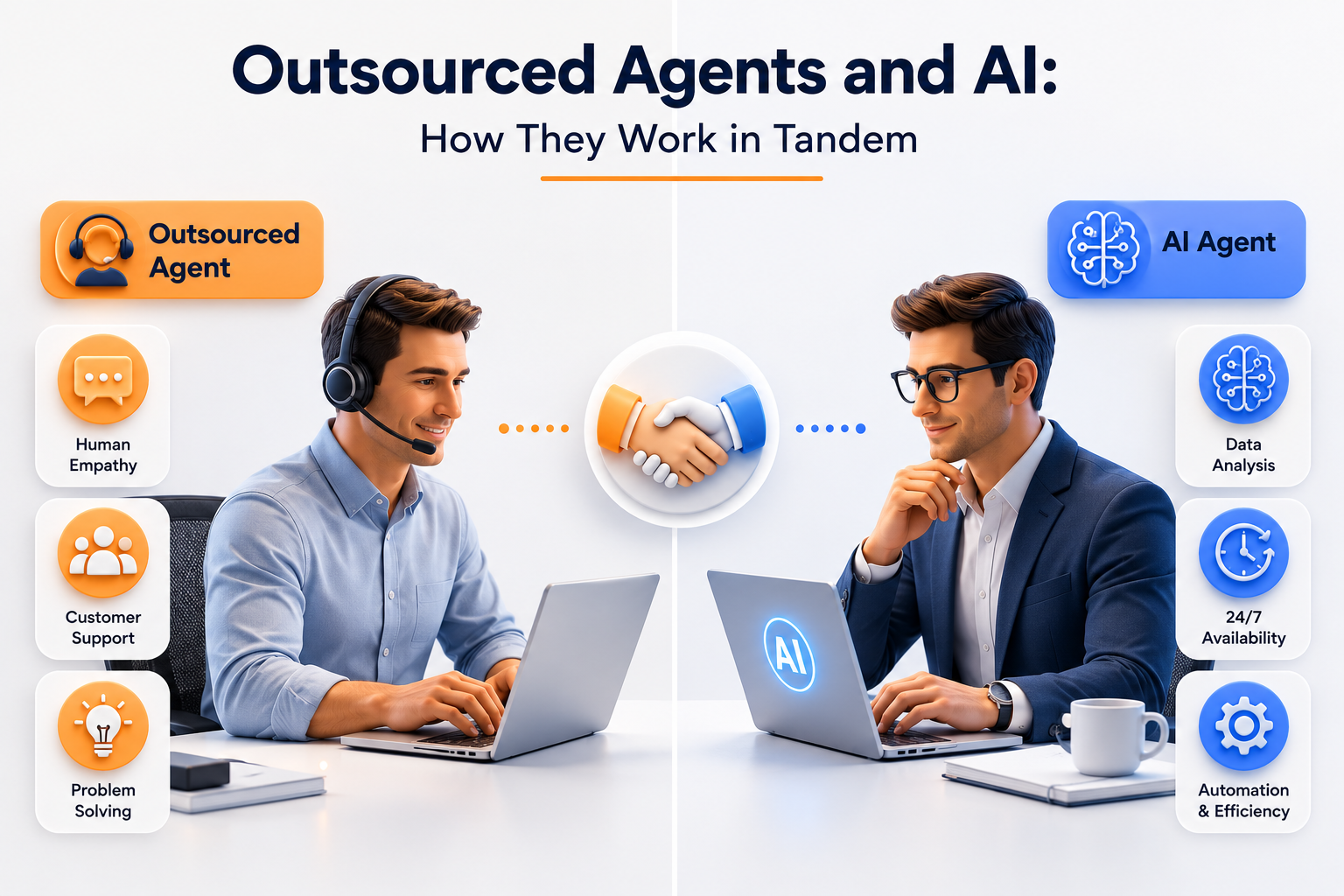
To build a hybrid model that works, you first need to understand what each side actually excels at, and stop asking either one to do the other’s job.
AI handles the heavy lifting of volume. It can field hundreds of simultaneous inquiries, instantly pull up order history, answer FAQs, and route tickets all without a coffee break. For repetitive, predictable interactions, it’s unbeatable on speed and consistency.
But customer service is rarely just transactional. When a customer is frustrated, confused, or dealing with a complex issue, they don’t want a chatbot cycling through scripted responses. They want a person who can read the room, adapt on the fly, and make a judgment call. That’s where outsourced agents earn their place, not as a backup plan, but as the critical layer that keeps customers from churning.
Want to know? How to Build Enterprise AI Agents
Where the Handoff Happens
The handoff is where most hybrid models either shine or fall apart.
Here’s what a well-designed customer service workflow looks like in practice: A customer reaches out about a delayed shipment. The AI handles the first touch, pulls the order details, checks the carrier status, and delivers an update in seconds. Most customers are satisfied and the ticket closes without a human ever getting involved.
But then there’s the customer who’s already contacted support twice this week. The AI flags it as a high-frustration case and routes it to a human agent, along with a full summary of every prior interaction. The agent picks up mid-conversation with full context, no “can you explain your issue again?” friction.
That seamless transfer, with context preserved, is the difference between a customer who feels taken care of and one who fires off a one-star review.
Outsourced Agents Make Your AI Smarter
Here’s the part most businesses miss entirely: the relationship isn’t one-directional. AI doesn’t just help your agents, your agents actively make your AI better.
Every time an outsourced agent resolves an edge case, flags an incorrect AI response, or handles a ticket the bot couldn’t, that’s a data point. Over time, those interactions become the feedback loop that trains your AI to perform better. Agents catch errors before they compound into bigger problems. They QA outputs at scale. They surface patterns, complaint spikes, confusing product language, broken checkout flows, that no dashboard would catch on its own.
This is why the smartest companies don’t treat outsourced customer service as a fallback when AI fails. They treat it as an active investment in making their entire operation smarter.
Building a Model That Actually Works
If you’re ready to stop choosing sides and start building a hybrid model, here’s what it actually takes:
Set clear escalation thresholds: Define exactly when AI hands off to a human, by issue type, sentiment signal, customer tier, or repeat contact. Don’t leave it ambiguous.
Give agents context on arrival: Your outsourced agents should never start a conversation cold. The right setup means they see the customer’s history, the AI’s attempted resolution, and the reason for escalation before they type a single word.
Train agents to work with AI, not around it: Agents who understand what the AI is doing and why it escalated a ticket resolve issues faster and contribute better feedback to improve the system.
Measure both layers: Track your AI containment rate alongside your human CSAT scores. If AI is deflecting volume but human scores are tanking, your handoff thresholds need tuning. Both numbers tell part of the story.
Listed here! Smart AI Agents Every Business Owner Needs Right Now
Sum up
The businesses winning at customer service right now aren’t the ones who went all-in on AI, and they’re not the ones who dismissed it either. They’re the ones who built a system where both sides do what they’re best at.
AI handles the volume. A reputable customer service outsourcing organization handles the moments that matter. Together, they create a customer experience that’s faster, smarter, and more human than either could deliver alone.
If your current support setup has you choosing between the two, that’s the problem worth solving, because the companies that figure it out aren’t just cutting costs. They’re building a genuine competitive advantage.