


App development can be done in various ways, as there are various platforms like no-code, low-code, etc that are used to develop applications. The app development companies are playing an important role in the proper optimization of platforms, but there are also various key app development technologies or languages that these development companies use to develop perfect mobile applications.
You cannot ask app development companies to build an application using just any technology, as each type of app requires specific technologies tailored to its development needs. It is necessary to know which technologies could be best for your app development and provide a seamless and smoother experience.
Leading app development companies can create and implement effective apps using a range of technologies. These technologies include cloud platforms, security tools, and programming languages and frameworks.
Cloud services like Firebase, backend languages like PHP, native development tools like Swift and Kotlin, and cross-platform frameworks like Flutter and React Native are examples of key app development technologies.
So, each development company has its specialty in development, so visit the company that has a past development record that meets your requirements perfectly.
We have listed! Top Questions Before Hiring App Development
Why Is Choosing The Right Technologies Important For the Development Of Apps?
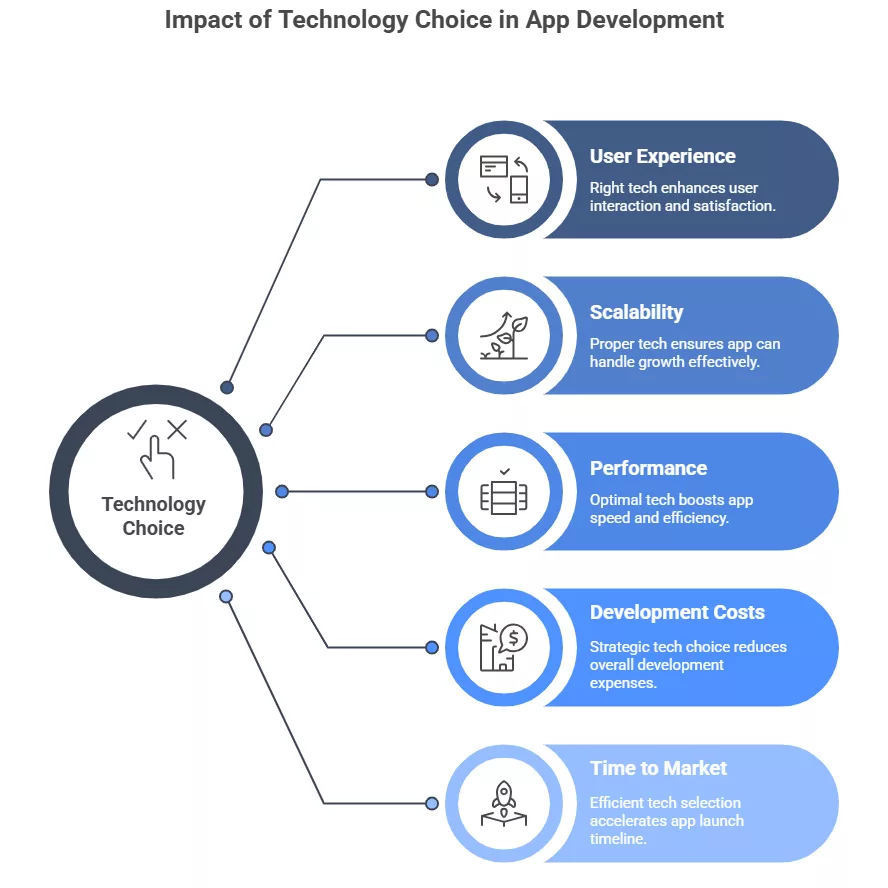
Choosing the right key app development technologies is important, as every technology has its specific features, development costs, applications, and benefits. Technology selection is essential for app development because it directly affects user experience, scalability, performance, development costs, and time to market.
So, when it comes to mobile apps, choosing the right technologies can make or break a project. Mobile App Development Technologies are continuously evolving, and keeping up with these advancements is essential for creating apps that stand out in a crowded market.
Key app development technologies like native development frameworks (such as Swift for iOS and Kotlin for Android) provide high performance and deep integration with the operating systems, making them a top choice for developers focused on creating responsive, feature-rich apps.
Moreover, hybrid app frameworks like React Native and Flutter are gaining popularity, allowing developers to write a single codebase for multiple platforms, reducing costs and development time.
While a poorly selected technology stack can cause expensive delays, performance problems, and scaling challenges, a well-chosen one can result in a more robust, efficient, and user-friendly application.
You can get a better idea by discussing the top app development companies using the technologies that are mentioned later in the upcoming paragraph.
Want to know? Trending App Development Frameworks 2025
Key Technologies Used by Top App Development Companies
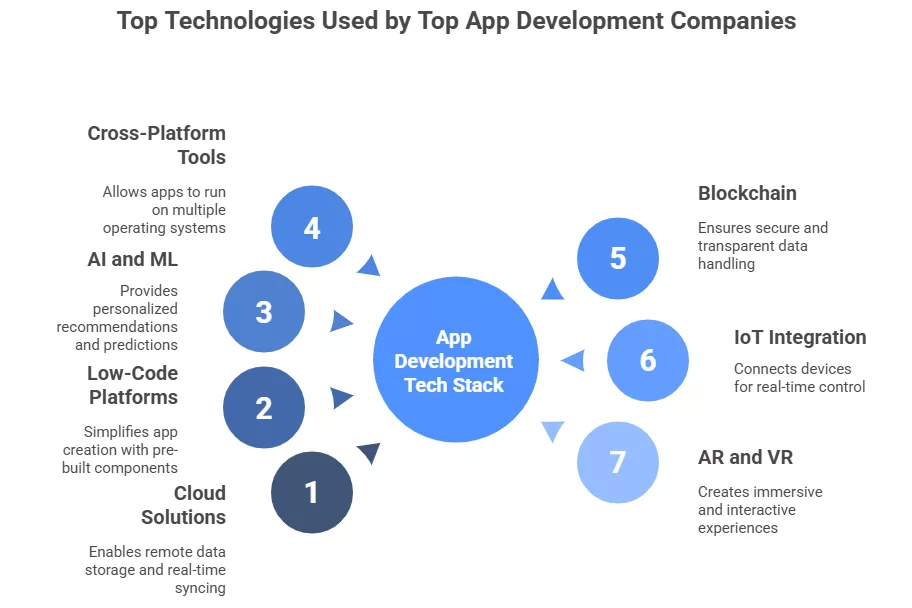
There are a lot of key app development technologies used by top app development companies. Here are a few mentioned below.
1) Cloud-Based Solutions in App Development
The rise of cloud computing has had a profound impact on mobile app development. Cloud solutions allow developers to store data remotely, enabling real-time syncing and data sharing between devices. Cloud-based technologies make apps more scalable, as companies can easily adjust the amount of storage and processing power they need without investing in physical infrastructure.
Apps integrated with cloud technologies also provide users with a seamless experience, as data remains consistent across multiple devices. Whether it’s Amazon Web Services (AWS) or Google Cloud, these platforms enable businesses to deliver faster, more reliable apps.
2) No-Code and Low-Code Platforms
As stated by the Harvard Business Review, the rise low-code/no-code platforms have evolved significantly, shifting from being simple tools for specific functions to enabling a broader range of employees to take control of their automation processes. These platforms allow business teams to develop new software applications without writing any code, thereby enhancing organizational productivity.
The benefits of low-code platforms are a growing trend in app development that require little to no coding expertise. These platforms come with pre-built components and templates, but also provide the flexibility for users to integrate custom code when needed. This adaptability makes low-code platforms more suitable for users with some technical knowledge.
A survey of 2,000 low-code developers revealed that 71% of them could deliver a fully functional solution within three months. Additionally, 50% of participants prefer the visual drag-and-drop features, which are integral to many low-code platforms, streamlining the development process.
Popular low-code and no-code tools include WordPress (29.3%) and FlutterFlow (16.5%), with Bubble taking third place. Bubble is especially favored by users with no coding background, making it a go-to option for those starting from scratch.
Key Features of Low-Code:
- Drag-and-drop functionality
- Ability to add custom code
- Scalability
Examples of Low-Code Platforms:
- Appian
- OutSystems
- Mendix
While low-code platforms may still require some programming skills, no-code solutions allow users to create apps entirely without coding. This could significantly reduce development time by up to 90%.
Key Features of No-Code Platforms:
- Airtable
- Webflow
- Wix
- Bubble
These tools offer a simple and efficient way to develop apps quickly, without the need for coding experience.
3) Artificial Intelligence and Machine Learning
Artificial Intelligence (AI) and Machine Learning (ML) are no longer just trends—they have become core components of modern app development. These technologies bring unparalleled value to mobile apps, making them smarter, more intuitive, and personalized.
With top AI app development companies, AI and ML algorithms can be utilized to analyze user behavior and offer personalized recommendations, enhancing the user experience. For instance, apps like Google Assistant and Siri leverage natural language processing (NLP) to interpret and respond to user queries.
Furthermore, machine learning models can continuously improve the accuracy of predictions and decisions made by an app, ensuring that it becomes more efficient and responsive over time.
Read once! Are App Development Companies Still Relevant In The AI Era?
4) Cross-Platform Development Tools
One of the most significant developments in mobile app development has been the introduction of cross-platform frameworks. Technologies like Flutter and React Native allow developers to create apps that run on both iOS and Android using a single codebase.
The advantages of these tools are clear: they reduce development time, cut costs, and provide a consistent user experience across platforms. This makes them an attractive option for businesses looking to reach a broader audience while maintaining quality.
Looking for? Top Rated Cross-Platform App Development Firms
5) Blockchain Technology
Blockchain is revolutionizing industries beyond just cryptocurrency. In mobile app development, blockchain technology provides a secure, transparent, and decentralized way to handle transactions and store data.
By integrating blockchain into mobile apps, businesses can offer users an extra layer of security, ensuring that sensitive data is stored securely and transactions are tamper-proof. For example, apps in the finance and healthcare sectors are increasingly adopting blockchain to improve data integrity and privacy.
Connect with! Top Blockchain Development Companies
6) IoT Integration in Mobile Apps
The Internet of Things (IoT) is another breakthrough technology shaping the future of mobile app development. By connecting devices through the internet, IoT enables apps to interact with a wide range of objects, from home appliances to wearable devices.
Through IoT integration, mobile apps can provide users with real-time updates and control over connected devices. For example, smart home apps allow users to control lighting, temperature, and security systems remotely.
7) Augmented Reality (AR) and Virtual Reality (VR)
Augmented Reality (AR) and Virtual Reality (VR) are creating immersive experiences that were once thought impossible on mobile devices. These technologies are reshaping industries like gaming, healthcare, education, and retail.
For instance, AR is used in apps like Pokémon Go to create interactive gaming experiences, while VR is revolutionizing training and educational apps by offering realistic simulations of real-world scenarios. Both technologies enhance user engagement, creating memorable experiences.
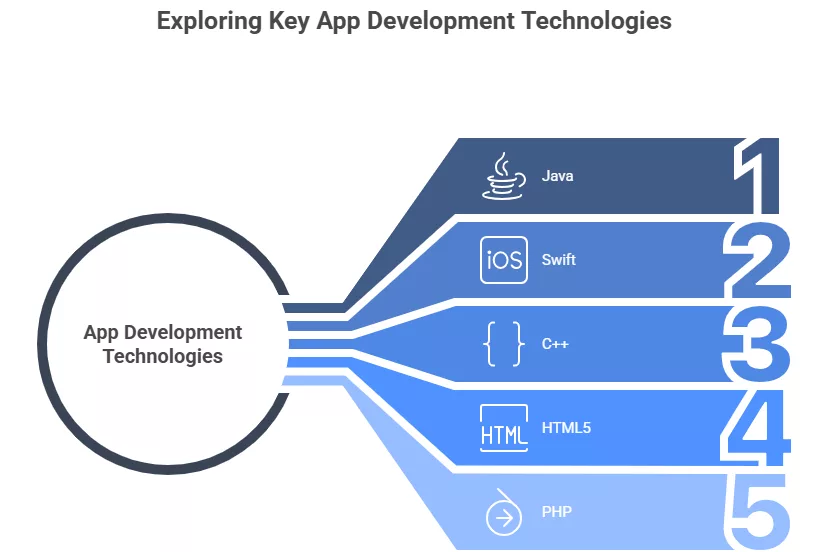
Additional key app development technologies used by Companies
1. Java
Java is one of the most used technologies by top app development companies as Java can prove best for the Android and iOS app development. Java has various features, as it does not require writing every time; it writes once and runs everywhere. Java is also a platform-independent language that makes it more versatile in comparison to other development languages or technologies.
Core Features Of Java
- Secure client applications development.
- Portables and codes are reusable.
- Automatic memory management, like other technologies, needs manual memory management.
- Platform independent, as it has its own JVM or Java virtual machine to run code.
2. Swift
Swift is an open-source programming language that has made the most contribution to the development of iOS applications. If you want to develop an iOS application, then surely Swift should be your top priority. It is fast, safe, and intuitive to code, and also not too messy in management in comparison to Java.
Core Features Of Swift
- Offer a wide range of applications.
- Simple and easy to maintain in comparison to most languages.
- Prevent garbage collection by minimizing memory usage.
- Offer solid customizations.
3. C++
C++ is one of the most demanding technologies that is used by top app development companies. C++ is generally used for high-performance, complex, and user-friendly mobile application development. The C++ powered development apps need to create one and can launch on various platforms like Android, iOS, Windows, etc, without compromising the security and performance.
Core Features Of C++
- Better control of memory and system resources.
- Potential to develop apps that can be compatible with various platforms and devices.
- Save time and effort for the developers.
- Faster error identification in comparison to other languages.
4. HTML5
HTML5 is the latest version of HTML as it becomes one of the most used technologies in app development in recent years. This technology is best for those who think that cross-platform app development is difficult. This technology offers consistency across web browsers and has incredible support for responsive design.
Core Features Of HTML5
- Can add video prompts without video player creation.
- Offers creativity and innovation.
- Flexible, easy to use, fast loading speed on the web, etc.
- Easy to modify over time.
5. PHP
PHP is a popular server-side scripting language that is open-source and mostly used for web development. It is well-known for being able to be incorporated into HTML, which enables database interaction and the creation of dynamic content. This is a multi purpose language or technology that can be used to develop apps for desktop and mobiles.
Core Features Of PHP
- Efficient session management.
- Multiplatform support that makes it versatile.
- Real-time access tracking and strong reporting.
- Offer predefined functions.
Read once! PHP vs Python: Which One Should You Choose for Your Next Web Application?
How Much Does It Cost to Develop an App with Different Technologies?
The cost of app development generally depends on various factors like the app’s complexity, the number of features, the platforms it supports, and the development team’s location and experience.
Below, we have provided an estimated table to give you an idea of the potential cost for your next app development.
| App Type | Estimated Cost Range (USD) | Description |
|---|---|---|
| Basic App Development | $5,000 – $50,000 | Simple apps with basic functionality, ideal for startups or small businesses looking for a straightforward solution. |
| Standard App Development | $50,000 – $100,000 | Apps with moderate functionality, including integration with APIs, user authentication, and more advanced features. |
| Complex App Development | $100,000 – $300,000+ | High-end apps with custom features, integration with multiple systems, complex UI/UX, and enterprise-level functionality. |
For you! How To Plan Your App Project With A App Development
Cost of Java-Based App Development
We have prepared the table below to provide an estimated cost breakdown for Java-based app development. These costs can vary based on factors such as complexity, features, and the development team’s expertise.
| Java App Type | Estimated Cost Range (USD) | Description |
|---|---|---|
| Basic Java App Development | $20,000 – $50,000 | Simple apps with basic functionality, typically suited for startups or small businesses. |
| Standard Java App Development | $50,000 – $150,000 | Apps with moderate features, such as integration with APIs, user authentication, and database management. |
| Advanced Java App Development | $150,000 – $250,000+ | Complex apps requiring advanced features, enterprise-level functionality, and custom integrations. |
| Enterprise Java App Development | $250,000 and above | Large-scale applications with multi-platform support, advanced security, and high scalability. |
Swift App Development Costs
Below, we’ve provided an estimated cost breakdown for Swift-based iOS app development. These costs are influenced by factors such as app complexity, design, and the required features. Understanding these ranges will help you plan your budget for a successful iOS app development project.
| Swift App Type | Estimated Cost Range (USD) | Description |
|---|---|---|
| Basic Swift App Development | $20,000 – $50,000 | Simple iOS apps with basic functionality, ideal for small businesses or startups. |
| Standard Swift App Development | $50,000 – $150,000 | Apps with moderate complexity, including user authentication, API integrations, and moderate UI/UX design. |
| Advanced Swift App Development | $150,000 – $250,000+ | High-end iOS apps with custom features, integration with third-party services, and advanced UI/UX design. |
| Enterprise Swift App Development | $250,000 and above | Large-scale enterprise apps with extensive functionality, high security, and multi-platform support. |
Cost of HTML5-Based App Development
The table below outlines the estimated costs associated with developing HTML5-based apps.
| HTML5 App Type | Estimated Cost Range (USD) | Description |
|---|---|---|
| Basic HTML5 App Development | $5,000 – $20,000 | Simple apps with basic functionality such as static content and simple user interfaces. |
| Standard HTML5 App Development | $20,000 – $50,000 | Apps with moderate functionality, including basic database integration and interactive features. |
| Advanced HTML5 App Development | $50,000 – $100,000 | Complex apps with dynamic features, responsive design, and third-party service integration. |
How Much Does It Cost to Develop a C++ Application?
Whether you’re building a simple app for a small project or a sophisticated application for large-scale use, it’s important to budget accordingly. Below is an estimated cost breakdown for C++ app development.
| App Type | Estimated Cost Range (USD) | Description |
|---|---|---|
| Basic C++ Application | $5,000 – $50,000 | Simple C++ applications with basic features, suitable for small projects or startups. |
| Standard C++ Application | $50,000 – $150,000 | Moderate complexity with advanced features, such as database integration and enhanced functionality. |
| Complex C++ Application | $150,000 – $300,000+ | Highly complex C++ applications with custom features, extensive integration, and large-scale enterprise-level functionality. |
PHP-Based Application Development: Cost Breakdown
When developing a PHP-based application, the costs can vary depending on several factors and the development team’s expertise. PHP is widely used for web-based applications due to its flexibility, scalability, and ability to handle high levels of traffic. Below is a breakdown of the potential costs involved in developing a PHP-based app.
| Development Phase | Estimated Cost Range (USD) | Description |
|---|---|---|
| Basic PHP Application Development | $5,000 – $30,000 | Simple applications with basic functionality, such as static websites or blogs. |
| Standard PHP Application Development | $30,000 – $100,000 | More advanced applications with additional features like user registration, forms, and integrations. |
| Complex PHP Application Development | $100,000 – $200,000+ | Highly customized applications requiring advanced functionality, such as e-commerce sites, complex databases, or enterprise-level systems. |
| Maintenance and Support (Annual) | $5,000 – $15,000 | Ongoing updates, security patches, bug fixes, and performance optimization. |
The total cost of development is determined by the complexity of the app, and development companies typically provide an initial estimate based on the project’s requirements.
The app development industry is constantly changing, driven by new technologies and user demands. One of the trends that is taking over is the shift towards AI and automation in app development. Automation tools are streamlining processes like testing, deployment, and updates, allowing developers to focus more on innovation.
Another critical trend is the increased focus on data privacy and security. With the growing concern over personal data breaches, users expect apps to prioritize security features like encryption, two-factor authentication, and compliance with privacy regulations such as GDPR.
Must See! Do You Need a Specialized App Developer for Your Industry?
Final Say
As the app development industry continues to evolve, staying up-to-date with Key App Development Technologies is essential for companies to remain competitive. Leveraging the right mix of technologies, from AI and cloud-based solutions to cross-platform tools and IoT integration, can elevate the performance, security, and user experience of mobile apps.
Innovation in app development is not a choice—it’s a necessity for businesses that want to meet the demands of today’s tech-savvy consumers. By embracing the latest technologies, companies can ensure their apps are future-proof, adaptable, and successful in the marketplace.


