
How IT Consulting Agencies Work: Process, Pricing & Deliverables
Currently, businesses often stumble across complex technical decisions that either delay growth or they end up making the wrong choice. That’s why most businesses are hiring IT consulting agencies. These firms specialize in analysing your company’s IT infrastructure, identifying challenges, and designing strategic solutions that are tailored to enhance your company’s performance.
If you are considering hiring one, understanding how IT consulting agencies work is essential.
What Does an IT Consulting Agency Do?
Many businesses know they need help, but they aren’t always clear on what IT consultants really do or how they fit into the bigger picture. Misunderstanding the role can lead to unmet expectations, excessive resources, or missed opportunities.
By understanding how IT consulting agencies work, businesses can utilize with them more effectively.
What does an IT consultant do?
Through a structured IT consulting process, these consultants assess how your systems impact daily operations whether your team is slowed by clunky software, exposed to security risks, or using tools that don’t integrate then they recommend carefully curated solutions that fit your budgets.
These solutions could be either rethinking infrastructure, adopting new tools, or just simplifying your workflows to save time and money. They blend technical expertise with real-world business insight.
After identifying challenges and crafting a solution roadmap, IT consultants move into implementation; turning plans into tangible results through a structured consulting workflow.
This often includes services such as:
- Cloud migration and infrastructure setup
- Cybersecurity assessments and risk mitigation
- Custom software recommendations and implementation support
Want to know? How IT Consulting Can Help Small Businesses 2025
Why Businesses Hire IT Consulting Agencies?
Internal IT teams are often swamped with daily tasks such as resolving helpdesk tickets, managing updates and patches, overseeing devices, and keeping systems secure. There’s rarely any time for strategic planning or enterprise-level IT assessments. This is why top IT consulting agencies are hired to fill the gap.
Companies often bring in these consultants to tackle initiatives such as:
- Planning and executing a cloud migration
- Strengthening their cybersecurity posture
- Investigating persistent performance issues
- Developing IT budgets and long-term roadmaps
- Reviewing system architecture before scaling
- Auditing vendor contracts to reduce license waste and optimize spending
Depending on the engagement model, consultants can either operate independently or as an extension of the internal team.
When you understand how IT consulting agencies work, it becomes easier to decide whether to involve them for short-term assessments or long-term partnerships.
Read once! Why Every Business Needs IT Consulting Services for Digital Transformation
The IT Consulting Process: Step-by-Step Breakdown
Each stage serves a specific purpose, with clear deliverables that keep stakeholders aligned and progress measurable. While every firm has its nuances, how IT consulting agencies work? They generally follow a six-step project lifecycle:

1) Initial Meeting
The process begins with an exploratory discussion; not a sales pitch, but a working session where consultants gather information about your business model, team structure, current technology stack, and ongoing challenges.
The goal here is to define clear objectives and evaluate whether the engagement model aligns with your business needs or not.

Asking the right questions
Consultants use open-ended questions to get deeper insights. Common prompts include:
- What specific challenges are you facing?
- What business outcomes are you hoping to achieve?
- Have similar issues been addressed in the past?
- Who are the key stakeholders involved?
Stakeholder identification
Mapping out decision-makers and influencers is important at this stage. They take tools like a Stakeholder Map Template which them helps visualize roles, responsibilities, and interests, ensuring that all voices are considered throughout the engagement.
Gathering background information
A consultant needs to understand the client’s industry, market pressures, and internal structures. Which includes reviewing current systems, past reports, existing workflows, and any documentation relevant to the issue at hand.
Identifying core issues
In most cases, the problem that the client describes is only a symptom. Through careful analysis, consultants aim to uncover the root causes and whether they stem from outdated technology, poor integration, or misaligned processes.
Defining objectives
Collaboratively, the consultant and you translate insights into clear, measurable goals. These serve as a compass for solution design and implementation which helps keep the project on track.
Setting expectations
A transparent discussion about the engagement model, timelines, deliverables, and communication preferences helps ensure both parties are aligned from the start.
Read once! Benefits of Remote IT Consulting Solutions for Global Companies
2) IT Assessment
Once the project begins, consultants collect both qualitative and technical data. This phase may involve:

- Auditing network configurations
- Reviewing server logs and cloud usage
- Examining licensing agreements and software inventory
- Interviewing employees who interact with mission-critical systems
This diagnostic step is foundational. It helps identify what’s underperforming, and why it matters to operations, compliance, or user experience.
3) Findings and Recommendations
The consultant then compiles all observations into a detailed report. This document highlights technical risks and inefficiencies; alongside actionable recommendations tied directly to your business goals.

Common findings usually include:
- Security vulnerabilities that expose sensitive data
- Redundant or outdated software draining budgets
- Systems that slow productivity or impact customer experience
- Opportunities to consolidate platforms and reduce operational costs
4) Solution Design
Once goals are set, the consultant creates a tailored action plan. It might include proposed technologies, phased deployment timelines, cost-benefit analysis, and steps for implementation.

The plan is designed with scalability, usability, and long-term value in mind.
Depending on your priorities, this phase might cover:
- Infrastructure modernization or cloud migration
- Policy development or governance improvements
- Enterprise software upgrades
- A comprehensive 12–36-month IT roadmap
5) Implementation Support
How this roadmap is executed? That varies from client to client. Some organizations rely on internal IT teams to manage the rollout; others bring in the consultant’s technical staff. Either approach can work but what matters most is defined accountability, communication, and adherence to timelines.

Consultants might:
- Coordinate with third-party vendors
- Manage hardware or software deployments
- Conduct system testing and validation
- Lead custom training to ensure team adoption
6) Post-Implementation Monitoring
Once changes go live, consultants often remain involved for short-term monitoring. They track performance, review system logs, and proactively address any early-stage issues before they escalate.

Though it’s not always mandatory but post-launch monitoring is highly recommended during major transitions or infrastructure overhauls.
What Are the Key Consulting Deliverables?
Consulting deliverables are the outcomes of an IT consulting engagement. They reflect the consultant’s work in action whether it’s a technology roadmap, security audit report, infrastructure design, or custom software recommendation. But to ensure these deliverables are effective, they must be grounded in well-defined SMART objectives which is Specific, Measurable, Achievable, Relevant, and Time-bound.
Consultants typically start by identifying desired outcomes, and then convert them into SMART objectives tailored to the engagement. This structured goal-setting approach allows businesses to measure progress, evaluate ROI, and track the impact of the work.
To meet expectations, consulting deliverables must be:
- Well-structured with clear sections, purpose, and timelines
- Professionally presented and formatted for both technical and executive audiences
- Rooted in client collaboration to reflect internal realities, not assumptions
- Aligned with project scope to ensure there’s no misalignment between what’s needed and what’s delivered.
Looking for? Top ECM Consulting Companies
What Are the Main Factors That Affect IT Consulting Rates?
Understanding the pricing behind IT consulting services is crucial for making effective budget decisions. Costs can vary widely depending on the engagement model, the size of the company, and the consultant’s involvement.

IT consulting fees can vary significantly depending on several key variables, each playing a crucial role in determining the overall cost of services. Below, lets discuss the most common elements that shape how much you’ll pay and why.
1. Consultant Expertise and Experience
One of the most important factors affecting IT consulting rates is the consultant’s level of expertise. Professionals with specialized skills, deep industry knowledge, and a strong portfolio generally charge higher fees.
Their ability to provide strategic guidance, identify risks, and deliver transformative IT solutions often brings exceptional value especially for businesses undergoing big change.
2. Scope and Complexity of the Project
The size and complexity of a project directly influence pricing. Projects that usually require in-depth assessments, custom IT architecture, or multi-phase rollouts will naturally demand more time, technical skill, and planning.
As part of the IT consulting process, consultants evaluate deliverables, dependencies, and risks to determine the level of effort needed and align pricing accordingly.
3. Duration and Timeline
Short-term or urgent consulting engagements often come at a premium due to the need for quick turnaround and dedicated resources.
On the other hand, long-term projects may offer more flexibility in pricing particularly when the engagement involves ongoing support, optimization, or periodic check-ins as part of the roadmap.
4. Location and Geographic Considerations
Where your business operates and where the consulting agency is situated can also affect rates. Consultants in high-cost regions like North America or Western Europe typically charge more than those in emerging markets. Factors such as cost of living, regional demand, and the local economic environment all influence pricing.
Understanding these geographic variables helps businesses plan wisely and determine if local, remote, or offshore consulting is the right fit.
Local vs. Remote vs. Offshore IT Consulting: A Comparison
| Criteria | Local Consulting | Remote Consulting | Offshore Consulting |
| Cost | Highest (due to regional labor rates, travel) | Moderate (reduced overhead, no travel costs) | Lowest (cost-effective labor markets) |
| Communication | Real-time, in-person, highly collaborative | Virtual, scheduled, often effective | May involve time zone gaps, cultural nuances |
| Time Zone Alignment | Full alignment with business hours | Usually aligned or slightly flexible | Often requires asynchronous communication |
| Availability | Dependent on regional demand/supply | Broad talent pool, flexible scheduling | Large talent pool, can scale quickly |
| Control & Oversight | High visibility and direct interaction | Moderate to high (with tools and processes) | Varies depending on vendor and project model |
| Cultural Compatibility | Fully aligned | Generally aligned | May require adaptation and expectation setting |
| Project Suitability | Best for high-stakes, hands-on projects | Ideal for hybrid/digital-first engagements | Great for well-defined, repeatable tasks |
| Speed of Onboarding | Fast (onsite meetings, direct access) | Fast (minimal logistics) | May take longer (contracts, ramp-up time) |
| Security & Compliance | Easier to manage locally | Manageable with policies and tools | Requires clear frameworks and audits |
5. Complexity of IT Solutions
Projects that involve advanced or emerging technologies will often cost more. Solutions like cloud computing, AI integration, cybersecurity frameworks, and enterprise resource planning (ERP) systems demand a specialization. Not only do these solutions require technical knowledge, but their design and deployment also involve considerable planning, integration, and risk mitigation which justifies high consulting fees.
6. Customization and Tailored Solutions
These engagements go beyond off-the-shelf fixes, requiring a deep dive into the company’s operations, workflows, and long-term goals. While personalized solutions tend to cost more, they also generate better alignment, higher efficiency, and stronger ROI making them a strategic investment.
7. Industry and Regulatory Requirements
Industry can significantly affect consulting rates, especially in sectors with strict compliance and regulatory demands. Fields like healthcare, finance, or legal services often require IT consultants who are well-versed in data privacy laws, security protocols, and specific industry regulations.
This specialized knowledge adds value but also increases pricing due to the additional responsibilities and potential liabilities involved.
IT Consulting Rates by Company Size
| Company Size | Hourly Rate (USD) | Project Size |
| Small IT Consulting Agencies | $75 – $175 | – |
| Medium-Sized IT Firms | $125 – $175 | $50,000 – $5 million |
| Large Consulting Firms | $200 – $300 | $125,000 – $5 million+ |
| Enterprise-Level Consultants | $250 – $850 | – |
IT Consulting Rates by Consultant Type
| Consultant Type | Hourly Rate (USD) | Notes |
| Fledgling Consultants | $25 – $50 | Entry-level or interns trying to gain experience. |
| Freelance Consultants | $100 – $300 | Often 10+ years of experience, varies by specialization. |
| Outsource IT Consultants | $25 – $75 | Rates vary by location (offshore/onshore). |
IT Consulting Rates by Region
| Country/Region | Average Hourly Rate (USD) |
| United States | $100 – $175 |
| Canada | $100 – $130 |
| Western Europe | $100 – $150 |
| Australia | $80 – $120 |
| Latin America | $25 – $50 |
| Eastern Europe | $25 – $50 |
| Asia | $20 – $40 |
| India | $20 – $30 |
IT Consulting Rates by Expertise Level
| Consultant Level | Hourly Rate (USD) | Typical Skills |
| Entry-Level (0–2 yrs) | $25 – $50 | Basic support, troubleshooting, basic coding |
| Mid-Level (2–5 yrs) | $50 – $120 | Cloud, cybersecurity, databases |
| Senior (5+ yrs) | $120 – $300+ | Enterprise strategy, architecture, digital transformation |
IT Consulting Rates by Industry
| Industry | Hourly Rate (USD) | Typical Projects |
| Finance and Banking | $120 – $250+ | ERP, compliance systems, fraud detection |
| Healthcare | $100 – $200+ | EHR systems, telemedicine, healthcare analytics |
| Technology and Software | $80 – $150+ | Cloud migration, DevOps, custom development |
| Retail and E-commerce | $70 – $120 | E-commerce, POS, inventory optimization |
| Telecommunications | $100 – $180+ | Network infra, 5G, telecom security |
IT Consulting Pricing Structures
| Model | Typical Range (USD) | Notes |
| Hourly/Daily | $1,500 – $3,000/day | Most flexible, based on hours worked. |
| Monthly | $2,000 – $15,000+/month | Varies based on service level and consultant experience. |
| Flat Fee | $2,000 – $25,000+ (per project) | Often used for defined projects like infrastructure or cybersecurity. |
| Tiered | Basic: $1,000–$3,000Standard: $3,000–$7,000Premium: $7,000–$15,000+ | Pricing scales with complexity and services included. |
| Performance-Based | $10,000/month + 10% bonuses for meeting KPIs | Linked to outcome-driven contracts. |
| Value-Based | 10% of project value | Premium model tied to impact or business value generated. |
| Project-Based | Set in advance, varies by scope | Upfront pricing for a defined project and delivery timeline. |
Must know? IT Consulting For Startups: Essential Tips For Companies
10 Tips for an Effective IT Consulting Process for Business
A successful consulting engagement requires thoughtful execution, strong communication, and a client-centered mindset.
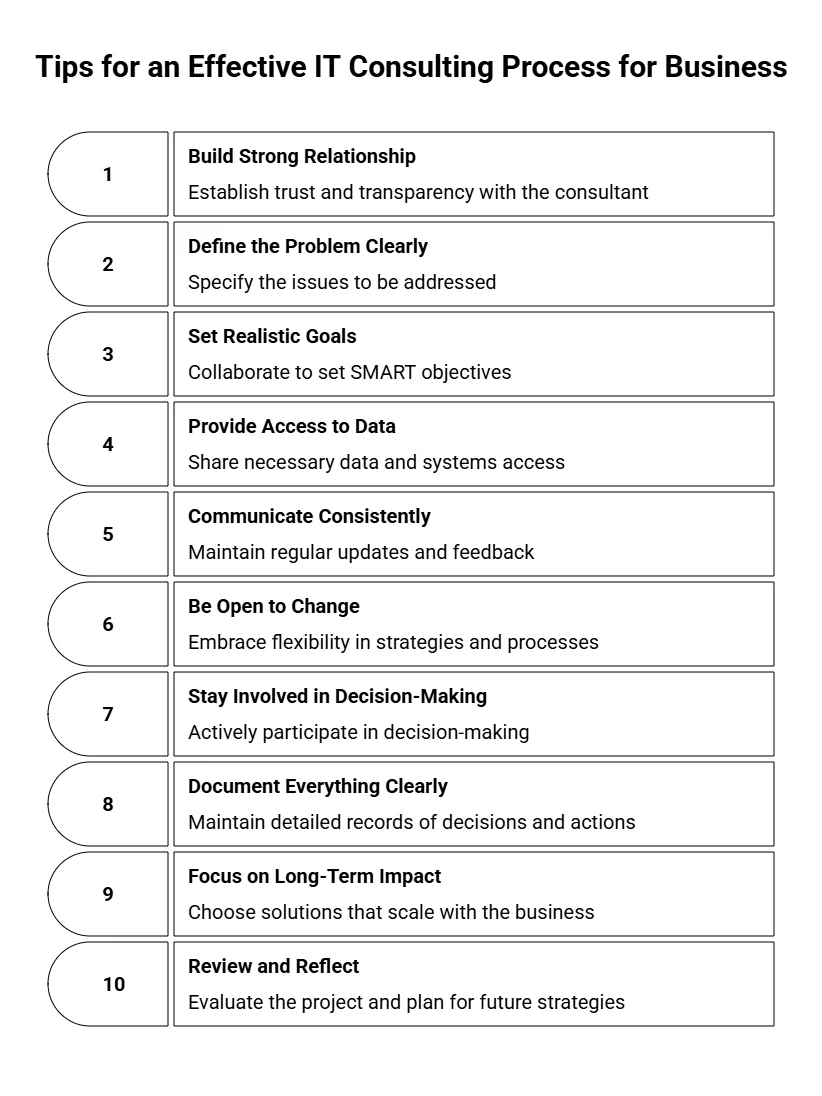
Here are 10 steps your business can take to improve collaboration, results, and ROI:
1) Build a Strong Working Relationship
- Be open and transparent from day one.
- Share your goals, internal challenges, and team dynamics.
- A trusted relationship makes every stage of the consulting process smoother.
2) Clearly Define the Problem
- Don’t just say “we need help”; be specific.
- Align the main issues before the initial meeting begins.
- A clear problem statement saves time, money, and confusion later.
3) Set Realistic, Measurable Goals
- Collaborate with the consultant to set SMART objectives (Specific, Measurable, Achievable, Relevant, Time-bound).
- These goals help track progress and define what success really looks like.
- Avoid overpromising or underexplaining since clarity is everything.
4. Provide Access to Data and Systems
- Be ready to share the data and access the consultant needs.
- The more complete the picture, the better the recommendations.
- Make sure key stakeholders are available for interviews or feedback.
5) Communicate Consistently
- Request regular updates and status meetings.
- Encourage simple, jargon-free explanations.
- Ask questions and give feedback early to avoid misalignment.
6) Be Open to Change
- Some recommendations may challenge your current processes.
- Stay flexible when timelines or strategies need to shift.
- Real transformation often requires letting go of old systems or habits.
7) Stay Involved in Decision-Making
- Don’t delegate everything, be an active participant.
- Your input is crucial to building practical, sustainable solutions.
- Involve other departments as needed to ensure adoption.
8) Document Everything Clearly
- Ask for deliverables in writing such as reports, recommendations, roadmaps, or policies.
- Keep notes on decisions, priorities, and action steps.
- Documentation helps with handover, implementation, and future planning.
9) Focus on Long-Term Impact
- Choose solutions that scale with your business instead of short-term fixes.
- Ask: “How will this affect us 12 months from now?”
- Sustainable solutions save more time and money in the long run.
10) Review and Reflect After the Project
- Schedule a debrief session with your consultant and internal team.
- Discuss wins, roadblocks, and what could be improved.
- Use the experience to build smarter IT strategies going forward.
Read once! Top Benefits of IT Consulting Services for Your Business
Sum up
In today’s digital world, technology is like a growth engine. Yet navigating IT decisions without expert guidance can feel like flying blind in a storm. That’s where understanding how IT consulting agencies work becomes your business advantage.
So before your next tech investment, system upgrade, or digital initiative, ask yourself: Is your internal team equipped to lead it? or is it time to bring in someone who’s done it a hundred times before?
Smart businesses don’t wait for problems to grow. They seek solutions—strategic, tailored, and expertly delivered.
Must know? Why Telecommunication IT Consulting Firms Are Key to Tech Innovation
FAQs
How do I know if I need an IT consultant or an internal team upgrade?
If your internal team is overwhelmed, lacks specialized skills, or struggles to manage transformation projects, it’s a strong signal to bring in external expertise. Knowing how IT consulting agencies work helps you decide when and where to bring in external support for maximum ROI.
How long does a typical IT consulting project take?
A short-term collaboration may take a few weeks, while bigger initiatives like digital transformation or cloud migration can span several months. The timeline depends on your consulting workflow, deliverables, and the complexity of your systems.
Is working with an IT consulting agency cost-effective for small businesses?
Absolutely. While enterprise-grade agencies may be pricey, many small and mid-sized IT consulting agencies offer tailored services that fit your budget. When aligned with the right engagement model, even a small investment can yield significant business value.
What industries benefit most from IT consulting?
While every industry can benefit, sectors like healthcare, finance, retail, and telecommunications often rely heavily on IT consulting to ensure compliance, security, and scalability. Understanding how IT consulting agencies work in different industries helps businesses choose consultants with the right domain expertise.
Do IT consulting agencies provide training to internal staff?
Yes. Many consultants include training as part of their engagement model. This ensures smooth adoption of new systems or processes and builds long-term internal capacity.
What happens if I’m not satisfied with the outcome?
A transparent IT consulting process includes regular checkpoints, documented deliverables, and client involvement. If dissatisfaction arises, reputable firms work collaboratively to revise the approach and meet expectations.
What should I look for when selecting an IT consulting agency?
Look for proven experience, industry specialization, clear communication, and a strong methodology. Understanding how IT consulting agencies work helps you evaluate whether their approach fits your business culture and challenges.