


In recent years, finance apps have become essential tools for young professionals in the U.S. Whether you’re fresh out of college or a few years into your career, managing expenses, building savings, or investing can feel overwhelming. Thankfully, finance apps help make this easier.
According to recent data, fintech adoption in the U.S. reached 74% in Q1 2025, with millennials leading the way in using apps for payments, credit, or investing.
Also, the global personal finance apps market was valued at USD 8 billion in 2024, and it’s expected to almost double by 2033.
From all-in-one dashboards that track net worth and investments, to hands-on budgeting tools that keep every dollar accountable, to investment platforms that make growing wealth easier—there’s something here for everyone.
By the end, you’ll know exactly which finance app fits your lifestyle, whether you’re focused on breaking the paycheck-to-paycheck cycle, getting serious about long-term investing, or simply building healthier money habits.
Ready to find the app that can make managing money feel less stressful and more empowering? Let’s get started.
About Finance Apps

Finance apps are mobile or web tools that help you handle your money. They let you link bank accounts, track income and spending, set savings goals, plan for bills, invest, and monitor your net worth. For young professionals, finance apps help bring clarity: instead of guessing where your money went, you see it.
These apps are growing quickly because many people want more transparency, better tools, and control over their finances. With the cost of living rising, student debt common, and many young people also thinking long term (retirement, investments), having a finance app can make a big difference.
What’s the Need to Find the Best Finance Apps?
Young professionals often juggle multiple financial demands—rent or mortgage, student loans, savings, maybe investing, maybe paying off credit cards. A generic bank app usually doesn’t give enough insight. You need tools that help you budget well, understand your cash flow, see long-term results, and avoid mistakes.
Choosing the right app matters because it can help you avoid high fees, bad investing decisions, overspending, or even getting in debt. The “best finance app” is one that fits your lifestyle, aligns with your goals, and helps you build good habits for the future.
Why Do People Use Finance Apps?
People use finance apps because:
- They provide a single view of all financial accounts: checking, savings, investments, debts.
- They give automated insights: showing where you’re spending too much, or helping you budget.
- They help with investing, even in small amounts, sometimes automatically.
- They help set goals (saving up, paying off debt) and track progress.
- They reduce mental load, so you spend less time stressing about money and more time focusing on what matters.
How Do Finance Apps Work?
Here’s a typical flow for how these apps work:
- Account connection – You give permission to connect your bank, credit card, investment, and loan accounts.
- Data ingestion – The app pulls transactions, balances, etc., then categorizes them (rent, groceries, entertainment, etc.).
- Analysis & insights – It highlights trends (you spent more this month than last month), projects cash flow, and gives alerts.
- Goal setting – You set savings goals, debt payoffs, or investment targets. The app tracks your progress.
- Action tools – Features like automatic transfers, investment options, or “round-ups.”
Security is key. The good finance apps use encryption, secure connections, multi-factor authentication, and never store your banking passwords themselves (they work through secure APIs). Many now also use AI in Finance to detect unusual activity, flag suspicious transactions, and provide smarter fraud protection.
Best Finance Apps for Money Management
These apps give you an overall view—tracking everything from spending to net worth and investments.
1) Monarch Money
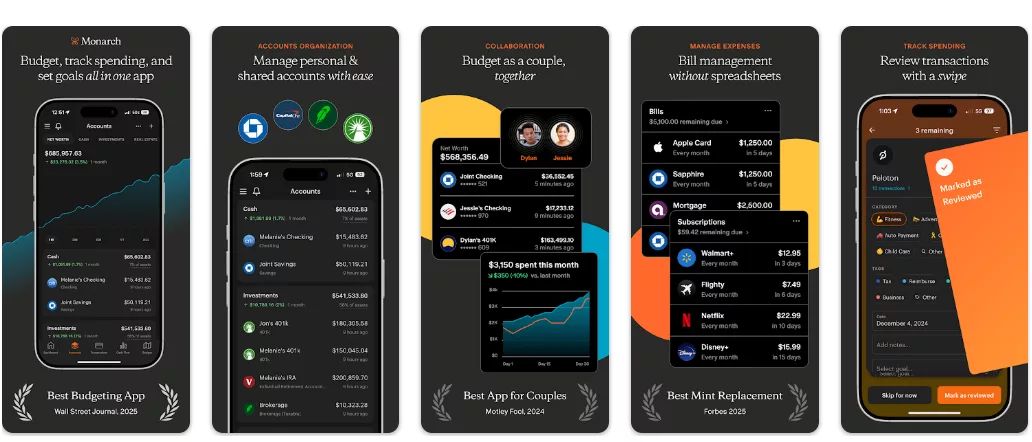
Monarch Money is ideal if you want customizable budgets, long-term planning, and a full financial picture. It connects checking, savings, investment, and loan accounts. You can see your net worth over time, see trends, and forecast what might happen. The interface is clean; it gives you flexibility in designing budget categories. If you share finances (with a partner or family), you can do that too.
Key Features:
- Connects all financial accounts — bank, credit cards, loans, investments
- Customizable budgeting categories and flexible budgeting methods
- Net worth tracking and trend visualizations
- Forecasting cash flows / projecting future balances
- Up to five collaborators (e.g., partner, spouse, family member)
Best For:
Professionals who want control and visibility over both short-term spending and long-term financial health.
Cost:
US $99.99 per year or US $14.99 per month. It offers a 7-day free trial to test features before committing.
Rating:
4.6 / 5
2) Empower (formerly Personal Capital)
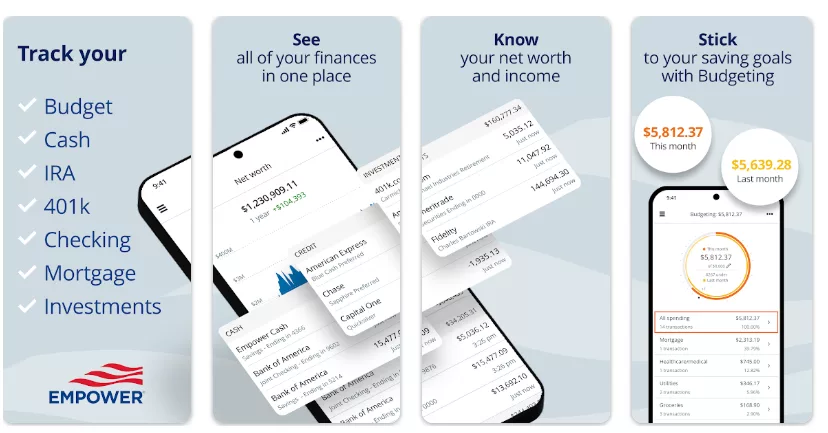
Empower (Personal Capital) excels when you care about investments as much as budgeting. It provides a dashboard that shows your spending, your investments, your net worth. The investment tools are strong: you can run “Investment Checkups,” see fees, compare your portfolio vs benchmarks. For people who already have investments or want to build wealth, it offers insights many basic fintech apps don’t.
Key Features:
- Holistic dashboard covering spending, savings, investments, and debts
- Investment performance tracking and benchmarking
- Tools for retirement planning & fee analysis
- Alerts for cash flow, investment fees, account balances
- Free core features; optional paid advisory for larger portfolios
Best For:
Young professionals who already or soon will have investment accounts, and want to optimize fees, growth, and long-term planning.
Cost:
Free for most features. Paid advisory services are extra (typically for those with larger assets under management).
Rating:
4.7 / 5
3) Quicken Simplifi
Quicken Simplifi is good if you want a straightforward, clean tool to build better spending and saving habits. It helps you set up a spending plan based on income, track your goals, and see a snapshot of where your money is going. It’s not overloaded with investment tools, so it keeps things simple.
Key Features:
- Custom spending plan that adjusts to your income and expenses
- Tracking savings goals
- Forecasting cash flow (what money remains after bills, etc.)
- Alerts when you’re approaching budget limits or overspending in categories
- Clean dashboard, intuitive design
Best For:
Professionals who want clarity in budgeting and saving, not necessarily investing or complicated financial planning.
Cost:
US $3 per month (if billed annually). Sometimes there are promotions or discounts.
Rating:
4.4 / 5
Best Finance Budgeting Apps
If you like managing every dollar, tweaking categories, and being very involved in your budgeting process.
4) YNAB (You Need A Budget)
YNAB is very popular among serious budgeters. It uses a “zero-based budgeting” method—every dollar gets a job. That forces you to plan ahead. If you overspend in one area, you adjust elsewhere. It’s especially helpful if you want to get out of living paycheck-to-paycheck. YNAB has a strong community and helpful tutorials.
Key Features:
- Zero-based budgeting framework
- Real-time sync across devices, shared budgeting if with a partner/family
- Goal tracking including debt payoff and savings goals
- Reports on trends & how your spending changes over time
- Free 34-day trial; special free year for college students
Best For:
Those who want discipline in their spending, want to allocate every dollar, and enjoy actively managing their budget.
Cost:
US $109 per year, or US $14.99 per month. Free for college students for one year.
Rating:
4.5 / 5
5) Rocket Money
Rocket Money is more automated, especially around subscriptions and recurring bills. If you have many subscriptions and lose track of them, this app helps. It also gives helpful alerts and has tools to cancel unwanted recurring payments. Premium versions add extras like savings automation and bill negotiation.
Key Features:
- Automatically tracks subscriptions & recurring charges
- Alerts for unusual charges or when due dates are coming up
- Savings automation features (round up, set aside)
- Bill negotiation service (premium)
- Clean, simple interface
Best For:
New budgeters, or people who dislike manual tracking and want help with recurring costs.
Cost:
Free basic version. Premium version runs around US $6 to US $12 per month depending on features.
Rating:
4.2 / 5
Best Finance Apps for Investing
These apps are more investment-oriented. Some are hands-off; others give you more control.
6) Acorns
Acorns is about micro-investing. It takes your spare change from purchases (rounding up) and invests it into diversified portfolios. It’s good if you want to invest without thinking about it much. There are options for recurring deposits too. Acorns also has educational content and retirement options for longer-term goals.
Key Features:
- Round-ups (spare change) investing automatically
- Pre-built diversified portfolios via robo-advisor
- Recurring investments or one-time deposits
- Retirement account options
- Educational resources
Best For:
Young professionals who are new to investing and want a low-effort way to grow without large risks.
Cost:
Plans of approximately US $3, US $6, or US $12 per month, based on level of services.
Rating:
4.3 / 5
6) Robinhood
Robinhood is well known for its easy-to-use interface, commission-free stock trades, and ability to buy fractional shares. It also offers options for crypto trading. It’s more suited if you want to be more active, watch the markets, maybe trade occasionally. It isn’t for everyone—there are risks, especially with more speculative investments.
Key Features:
- Commission-free trading of stocks, ETFs, and crypto
- Fractional shares (you can buy pieces of expensive stocks)
- Real-time market data, news, and alerts
- Cash management features in some cases
- User-friendly mobile app
Best For:
People who want control over their investments, enjoy learning about stocks, trading, or just want to try investing without high fees.
Cost:
Free trades in many cases. Some fees may apply (for things like wires, or premium features).
Rating:
4.5 / 5
7) Fidelity
Fidelity is more traditional, reliable, and powerful. If you want strong research tools, options for retirement accounts (401k, IRAs), mutual funds, ETFs, and long-term investing, Fidelity has you covered. It supports fractional shares, has very good educational tools, and is trusted by many for stability.
Key Features:
- Wide selection: stocks, ETFs, mutual funds, retirement accounts
- Fractional shares and low minimums
- Excellent research tools and market analysis
- Strong customer service and reputation
- Secure, regulated platform
Best For:
Professionals who want long-term growth, retirement planning, or diversified portfolios without frequent day trading.
Cost:
No account minimums or commission fees for standard trades. Some specialized services may have fees.
Rating:
4.7 / 5
Free Alternatives to Paid Budgeting Apps
If you don’t want to pay subscriptions right now, there are solid free options:
- Mint – Free budgeting, account linking, bill reminders. Good for basic tracking, though less investment tools.
- NerdWallet – Free advice, calculators, tracking; strong educational content.
- Empower’s free features – As mentioned, you get a lot without paying, especially investment oversight and dashboards.
These free apps may have limits: fewer customizations, less in-depth forecasting, maybe ads or less premium support. But they’re great for getting started without risk.
Top Finance Apps For Young Professionals
Here’s a side-by-side look to help you pick:
| App | Best Use Case | Cost | Investment Tools | Budgeting & Savings Features | Rating |
|---|---|---|---|---|---|
| Monarch Money | Complete view — net worth, forecasting | US $14.99/month or US $99.99/year | Yes — tracks investments | Custom budgets, collaborators | 4.6 |
| Empower | Wealth + spending overview | Free core; paid advisory options | Strong investment tracking | Spending insights, fee alerts | 4.7 |
| Quicken Simplifi | Simple spending/saving plans | ≈ US $3/month (annual billing) | Basic / less focus | Forecasts, alerts, clean dashboards | 4.4 |
| YNAB | Hands-on, zero-based budgeting | US $14.99/month or US $109/year | Very minimal investment components | Very strong budgeting discipline | 4.5 |
| Rocket Money | Subscription & recurring cost management | Free + premium (US $6-12/month) | Minimal investment tools | Auto-cancellation, alerts, savings automation | 4.2 |
| Acorns | New investors, micro investing | US $3-$12/month | Full robo-advisor portfolios | Basic budgeting tools | 4.3 |
| Robinhood | Active trading & stock market access | Free trades usually | Yes — stocks, ETFs, crypto | Basic saving & spending tracking | 4.5 |
| Fidelity | Long-term investing & retirement planning | Low/no fees for basic trades | Very strong | Basic budgeting through linked tools | 4.7 |
Choosing the Right Finance App for You
To decide which app fits best, think about:
- Your financial goals — Are you trying to budget and stop overspending? Or do you want to invest and build wealth? Or both?
- How involved you want to be — Do you want to manage every dollar manually (YNAB-style)? Or would you rather automate or “set and forget” (like Acorns or Rocket Money)?
- Fees vs value — Sometimes a paid app gives far more insights or helps you save more than its cost. But free apps can be sufficient if your needs are simple.
- Features you’ll actually use — If you don’t care about investments, you don’t need investment-heavy tools. If recurring subscription costs bug you, a tool like Rocket Money could help.
- Security & trust — Choose apps with good reviews, strong user feedback, and clear data-protection policies.
Why You Should Launch Your Finance App?
If you’ve ever thought, “I wish there was a money app that really understood my financial situation,” you’re not alone. The U.S. personal finance app market is booming—valued at over $8 billion in 2024 and projected to nearly double in the next decade. That growth shows there’s still space for new finance apps that target unmet needs.
Young professionals often have very different financial challenges than older generations. They’re balancing student loans, rising living costs, side hustles, and an interest in investing early. Current apps solve a lot—but not everything. That gap is your opportunity.
Here’s why launching a finance app makes sense right now:
- Huge demand: Millions of professionals want tools that simplify debt payoff, savings, and investing.
- Niche opportunities: You don’t need to beat Mint or Fidelity—you can focus on one problem (like student loan tracking, crypto-friendly budgeting, or AI-driven savings).
- Recurring revenue: Many finance apps run on subscriptions ($5–$15/month). With the right features, even a small user base can bring strong revenue.
- Community-building: Younger users value apps that feel personal and relatable. A finance app that speaks their language can stand out fast.
- Tech partnerships: With so many skilled app development companies in the U.S., building a secure, user-friendly product is more accessible than ever.
In short, launching a finance app is not just about making money—it’s about solving real problems for a generation that’s hungry for better financial tools. If you can blend trust, simplicity, and innovation, your app could be the next go-to platform for money management.
That’s all
The world of finance apps in the U.S. is more than convenience—it’s a way to take control of your financial future. For young professionals, the right app means clarity—seeing where your money goes, making smarter decisions, and having space to grow.
If you want full visibility and long-term planning, Monarch Money or Empower will be powerful. If budgeting discipline is what you need, YNAB or Rocket Money can totally change your habits. And if growing wealth is important, Acorns, Fidelity, and Robinhood give you tools to invest confidently without needing a finance degree.
Think of this as your financial toolkit. Try using one budgeting-focused app and one investment-focused one for a few months. See which feels natural, which motivates you. Over time, you’ll develop habits and decision-making that set you up well for the years ahead.
FAQs
What are the most recommended budget apps on Reddit right now?
Reddit users often recommend YNAB (You Need a Budget) for serious hands-on budgeting, Rocket Money for tracking subscriptions and cutting bills, and Monarch Money for a clean all-in-one experience. Mint used to be a favorite, but with its discontinuation, many Redditors have migrated to Simplifi or Monarch. YNAB usually wins in discussions for its effectiveness, even though it’s pricier, while Rocket Money is praised for helping beginners quickly.
Are finance apps safe to use for banking and investing?
Yes, most reputable finance apps in the USA use bank-level security measures, including 256-bit encryption, multi-factor authentication, and secure APIs for account connections. Apps like Monarch Money, Empower, and Fidelity do not store your login credentials directly—they use encrypted connections via trusted services like Plaid. As long as you download apps from official sources (App Store/Google Play) and enable security features, they are generally very safe.
What’s the average cost of using a finance app?
Finance app costs vary depending on features:
- Free apps (like Empower’s core features, Mint, NerdWallet) work for basic tracking.
- Budgeting apps like YNAB or Monarch Money cost around $7–15 per month.
- Investing apps like Acorns start at $3 per month, while platforms like Fidelity are free to use but may charge for certain trades or services.
For most young professionals, the cost of a finance app is easily justified if it helps save or invest smarter.
Can I use more than one finance app at the same time?
Absolutely. Many young professionals use a combo approach: one app for budgeting (like YNAB or Rocket Money) and another for investing (like Acorns or Fidelity). Some people also keep a comprehensive app like Monarch Money or Empower running in the background to get a full dashboard of their net worth. The key is making sure you don’t overcomplicate things—choose apps that complement each other.
How do finance apps actually make money if some are free?
Free apps often generate revenue through:
- Ads shown within the platform (like Mint).
- Referrals or affiliate commissions when recommending credit cards, loans, or investment products.
- Optional premium upgrades, such as Empower’s paid advisory services.
- Value-added services like Rocket Money’s bill negotiation.
So even if you’re not paying directly, free apps can still profit by connecting you with financial products.
Which finance app helps the most with student loan management?
While not every app directly manages student loans, some can track them effectively. Empower lets you connect loan accounts, so you can see balances and repayment progress. YNAB works great for planning repayment strategies using its debt payoff simulator. For those who want tailored tools, apps like Quicken Simplifi help forecast cash flow so you know exactly how much you can allocate toward student loans each month.
Which finance app is best for beginners?
It depends on your primary goal:
- If you want basic budgeting help, start with Rocket Money for automation.
- If you’re serious about budgeting habits, go with YNAB.
- For automated investing, Acorns is a great beginner-friendly choice.
- If you want a free, all-in-one dashboard, Empower is excellent.
Start with one app that matches your most pressing need, then expand as your financial situation grows.
What’s the easiest app for building long-term wealth, not just budgeting?
If your goal is building long-term wealth (retirement, investments, savings), Fidelity is the best all-around option because it supports retirement accounts (IRAs, 401k rollovers), mutual funds, and ETFs with strong research. Acorns works well for beginners who want to grow money without thinking about it, while Empower helps track your net worth and provides retirement planning calculators for free.
Which app is best if I want to track spending with my partner?
For couples or roommates splitting bills, Monarch Money is excellent because it allows up to five collaborators. YNAB also supports shared subscriptions, so you and your partner can manage one budget together. If you prefer something lightweight, Rocket Money works well for shared visibility into recurring subscriptions and bills.