


Online research tools make it easier to access information that once required visits to county offices, phone directories, or multiple search engines. BeenVerified is one of the most widely used record-aggregation platforms in the United States. It brings together public records, contact data, property information, and other open-source details into a single interface. This BeenVerified Review explains how the system works, what it does well, where it struggles, and what users should know before relying on it.
Consumers often turn to BeenVerified when they want to verify contact information, understand who is behind an unfamiliar phone number, look up property data, reconnect with old acquaintances, or research publicly available court and criminal records.
These tasks can be time-consuming when done manually. Aggregation services are designed to centralize these steps, but they also have limitations such as incomplete records, regional differences in data availability, and delays in updates from public agencies, similar to how an image search apps platform may face gaps in indexing or delayed content updates.
A key point to clarify from the start is that BeenVerified is not a platform for employment screening, tenant screening, or credit checks. Those types of checks are governed by the Fair Credit Reporting Act (FCRA), and BeenVerified does not fall under that category. It is a consumer information tool. This distinction matters because the platform cannot legally be used to make decisions about hiring, housing, or professional eligibility.
In this guide, we break down how BeenVerified works, what you can expect from the results, how pricing is structured, and how it compares to other background check sites. The tone is neutral, the explanations are practical, and the focus remains on helping readers understand how the tool functions in real-world use.
Apps Listed here! To view profiles anonymously
What BeenVerified Does: An Overview

BeenVerified collects data from public and commercially available sources and organizes that data into searchable categories. Instead of visiting multiple websites to look up phone numbers, property records, or court filings, users type information into a search field and the system gathers likely matches.
The platform retrieves information from sources such as:
- County and state court databases
- Property tax records
- Professional license registries
- Phone directories
- Social media profiles
- Publicly available online content
- Vehicle and VIN records
- Email metadata sources
These sources vary widely by state and county because each region decides how frequently it updates records, how much data can be shared publicly, and whether certain information is digitized at all. As a result, no search tool, including BeenVerified, can provide complete accuracy or full coverage.
Key Terms
Public records: Documents or data that government agencies make publicly available, such as court filings, property ownership data, and business registrations.
Reverse phone lookup: A tool that identifies information associated with a phone number. It typically searches carrier data, marketing databases, spam-reporting systems, and anywhere else numbers appear publicly.
Background report: A document that compiles public data related to a person. In this context, it is not a regulated FCRA background check.
BeenVerified’s main function is not to judge the accuracy of individual data points but to aggregate what already exists in various databases. Understanding this helps set realistic expectations about the information presented.
We have listed! Most Trusted Best Background Check Sites for Accurate Results
How BeenVerified Works?
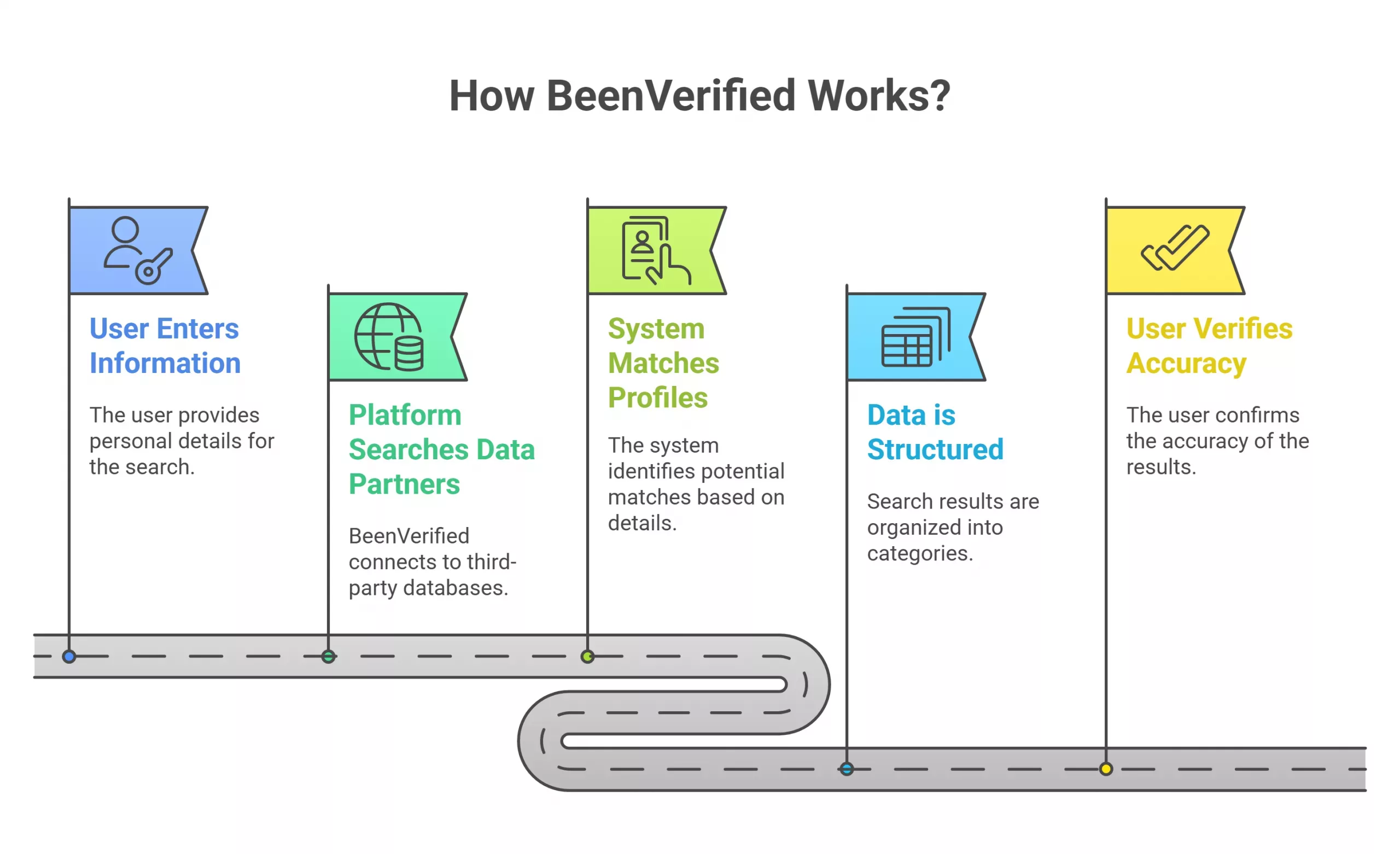
The system follows a straightforward workflow.
Step 1: User enters available information
The user provides one or more of the following:
- Name
- Phone number
- Email address
- Address
- Vehicle VIN
The more specific the input, the more precise the results tend to be.
Step 2: The platform searches its data partners
BeenVerified connects to multiple third-party databases. These partners continuously update their information using public records, marketing data, government filings, and consumer directories. Because updates depend on each source, there may be gaps.
Step 3: The system matches likely profiles
Matching relies on details such as:
- Middle initials
- Past addresses
- Known relatives
- Age ranges
This is where errors can occur. People with common names are more likely to have mismatched results. For example, “Michael Johnson from Texas born in the 1980s” may produce several partial matches. The system groups these into a list rather than selecting one at random.
Step 4: Data is structured into categories
Search reports divide information into sections so the user can review:
- Contact information
- Address history
- Possible relatives
- Criminal or traffic records
- Property ownership
- Social media links
This organization is helpful because it lets users cross-check patterns rather than rely on a single detail.
Step 5: The user verifies accuracy manually
Even if the system provides multiple data points, it is the user’s responsibility to determine whether they refer to the correct person. For example, matching a birth year with a known address helps confirm identity.
Someone receives repeated calls from an unfamiliar number. A search through the reverse phone lookup feature may reveal:
- The carrier type (mobile or VoIP)
- Possible location
- Spam reports
- Name associated with the number
- Potential linked emails or addresses
The user then decides whether the call requires attention or can be safely ignored.
Limitations
- Some counties do not digitize court records.
- Some states restrict criminal record access.
- Commercial marketing datasets may list outdated phone numbers or emails.
- Data may be delayed by weeks or months depending on the source.
These limitations are common across all platforms in this category.
For you! Free Social Catfish Alternatives and Similar Apps
Key Features of BeenVerified
1) People Search
The people search tool collects publicly available details tied to a name and location. Reports generally include:
- Address history
- Known relatives
- Contact numbers
- Possible employment history
- Possible educational records
- Criminal or civil court records (where available)
Example: If a user searches for a former classmate but only remembers a name and state, the people search tool may reveal previous addresses or associated individuals that help identify the correct person.
2) Reverse Phone Lookup
This feature looks for publicly documented associations with a phone number. It draws from carrier data, online directories, marketing databases, and spam-reporting sources.
Example: A persistent caller leaves no voicemail. A lookup may show the number has been flagged as a telemarketing line.
3) Email Lookup
Email addresses often appear in public forums, data-breach dumps, social media accounts, and domain registrations. The email lookup attempts to connect the email to possible names, linked phone numbers, or related accounts.
Example: A user receives an unexpected message from a sender claiming to be a landlord. Running the email may reveal whether it is tied to other suspicious online activity.
Try once! App based on phone numbers
4) Social Media Search
This tool attempts to locate profiles that match a name, phone number, or email. It does not bypass privacy settings. Instead, it searches open-source profile data, usernames, and references from public posts.
Example: A person reconnecting with an old friend may identify their updated profile after confirming the city and age range.
5) Address Lookup
Address search tools compile property tax data, zoning information, mortgage details (where public), and ownership history.
Example: Someone planning to rent a house might check whether the person claiming to be the landlord is listed as the property owner.
6) Vehicle Lookup
Users can enter a VIN to find:
- Vehicle specifications
- Model history
- Title branding (if publicly documented)
- Past sale information
Example: Before purchasing a used car from a private seller, a buyer might check whether the VIN has any red flags such as salvage branding in public databases.
7) Criminal Records Search
Criminal record searches vary widely by jurisdiction. Some states provide open access, while others restrict details.
Results may include:
- Misdemeanor or felony charges (if publicly available)
- Arrest data
- Court outcomes
- Traffic offenses
- Sex offender registry entries
A “no record found” result means no matching data was found, but it does not guarantee the absence of a record.
What is the monthly cost of BeenVerified?
At the time of writing, BeenVerified uses a subscription model with two primary tiers:
- A monthly subscription that renews automatically.
- A longer-term plan that reduces the monthly rate.
Users gain access to all main lookup tools under one subscription, but certain vehicle-related or court-document requests may involve additional fees from the source databases themselves.
There is no permanent free tier. Single reports are not offered a la carte.
Renewal policies require users to cancel before the next billing cycle if they no longer need the service. This structure is common among background check tools.
Pros and Cons of BeenVerified
Pros
- Simple interface suitable for non-technical users
- Multiple lookup tools under one account
- Wide range of public-record categories
- Helpful for verifying contact information
- Saves time compared to manually searching county websites
Cons
- Not always fully accurate due to limitations of public records
- Cannot be used for employment or tenant screening
- Mismatches possible, especially with common names
- Subscription required for full access, even for a single search
- Some data categories may be incomplete in rural areas
Is BeenVerified worth it in 2026?
Value depends on the user’s goal. In 2026, digitized public records continue to expand, which benefits platforms that aggregate data. However, regional consistency remains an issue. Some counties still lag in updating online databases.
Who benefits most?
- Users trying to verify unknown callers
- Individuals checking property records before rentals or purchases
- People reconnecting with old acquaintances
- Consumers conducting basic safety checks before online transactions
Who may not find value?
- Users needing precise, legally verified information
- Individuals dealing with highly common names
- Researchers who need full historical court cases (these often require direct county requests)
If someone only needs basic address verification or wants to check whether a phone number is a known spam caller, free tools exist. However, these free tools rarely include comprehensive public records, which is why many users also compare several beenverified alternativs before deciding which service fits their needs.
Overall, BeenVerified is worth considering for personal research in 2026, provided users understand its limitations and verify important details independently.
If you are looking for? Free Cheaterbuster Alternatives that Provide Reliable Results!
BeenVerified vs TruthFinder vs Intelius: Detailed Comparison for 2026
Choosing a public-record lookup service can be confusing because the major platforms pull data from similar sources but present it differently. This section compares BeenVerified, TruthFinder, and Intelius so readers can understand how each service works, where they differ, and which one fits specific research needs.
The goal is not to recommend one platform over another but to show how their features and pricing structures align with different use cases.
Before choosing a service, it helps to know that all three rely on public and commercially available data. None of them provide guaranteed completeness because record availability varies by state, county, and update schedules.
What you are really choosing between is usability, depth of categories, and the type of reports each platform emphasizes.
| Feature / Category | BeenVerified | TruthFinder | Intelius |
|---|---|---|---|
| Search Tools | People search, phone lookup, email search, property records, VIN lookup, criminal records | People search, deep-web scans, social links, phone lookup, criminal records | People search, phone lookup, property records, email search, criminal records |
| Ease of Use | Very straightforward and beginner-friendly | More tool options, slightly more complex interface | Clear layout, somewhat more data fragmentation |
| Data Depth | Balanced coverage across most categories | Often stronger in social media and deep-web connections | Strong in property and people-search data |
| Pricing Structure | Monthly subscription, no one-off reports | Monthly subscription, some add-ons | Monthly subscription, occasional one-off options |
| Best Use Case | General personal research and quick lookups | Users who want detailed digital trace and social links | Users focused on property history and structured people searches |
| Limitations | Occasional mismatches with common names | Interface may feel overwhelming to new users | Some results may be spread across multiple report sections |
Which Service Should You Choose?
The best platform depends on the user’s goal:
- Choose BeenVerified if you want a simple interface and balanced coverage across people searches, property details, and basic public records.
- Choose TruthFinder if your priority is identifying online profiles, usernames, and other digital connections.
- Choose Intelius if you frequently research addresses, ownership history, or structured people-search data.
Each platform has strengths, and each one also has limitations based on the region and the availability of public records.
Looking for? Snapchat Friend Finder Apps You Must Try
BeenVerified: Privacy, Security, and Legal Considerations
BeenVerified pulls from records that are already public. It does not gather confidential data such as bank information, private messages, or social-security details. Users must follow federal and state laws when using the service.
FCRA compliance
Because BeenVerified is not an FCRA-regulated service, it cannot be used for:
- Employment decisions
- Housing decisions
- Insurance underwriting
- Professional licensing evaluations
Opt-out options
Individuals can remove their profiles from BeenVerified through an opt-out request. This process removes the data from the platform’s search results but does not remove the underlying public records from government databases.
Security
The platform uses standard encryption practices during data transmission. Users should still avoid sharing sensitive personal information inside the search tool.
Looking for? Best Similar Sites Like Swindlerbuster.com to Find People on Tinder
BeenVerified Legit or Scam?
BeenVerified operates as a public record aggregation service that has been active for many years. It is a legitimate business that provides access to publicly available data through a subscription model.
However, consumer complaints often arise from:
- Renewal charges when users forget to cancel
- Confusion between public record accuracy and the platform’s responsibility
- Expectation that the service provides complete, court-verified information
These issues are common across similar platforms. The service is legitimate, but users must understand its scope and verify any important information through primary sources.
Practical Tips for Users
1. Verify multiple data points
Instead of relying on one detail, combine information such as:
- Address patterns
- Age range
- Relatives
- City history
This reduces the likelihood of misidentifying someone.
2. Be aware of data limitations
If a record is missing, it may not mean it does not exist. The county might simply not publish the record online.
3. Cross-check addresses
If a name appears with several addresses, match the dates against what you already know. This helps identify likely matches.
4. Use reports as a starting point
For important decisions, always follow up with primary sources such as county clerk offices or state record databases.
For making new friends! Apps Like Wizz Alternatives to Make New Friends
Sum up
BeenVerified provides structured access to public records that can otherwise be time-consuming to locate. It is useful for tasks such as verifying contact details, researching property information, or understanding publicly documented court activity. This BeenVerified Review shows that while the platform is effective for broad personal research, it is not a replacement for official background checks or legal records.
Users benefit most when they treat the service as an information organizer rather than a definitive source. Those who understand its limitations, verify important findings, and interpret results with caution will get the most value.
FAQs
Does BeenVerified notify the person you search for?
No. BeenVerified does not send alerts or notifications to the person you look up. Searches are private and remain visible only to the account holder. However, the information you access must still be used within legal limits, meaning you cannot use it for employment, housing, or credit decisions.
How often does BeenVerified update its data?
BeenVerified updates its data continuously, but update frequency depends on the source. Some public agencies update weekly or monthly, while others refresh daily. Because BeenVerified cannot control how often each county or state releases new information, users may see delays in criminal records, property transfers, or court filings.
Can I run a background search on myself with BeenVerified?
Many users search their own names to see what public information is available online. This can help with reputation management, verifying identity information, or checking whether any outdated or incorrect data appears in public records.
Does BeenVerified offer single reports instead of subscriptions?
BeenVerified does not offer pay-per-report options. Full access is subscription-based, and users must cancel manually if they no longer want recurring billing. This is important for anyone who only needs the service for a brief period.
Can I get official criminal records directly from BeenVerified?
BeenVerified is not a source of official court-certified documents. It provides summaries based on public and commercial datasets. If you need official copies, such as certified court documents or state criminal history checks, you must request them directly from the relevant court or state agency.