How to Outsource a Ruby on Rails Project: Costs, Risks, Checklist
In a world where speed, agility, and smart spending shape the future of tech, it’s no surprise that businesses are continuously seeking smarter ways to build and scale their applications.
If you’re working with Ruby on Rails and suddenly hit a technical wall, maybe a feature that’s out of your team’s expertise, or a scaling issue that’s stalling your roadmap. You might be wondering whether you should opt for outsourcing.
Maybe your in-house team doesn’t have the specific expertise needed for the next big upgrade. Maybe you’re worried that delays and knowledge gaps could hurt your product quality or push deadlines.
In this guide, we will walk you through how to outsource Ruby on Rails project. Regardless of what you want to achieve, we will discuss everything you need to keep in mind.
What to Look for when Outsourcing a Ruby on Rails Development Team
Choosing the right Ruby on Rails team will significantly affect your project’s success, especially when it comes to code quality, delivery timelines, and ongoing support.
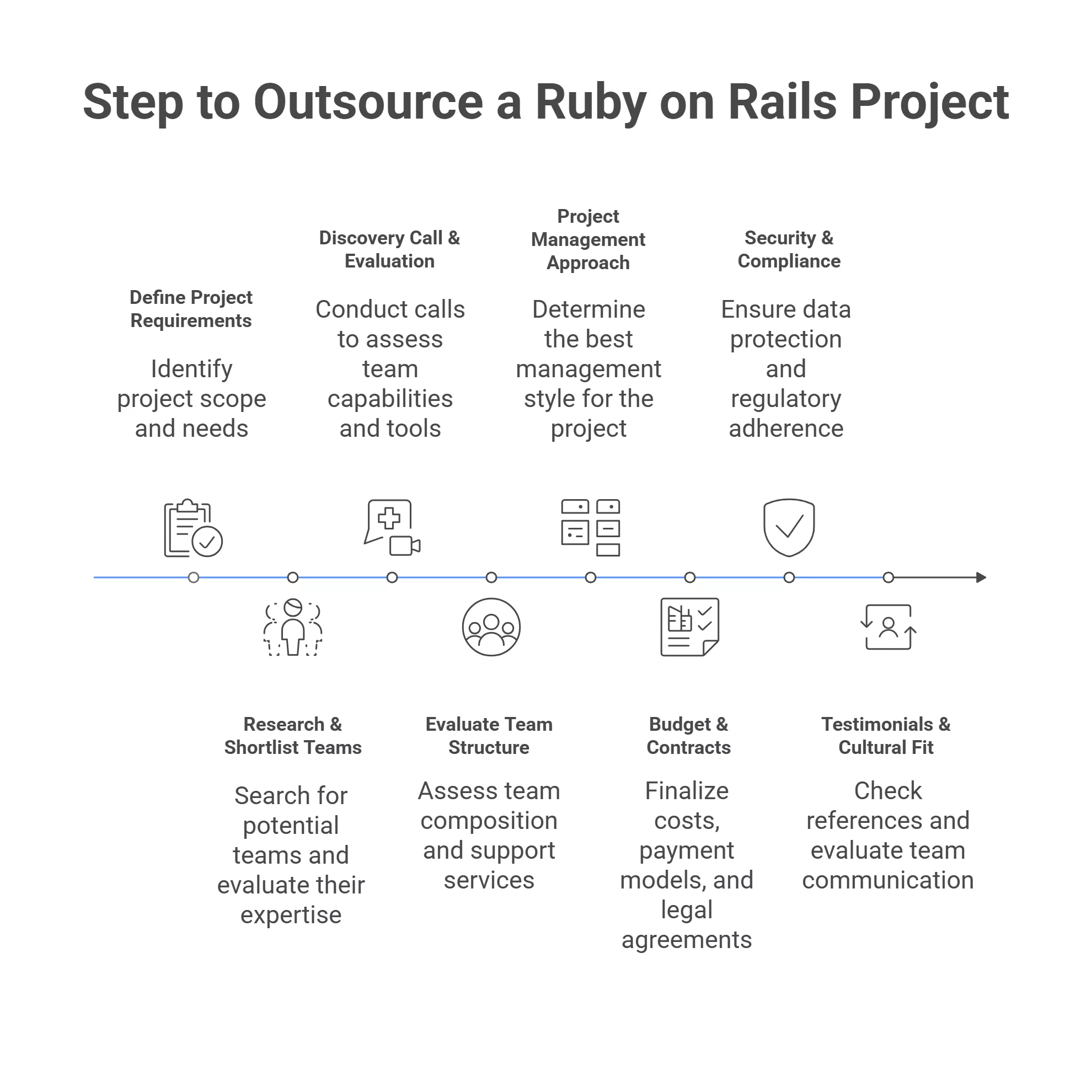
So, how do you spot the right fit? Below is a step-by-step guide that will help you hire smart.
Step 1: Define Your Project Requirements
When you are outsourcing a team, whether it’s for Ruby on Rails or something else, defining your scope is the most basic and important part of the process.
You first need to identify whether you are building an MVP, a scalable SaaS app, or upgrading an existing product.
Then specify required integrations like payment gateways, APIs, what platforms you want your application to be on, and the back-end functionalities, etc.
Step 2: Research and Shortlist Development Teams
Then you should start your search for Ruby on Rails outsourcing partners through reputed channels like Clutch, Upwork, GoodFirms, LinkedIn, developer forums, Slack communities, or through referrals.
Now that we have discussed where, let us talk about what to look for. You should check company websites for case studies, testimonials, service offerings, portfolios showing experience with RoR frameworks, gems, and back-end architecture, or if they have any domain expertise, have they built any applications in your industry before? Do they understand your audience? Etc.
Step 3: Discovery Call & Evaluation
A discovery call is how you dig deep into their technical capabilities and collaboration style. Let’s look at a few questions that you can ask to evaluate their capabilities:
- Are they well-versed in Ruby on Rails, PostgreSQL, Redis, Sidekiq, or any relevant APIs?
- Do they have any experience in building scalable, high-performance RoR applications?
- Can they provide code samples or GitHub contributions?
- Ask them to walk you through a past project.
- How do they manage timelines and unexpected challenges?
- What was their role in architecture, testing, and deployment?
- Do they use version control (e.g., Git, GitHub)?
- What coding standards do they follow?
- Do they practice unit testing, automated testing, or test-driven development (TDD)?
- What tools do they use? (Slack, Trello, Jira, Notion, Zoom?)
- How do they handle time zone differences?
- Are they responsive, transparent, and anticipatory?
Step 4: Evaluate Team Structure & Resource Availability
Understanding the team you are about to hire is important. Ask them about the team structure, how many project managers, developers, QA testers, and designers they have. You need to make sure they have backup developers to cover absences and transitions, and confirm that they offer design, DevOps, QA, and post-launch support in-house in case you need it.
Step 5: Review Project Management Approach
It’s imperative that you’re outsourcing partner aligns with your preferred project methodology.
- For evolving or exploratory projects, Agile (Scrum or Kanban) is best.
- For fixed-scope projects, Waterfall or Hybrid might work better.
- Ask how they handle iterations, feature prioritization, backlogs, and client approvals.
A well-aligned management model will reduce bottlenecks and make sure your Rails outsourcing project stays on track.
Step 6: Budget & Contractual Clarity
Cost transparency is just as important as the technology stack. Get a breakdown of Rails project outsourcing cost, which includes design, development, testing, and support. Confirm the payment model, whether it is hourly, fixed price, or retainer, and ensure legal clarity on IP ownership, NDA & confidentiality, and Post-launch support agreements.
Even when you are opting for outsourcing because of a tight budget, you should always prioritize value over cost; a low-cost team with poor processes can cost you far more in rework and delays.
Step 7: Security and Compliance
If you work with user data, security should be built into every layer of your Ruby and Rails application. Always ask your outsourced team about their security protocols, how they handle authentication, encryption, and database access. Do they comply with industry regulations like GDPR, HIPAA, etc? What are their data handling and backup practices?
Step 8: Testimonials, References & Cultural Fit
You should never skip a trust check. Ask for references from past clients, preferably the ones with similar project types or industries. Read their testimonials and case studies, evaluate the cultural fit, and is their communication style collaborative? Are they open to feedback? Cultural alignment improves your team collaboration, especially when you hire Rails developers overseas, who will be working closely with your internal team.
Read once! Ruby On Rails Vs Django For Startups
Cost Breakdown of Ruby on Rails Application Development
Before you decide to outsource a Ruby on Rails project, you should get a firm understanding of the development cost.
Below is the list of what affects your development cost.
- Project complexity: Project complexity depends on the features you want in your application. A simple content management system is cheaper than a multi-vendor ecommerce platform or a custom SaaS product with API integrations and real-time data handling.
- Development team structure: Your development cost is directly affected by the team size, experience level, and roles you require.
- Design and user experience: Aesthetically pleasing UI/UX might attract more users, but custom designs, interactive flows, and Micro Animations need dedicated designers, which will increase the development cost significantly.
- Testing and quality assurance: Quality won’t test itself, Q&A adds up to 10 to 20% on your budget, especially if you include automated test suites, performance testing, and penetration testing for security.
- Project timelines: If you want to develop your application faster, it will cost you more since you will need to hire more developers, pay for overtime, and skip phase rollouts.
- Maintenance and support: There are certain things that you absolutely cannot skip, like bug fixes, updates, patching vulnerabilities, and monitoring, and these add up to 10 to 20% annually in ongoing support. These are the recurring annual costs that grow with your application usage and complexity.
- Regulatory compliance: For domains like fintech, healthcare, or Edtech, you will need to comply with GDPR, HIPAA, SOC2, etc. These compliances will add extra charges to your overall development cost.
- Geographic location: The most basic principle of outsourcing is that your developer’s location will significantly affect your budget. Let’s look at some of the developers’ in-house annual salaries by Region:
| Region | Junior | Mid-Level | Senior |
| North America | $45K – $60K | $60K – $98K | $98K – $160K |
| UK & Western EU | $35K – $60K | $60K – $100K | $100K – $150K |
| Eastern Europe | $20K – $42K | $42K – $72K | $72K – $100K |
| South America | $15K – $30K | $30K – $50K | $50K – $80K |
| Asia (India) | $8K – $20K | $20K – $40K | $40K – $70K |
| Africa | $7K – $15K | $15K – $35K | $35K – $70K |
Outsource developer annual cost by region
| Region | Junior | Mid-Level | Senior |
| North America | $60K – $80K | $80K – $110K | $110K – $150K |
| Canada | $50K – $70K | $70K – $100K | $100K – $150K |
| Western Europe | $40K – $60K | $60K – $80K | $80K – $120K |
| Eastern Europe | $20K – $40K | $40K – $60K | $60K – $90K |
| South America | $15K – $30K | $30K – $45K | $45K – $75K |
| Asia (India) | $10K – $20K | $20K – $30K | $30K – $50K |
| Asia (Philippines) | $8K – $18K | $18K – $28K | $28K – $45K |
| Africa (Nigeria) | $7K – $15K | $15K – $25K | $25K – $40K |
| Australia | $50K – $70K | $70K – $100K | $100K – $150K |
Looking for? Largest Custom Software Development Companies
When Should You Outsource Ruby on Rails Development?
Outsource Ruby on Rails project decisions are often driven by specific needs. Below are some of the common challenges you might face that may require outsourcing.
1) Your In-House Team Faces Knowledge Gaps
Every technological team has its limits, whether it’s unfamiliar gems, performance optimization challenges, or advanced integrations, it is best if some tasks are handled by niche experts.
Ruby on Rails development often requires experience with background jobs like Sidekiq, API integrations, DevOps for development like Docker, Heroku, or AWS, and database optimization. Outsourcing fills those gaps with a specialist who already knows what to do and how to do it quickly.
Through this, you save time and the cost of upskilling internal developers or hiring for short-term needs.
2) Budget Constraints
Hiring a full-time senior Ruby on Rails developer can be expensive, especially in markets like North America and Western Europe. For in-house developers, you will have to provide health insurance, equipment, office space, and onboarding, which could double your budget.
Outsourcing will remove these hidden costs, and you will pay only for the work that is delivered. You can hire Rails developers overseas in regions with competitive rates without compromising on quality. It’s easier to get transparent estimates upfront, which helps you control the Rails project outsourcing cost effectively.
Which One Should You Hire? Dedicated Developers vs. Freelancers
3) Time-to-Market is Crucial
If you have an investor demo next month or need to launch a new feature before your competitor does, building an in-house team will take months. But when you are top outsourcing partners, they already have teams that are trained, aligned, and ready to go. And with a dedicated Ruby on Rails outsourcing team, you will start developing in days instead of weeks. Experienced outsourcing teams will bring you efficient development workflows, built-in QA, and a faster feedback loop.
4) You Want Access to the Latest Technology
Ruby on Rails is constantly evolving, and keeping up with emerging technologies can be a bit overwhelming for teams that are already burdened with maintenance tasks.
So, best outsourcing partners that specialise in RoR can give your business the modern and scalable solutions it needs instead of outdated implementations that hold you back.
5) Launching a High-Risk Product or MVP
Launching something new always comes with risks. Will it scale? Is the architecture solid? Can it be built before funding runs out? So many questions with one solution. Outsourcing a reliable Ruby on Rails partner.
They will offer you a pre-tested framework, rapid development workflows, and help you de-risk the MVP phase through faster iterations, fail-safes, and objective code reviews, which will ultimately help you scale up and down based on how the product performs without restructuring your team.
6) You Need Resource Flexibility
Oftentimes, workloads will spike, priorities shift, and requirements might change during the development process. When that happens, outsourcing allows you to easily hire or fire developers, which is ideal for businesses that deal with seasonal or project-based demands. It eliminates the need for long-term contracts or commitments. This flexibility helps you align development velocity with business needs without stretching internal resources thin.
7) Your Focus Needs to Stay on Core Business
Every minute your in-house team spends on debugging Rails issues or managing junior developers is a minute that is not spent on product strategy, marketing, or growth. Outsourced teams handle the engineering legwork while your internal stakeholders stay focused on core business goals. They come with project managers, scrum leads, and tech leads, which reduces your need to micromanage the shared responsibility and improves productivity across the board.
8) You Want Global Talent Without Relocation Hassles
The Ruby Developer Community is global, so limiting yourself to local hiring means potentially missing out on some of the best minds in the industry.
You can hire Rails developers overseas from developer-rich regions like Eastern Europe, Latin America, or South Asia. These developers are used to working with remote clients collaborating across time zones and delivering to international standards; the cost-to-skill ratios are often higher compared to domestic hiring.
Common Challenges in Ruby on Rails Outsourcing
1) Communication gaps
When you outsource a Ruby on Rails project, miscommunication is one of the biggest risks. But if you use Slack, Zoom, and project management tools, schedule regular check-ins and ensure everyone’s comfortable using a shared working language, you can easily manage them without much difficulty.
2) Time zone
If you are hiring Rails developers overseas, you’ll likely deal with different working hours. So you should plan a few overlapping hours for live discussions and use self-paced tools like Loom or Notion to keep collaboration flowing smoothly.
3) Cultural misalignment
Cultural nuances can affect collaboration. If you’re outsourcing Ruby on Rails development across regions, it’s best to promote mutual respect, do a bit of cultural training, and encourage open conversations. It will build stronger team dynamics.
4) Quality slipping through the cracks
One of the biggest fears with Ruby on Rails outsourcing is losing control over quality. Though you can avoid it by setting clear coding standards, regular code reviews, and aligning on what a “finished” feature actually looks like.
5) Lack of visibility or control
It’s common to feel disconnected when you outsource Ruby on Rails development. Maintain visibility with weekly updates, performance tracking, and if the project can’t be overlooked, consider splitting work across trusted partners.
6) Security
When you are hiring Rails developers overseas, data protection should be top priority. Always sign NDAs, use secure tools, and ensure your partner follows global security standards like ISO or SOC 2.
7) Vendor dependency
Simply put, long-term dependency on one vendor can backfire. So, you need to define clear deliverables, own the documentation, and make sure your in-house team stays involved to avoid knowledge silos.
8) Budget Overruns
One of the most common rails project outsourcing cost issues is budget creep. Explain pricing and scope from the start, set boundaries for change requests, and review spend regularly to stay on track.
9) Lack of domain knowledge
You need a strong knowledge transfer plan because, without it, your internal team could be left out of the loop. Encourage shared documentation, team crossovers, and joint review sessions between your team and your outsourcing partner.
10) Managing remote teams
Remote teams thrive on trust. So, set clear roles, foster open communication, and create a feedback loop that works both ways.
11) Legal uncertainty
Legal pitfalls are real in Ruby on Rails outsourcing. Work with a legal professional to draft airtight agreements that protect your business and your code.
12) Changing requirements mid-project
Scope creep often happens, especially when outsourcing. Include flexibility in your plan, document every change, and communicate shifts clearly to your Rails development team.
Find Intresting? Are App Development Companies Still Relevant In The AI Era?
Sum up
Outsourcing a Ruby on Rails project is a strategic decision that can speed up development at a lower cost. Whether you are launching an MVP, scaling a Saas platform, or modernising legacy systems, the right development partner can make a huge difference.
Since every step from understanding your needs to choosing the best outsourcing destination matters, if it’s done right, you will not only save on Ruby on Rails outsourcing costs but also gain access to a global pool of highly skilled developers.
FAQs
How do I choose the right Ruby on Rails outsourcing partner?
You should start by looking for a proven track record with Ruby on Rails projects, strong client reviews, solid technical expertise, and transparent communication, and always request a discovery call, case studies, and check for time zone Compatibility.
How much does it cost to outsource a Ruby on Rails project?
The rails project outsourcing cost varies based on its complexity, team size, and developer location rates, typically ranging from $20 per hour in Asia to $150 per hour in North America.
Is it better to hire a freelance Rails developer or an agency?
Well, it depends. Freelancers are cost-effective for short-term or small projects. Agencies, on the other hand, offer broader expertise, project management, QA, and scalability, which is ideal for larger or ongoing Ruby on Rails outsourcing needs.
How do I manage post-launch support with an outsourced team?
You have to discuss this up front, ensure that your contract includes bug fixes, performance monitoring, and a dedicated point of contact for urgent support. Many Ruby on Rails outsourcing partners of a monthly retainer plan for ongoing support. You should look into it when you are deciding on an agency.