How to Manage an Offshore App Development Team
In a world where digitalization has become a trend and a way to enhance efficiency, businesses from every industry are engaging in launching innovative applications to hook customers and provide a seamless user experience. Even though developing applications might have a high return on investment, the initial cost isn’t pocket-friendly. And that’s why businesses choose Offshore App Development team.
Offshore app development refers to the practice of outsourcing mobile app development to a third-party team in a different country. This is a cost-effective approach that allows businesses access to a global pool of skilled developers. It is for businesses looking to reduce the development cost or for the ones on a budget. It also gives them access to advanced tech and niche expertise.
According to Existek, offshore software development services are 50% more cost-effective compared to in-house teams.
Although it may seem like a simple process that involves hiring a development team at first, offshoring comes with certain challenges and the biggest one is managing that team.
Who Should Opt for Offshore Development?
Outsourcing isn’t just a way to reduce cost it also reduces time to market and gives a competitive edge to most businesses.
Whether you are a startup, a small business, a company on a tight budget, businesses seeking rapid scalability, that require specialized skills, companies looking to reduce time to market, or a company trying to expand globally, offshore development is the answer to all.
Key Roles in an Offshore Development Team
| Position | Responsibilities |
| Project Manager (PM) | • Define project scope and goals. • Communicate with the client. • Allocate tasks and track progress. • Manage risks and ensure deadlines. |
| Business Analyst (BA) | • Gather and analyze client requirements. • Translate business needs into technical specifications. • Recommend solutions and improvements. |
| Software Architect | • Design the software architecture. • Ensure scalability, security, and performance. • Review code and set technical guidelines. |
| Front-End Developer | • Focus on UI/UX. • Write clean, responsive code for web and mobile interfaces. • Collaborate with designers to implement features. |
| Back-End Developer | • Handle server-side logic, database management, and API integrations. • Ensure software performance and scalability. • Fix bugs and technical issues. |
| Full-Stack Developer | • Work across both front-end and back-end. • Handle the entire development cycle from database to user interface. • Build complete solutions end-to-end. |
| QA Engineer | • Design and execute test plans. • Perform manual and automated testing. • Identify bugs and ensure software quality. • Report defects to developers. |
| UI/UX Designer | • Create wireframes, prototypes, and final designs. • Conduct user research and implement feedback. • Ensure usability and accessibility best practices. |
| DevOps Engineer | • Manage cloud infrastructure and deployment pipelines. • Ensure continuous integration and delivery (CI/CD). • Monitor and optimize system performance. |
| Technical Support | • Provide ongoing post-deployment support. • Troubleshoot and resolve customer-reported issues. • Collect feedback for future improvements. |
Offshore Software Development Rates by Region
| Region Average | Hourly Rate (USD) |
| United States | $80 – $150 |
| Western Europe | $70 – $130 |
| Eastern Europe | $25 – $100 |
| India | $15 – $70 |
| Canada | $90 – $150 |
| Latin America | $25 – $100 |
| Southeast Asia | $15 – $60 |
We have listed! Reasons to Invest in Offshore Mobile Application Development
How to Select an Offshore Mobile App Development Company
Choosing the right partner is crucial for the success of your project. Here are some things you should consider when choosing one:
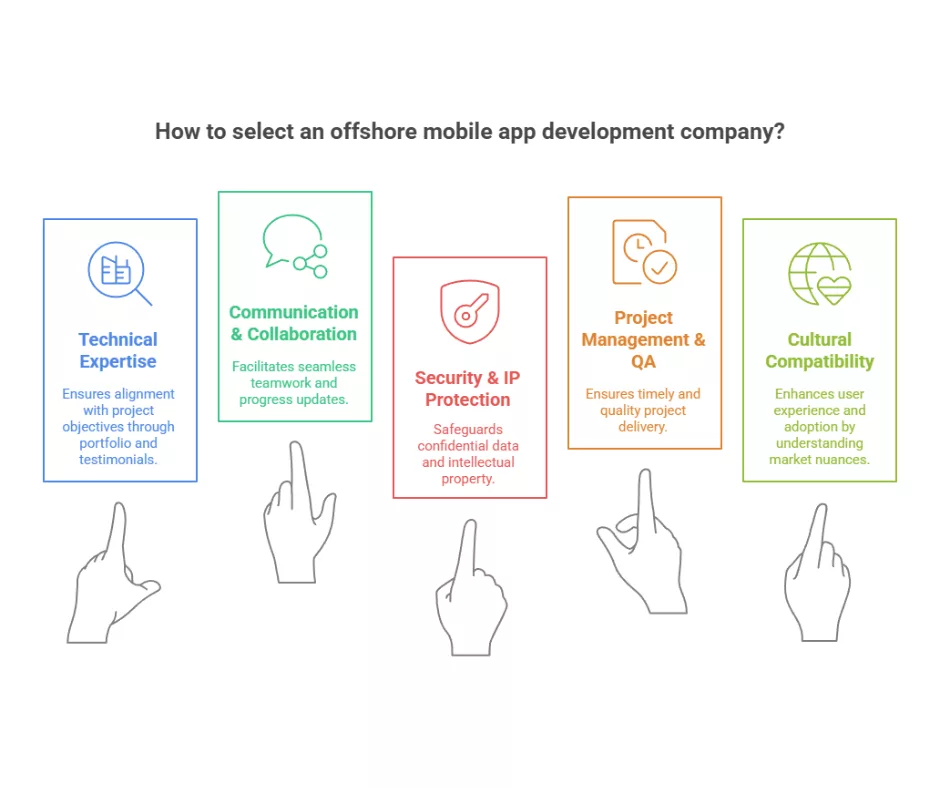
Technical expertise
Thoroughly evaluating a company’s portfolio, experience and testimonials are vital to ensure they align with your objectives.
Communication and Collaboration
Ensure the company has strong systems for seamless collaboration and regular progress updates. Having clear and concise communication is important for collaboration, especially in offshore projects.
Security and intellectual property protection
Verify the company complies with strict policies and measures to safeguard confidential data and intellectual property.
Project management and quality assurance
Assessing the company’s management, quality assurance and ability to meet deadlines is important to ensure the deliveries aren’t delayed.
Cultural compatibility
Look for a company that has a strong understanding of your target market’s cultural nuances and preferences because this can significantly impact the app’s user experience and adoption.
Looking for? Best App Ideas With Features, Benefits, & Costs
Best Practices for Managing Offshore App Development Teams
Managing the team can be a challenge but if you maintain proper communication, transparency, bonding, etc it can be overcome easily. Lets discuss these below:
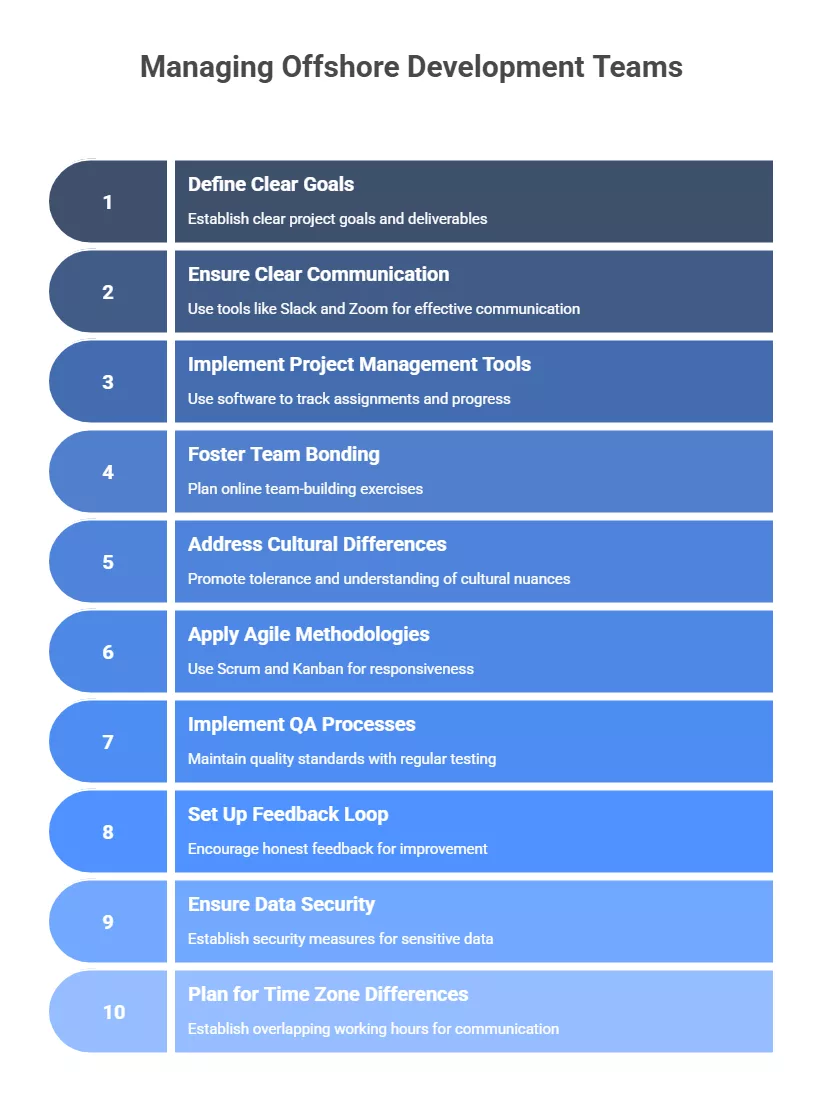
Define Clear Goals, Roles, and Deliverables
Establishing clear project goals and deliverables is crucial for project success; your team needs to understand what is expected of them.
- Set expectations for quality standards and coding practices.
- Ensure team members understand their roles.
- State document requirements in a structured format with the help of tools like JIRA, Confluence, or Notion to ensure clarity.
Clear communication
According to research from the Project Management Institute, poor communication causes 30% of failed projects. Consider communication as the key to success and since your team is in different region utilize tools such as Slack, Microsoft Teams, or Zoom for effective communication.
- Set up preferred communication channels and response time expectations.
- Set up points of reporting, testing, and discussion
- Video conferencing for more personal interactions and to build rapport.
- Monitor individual performance and project progress in relation to predetermined metrics.
- Adapt processes and strategies in light of performance information.
Project Management Tools
- To keep track of assignments and due dates, use project management software.
- Establish a centralized platform for project updates, code repositories, and documentation.
- Make sure everyone on the team has access to the project’s progress.
- Dashboards and reports can be used to track performance and pinpoint bottlenecks.
Get to know people
- Plan online team-building exercises to improve connections.
- Encourage team members to work together and support one another.
- Acknowledge both individual and group accomplishments to raise spirits.
- Promote cross-functional cooperation to exchange expertise.
Address Cultural Differences
- Understanding cultural quirks is essential for good communication.
- Modify management approaches to fit the needs of the remote team.
- Promote tolerance for different viewpoints and methods.
- Encourage understanding by facilitating conversations about cultural differences.
Agile Methodologies
- To improve responsiveness, implement agile techniques like Scrum and Kanban.
- To evaluate progress, organize and analyze sessions on a regular basis.
- Make use of iterative development to adapt to evolving needs.
- Promote rapid feedback loops to find and fix problems early.
Implement QA Processes
- With the help of a strong quality assurance (QA) framework, maintain high standards of quality.
- Test and conduct code reviews on a regular basis during the development process.
- To make QA work more efficient, use automated testing tools.
- By collecting feedback from QA procedures, you can enhance ongoing improvement.
Set Up a Feedback Loop
- Regularly give team members helpful criticism.
- Invite team members to provide input on management and procedures.
- Establish an anonymous feedback system to encourage honesty.
- Make changes and improve team dynamics by using feedback.
Ensure Data Security and Compliance
- Set up security measures for intellectual and sensitive property.
- Verify that the offshore group complies with security guidelines.
- Team members should receive instruction on security best practices.
- Audit adherence to security guidelines and standards on a regular basis.
Plan for Time Zone Differences
- To enable real-time communication, establish overlapping working hours.
- Time zone effects should be taken into account when communicating deadlines and expectations.
- For effective scheduling, use tools that support time zone management.
Read once! Benefits Of Custom Mobile App Development
Misconceptions about Offshore App Development Team
Below are some common misconceptions and the reality.
Offshore teams provide lower-quality work.
Highly qualified, certified professionals are also a part of offshore teams. They’ve worked in a lot of different industries. notable offshore companies uphold strict quality standards, using methodologies such as Agile, Scrum, and ISO certifications to guarantee top-notch outcomes.
Offshoring takes away employment from in-house employees.
In-house teams can benefit from offshore development. It enables them to concentrate on strategic planning and important business tasks. Additionally, it makes it possible for companies to grow more efficiently.
Time zone and language barriers cause communication problems for offshore teams.
Many offshore software development teams are fluent in English. These companies are known to invest in communication skill training for their employees. Regular check-ins and real-time updates are made possible by project management and communication tools.
Security Risks and Data Privacy Issues
Renowned offshore suppliers adhere to international security regulations. To protect client information, they have comprehensive security policies, encrypt data, and employ adequate safety protocols.
Hidden costs, like extra management and integration fees, offset the initial cost savings.
Even though setup and management expenses must be taken into consideration, many offshore vendors have clear pricing structures. Offshore development is incredibly cost-effective when the proper engagement model is selected and project requirements are clearly defined, as this minimizes hidden costs.
Offshore Teams Don’t Understand Company Culture
Many offshore vendors try to align their work practices with the client’s company culture. Company presentations, shared documentation, and frequent video conferences all aid in bridging cultural differences. To guarantee seamless cooperation, some businesses even provide cultural training to their remote workers.
Only Suitable for Large Companies
Offshore teams can also be beneficial for small and medium-sized enterprises. Businesses of all sizes and project durations can benefit from offshore services.
Teams Have Limited Flexibility and Adaptability
Offshore teams that use Scrum and Agile approaches are made to be adaptable. Numerous remote vendors operate with the same flexibility and promptness as in-house teams.
Companies lose control and ownership of their projects.
Clear project guidelines, regular status updates, and agreed-upon deliverables help businesses maintain control. The client can maintain control over important choices and the course of the project by using project management software and open communication techniques.
Looking for? Top Android App Development Companies In USA
Final Take
Offshore development has many benefits though the success lies in how you manage and collaborate with the team. Treating offshore teams as partners, not just vendors with the right strategy and support, they can deliver faster, be cost-efficient, and support scalability.
FAQs
What is the best way to manage an offshore development team?
Setting specific project goals, keeping lines of communication open, utilizing project management software, and adhering to agile methodologies are the best ways to lead an offshore development team. Long-term success requires developing trust and viewing your offshore team as a strategic partner.
What are the challenges of offshore team management?
Communication delays cultural differences, time zone differences, and quality control are typical issues for managing an offshore team. By implementing structured feedback loops, overlapping work hours, and agile workflows, these can be avoided.
What tools are essential for managing offshore software teams?
Key tools for offshore software team management include project trackers like Jira or Trello, communication platforms like Slack and Zoom, code repositories like GitHub, and documentation tools such as Confluence or Notion.
How can I avoid hidden costs when working with offshore developers?
Avoiding hidden costs in management working with offshore developers involves clear contracts, transparent pricing models, and regular performance tracking. Clearly document all technical and managerial expectations beforehand.
How do I address cultural differences when managing outsourced development teams?
Cultural sensitivity is crucial in managing outsourced development teams. Encourage open dialogue, avoid assumptions, and adapt communication styles when needed. Understanding different work ethics and holidays improves collaboration.
Is it safe to share sensitive data with offshore developers?
Yes, considering that your offshore development team follows strict security protocols, signs NDAs, and complies with data protection laws like GDPR. Conduct regular audits and enforce secure coding practices.
How do I choose the right offshore development partner?
Choosing the right offshore development team involves evaluating technical expertise, communication skills, cultural compatibility, security practices, and past client reviews. Always request a trial project or case studies before committing.