


In a world where digitalization has become a trend and a way to enhance efficiency, businesses from every industry are engaging in launching innovative applications to hook customers and provide a seamless user experience. Even though developing applications might have a high return on investment, the initial cost isn’t pocket-friendly. And that’s why businesses choose Offshore Mobile Application Development.
Offshore app development refers to the practice of outsourcing mobile app development to a third-party team in a different country. This is a cost-effective approach that allows businesses access to a global pool of skilled developers.

Why go offshore for app development?
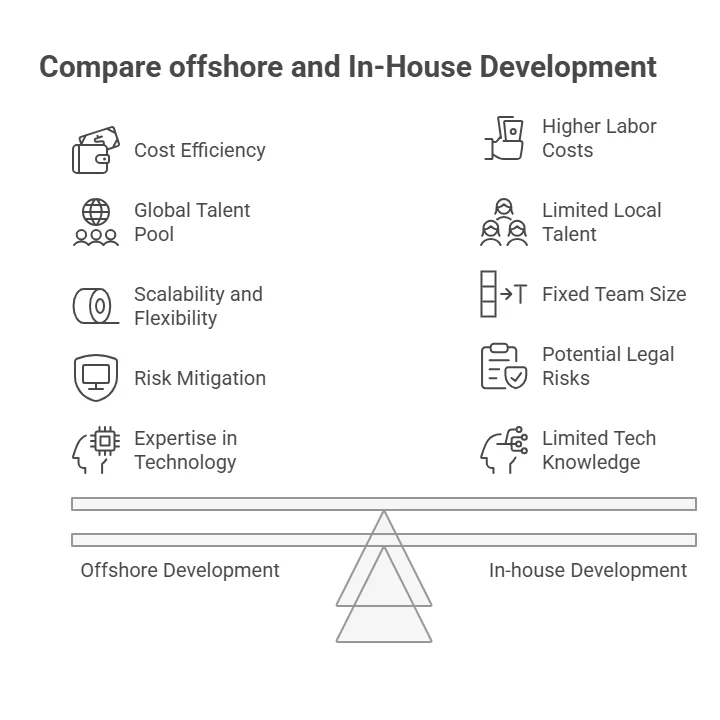
Because developing an app isn’t as pocket-friendly as you would think. Outsourcing is good for businesses on a budget. You can hire experts from regions with low hourly rates without compromising quality, and sometimes their expertise might even exceed the ones in your region.
| Region Average | Hourly Rate (USD) |
| United States | $80 – $150 |
| Western Europe | $70 – $130 |
| Eastern Europe | $40 – $80 |
| India | $25 – $60 |
| Canada | $90 – $150 |
| Latin America | $35 – $70 |
| Southeast Asia | $20 – $50 |
Another reason is time-sensitive projects. You can leverage a large workforce, and a large workforce means a fast development cycle and quick launch. And these are just two of the many reasons you should opt for offshoring. Let’s discuss the rest below.
10 Reasons to Invest in Offshore Mobile App Development
Offshore mobile app development has become a strategic option for startups, growing businesses, and enterprises looking to build high-quality mobile applications without carrying the cost and complexity of a large in-house development team. In 2026, businesses are no longer choosing offshore development only to reduce expenses. Access to specialized talent, faster product delivery, AI capabilities, flexible scaling, and global development expertise have become equally important factors.

An offshore mobile app development company can provide access to experienced developers, UI/UX designers, QA engineers, cloud specialists, and other technical professionals while allowing businesses to maintain greater control over development costs and timelines. Here are the key reasons why investing in offshore mobile app development can make sense in 2026.
1. Reduce Mobile App Development Costs
One of the biggest reasons businesses choose offshore mobile app development is cost efficiency. Building an internal team requires more than developer salaries. Businesses also need to account for recruitment, employee benefits, office infrastructure, software licenses, training, equipment, and ongoing administrative costs.
Offshore development allows companies to access skilled professionals from regions with more competitive development rates. Instead of maintaining a large permanent team, businesses can work with an offshore development partner based on their project requirements.
This approach can be particularly useful for startups and small businesses that need to manage limited budgets while still building a reliable mobile product. The money saved can also be redirected toward product marketing, customer acquisition, cloud infrastructure, security, and future feature development.
2. Access a Larger Pool of Mobile App Developers
Finding experienced mobile developers can be challenging, especially for technologies such as Flutter, React Native, Swift, Kotlin, AI integration, cloud computing, and advanced backend development.
Offshore mobile app development expands the talent pool beyond your local market. Businesses can work with developers who already have experience building applications for different industries, platforms, and business models.
This is particularly valuable when a project requires specialized expertise that may be difficult or expensive to hire locally. An offshore partner can bring together developers with complementary skills instead of forcing one or two employees to handle every technical responsibility.
3. Speed Up App Development and Product Launch
In competitive markets, getting a mobile application to users quickly can provide an important advantage. Offshore development teams can help accelerate development by providing dedicated resources and established development processes.
Time-zone differences can also become an advantage when managed properly. A business team can complete requirements or reviews during its working hours, while the offshore team continues development in another time zone.
With the right communication structure, development can effectively continue across different working hours. This can help shorten development cycles and allow companies to launch their minimum viable product (MVP), test the market, collect user feedback, and improve the application faster.
4. Scale Your Development Team When Needed
Mobile app requirements rarely remain the same throughout a product’s lifecycle. A startup may initially need two developers, but after gaining users, it may require additional backend engineers, QA specialists, UI/UX designers, or DevOps professionals.
Hiring permanent employees for every stage can be expensive and time-consuming.
Offshore development provides greater flexibility because businesses can scale their teams according to project requirements. Additional developers can be introduced when development accelerates, while the team can be reduced after a major release or development milestone.
This flexible model is especially useful for businesses developing applications through multiple stages, from MVP development to full-scale production and continuous maintenance.
5. Work With Specialized Technology Experts
Modern mobile applications are increasingly connected to technologies such as artificial intelligence, machine learning, cloud computing, IoT, blockchain, augmented reality, and real-time data processing.
Finding specialists in all these areas within a single local team can be difficult.
An experienced offshore mobile app development company may already have specialists across multiple technology areas. This allows businesses to build a development team around the application’s actual technical requirements rather than limiting the project to the skills available internally.
For example, an AI-powered healthcare application may require mobile developers, AI engineers, cloud specialists, cybersecurity professionals, and compliance expertise. An offshore partner can potentially provide access to these capabilities through a single development engagement.
6. Improve Development Flexibility
Offshore development can provide businesses with different engagement models based on their project requirements. Companies can choose dedicated development teams, fixed-price projects, time-and-materials models, or other arrangements depending on the scope and level of uncertainty.
This flexibility is useful when the product roadmap is expected to change.
For example, a business may begin with a basic mobile application and later introduce personalized recommendations, AI-powered features, subscription functionality, payment integration, or third-party APIs. An offshore team can adjust its resources as the product evolves.
Instead of treating app development as a one-time project, businesses can build a long-term technical partnership that supports continuous product development.
7. Maintain Focus on Core Business Operations
Building an application internally can consume significant management time. Business leaders may need to deal with hiring developers, managing technical teams, purchasing development tools, handling infrastructure, monitoring performance, and solving technical issues. Outsourcing development allows internal teams to focus more heavily on their core responsibilities.
For startups, this could mean spending more time on fundraising, customer acquisition, product strategy, and market validation. For established companies, internal teams can focus on business operations and customer relationships while the offshore development team handles technical execution.
The result is a clearer division of responsibilities between business strategy and software development.
8. Benefit From Mature Development Processes
Established offshore development companies often work with structured processes for project management, software development, testing, deployment, and maintenance.
A mature process can reduce development risks by introducing clear requirements, sprint planning, code reviews, quality assurance, documentation, and release management.
This becomes increasingly important in 2026 as mobile applications become more complex. Users expect fast performance, intuitive interfaces, secure transactions, reliable integrations, and regular updates.
A development partner with established engineering practices can help create a more predictable development environment and reduce the chances of quality issues appearing late in the project.
9. Build More Secure and Scalable Mobile Applications
Security and scalability should be considered from the beginning of mobile app development rather than added after launch.
Applications may handle sensitive customer information, payment data, personal accounts, business information, or other valuable data. Poor architecture or weak security practices can create significant risks as the application grows.
Experienced offshore development teams can help businesses implement secure authentication, API protection, encryption, cloud infrastructure, secure database architecture, monitoring, and appropriate access controls.
They can also design applications with scalability in mind. Instead of building an application that works only for its first few thousand users, the architecture can be designed to support increasing traffic, transactions, integrations, and data volumes.
10. Gain a Long-Term Technology Partner
The strongest reason to invest in offshore mobile app development is that the relationship does not have to end when the application launches.
A mobile app requires continuous improvement. New operating system versions, security updates, user expectations, technology trends, and market requirements can all influence the product roadmap.
An offshore development partner can support ongoing maintenance, bug fixing, performance optimization, feature development, cloud management, security updates, and future versions of the application.
This long-term relationship can be especially valuable for businesses that want to continuously improve their mobile products rather than launch an app and leave it unchanged.
Read once! Benefits Of Custom Mobile App Development
Is Offshore Mobile App Development Worth the Investment in 2026?
Yes, when the development partner is selected carefully and the engagement is structured around clear business and technical goals.
The value of offshore mobile app development in 2026 goes beyond lower development costs. Businesses can gain access to a wider technology talent pool, specialized expertise, flexible team structures, faster development cycles, and long-term technical support.
However, choosing an offshore development company should not be based solely on hourly rates. Businesses should evaluate the company’s mobile development experience, technology expertise, portfolio, communication practices, security processes, development methodology, client reviews, post-launch support, and ability to understand the business objective.
The right offshore partner should function as an extension of your product team, not simply as an external vendor. When that relationship is built correctly, offshore mobile app development can help businesses turn an application idea into a scalable digital product while keeping development resources flexible and predictable.
Looking for? Best App Ideas With Features, Benefits, & Costs
10 steps to help you with offshore app development
Now that you understand why, lets discuss how.
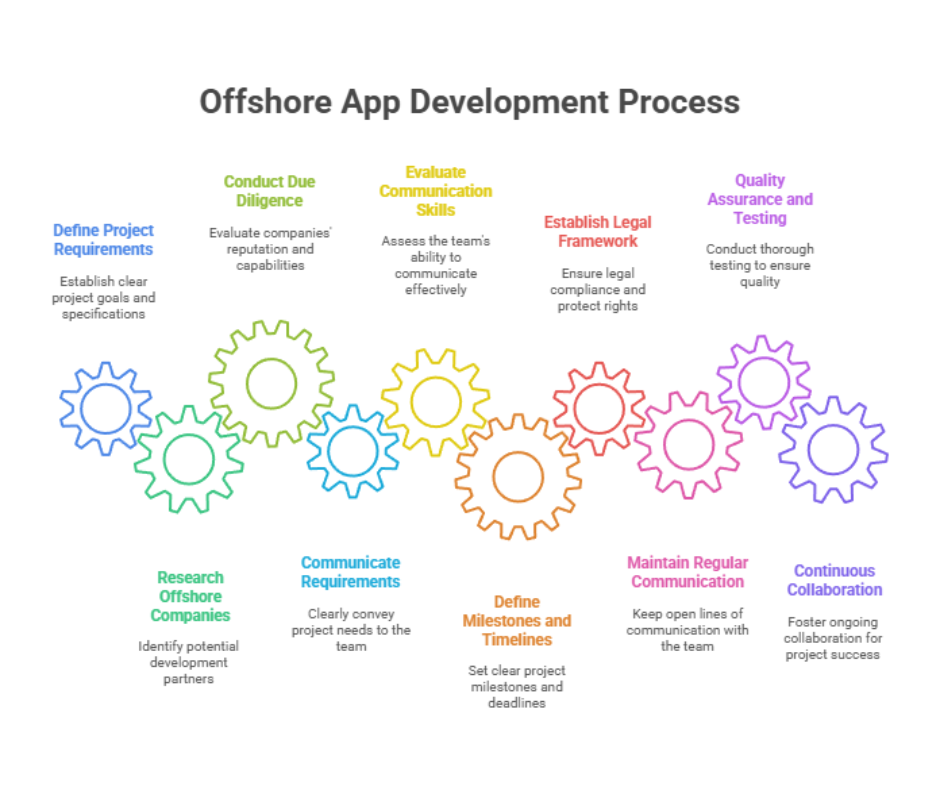
Step 1 – Define project requirements
- Provide app overview, target audience, and objectives for offshore team.
- Define the app’s functionality, break features into user stories, and understand behavior.
- Outline the app’s technical requirements, platforms, languages, frameworks, performance, scalability, and security.
- Provide guidance on app design, user experience, brand guidelines, and elements.
- Consider non-functional requirements like app performance, security, scalability, and usability.
- Establish project timeline and milestones, and ensure shared understanding with the offshore team.
- Communicate expectations for quality assurance, testing, compliance, and documentation.
Step 2 – Research offshore development companies
- Define app development project requirements to assess offshore companies’ expertise.
- Seek referrals and recommendations from experienced offshore app developers.
- Conduct online research to identify offshore development companies.
- Evaluate offshore development expertise, past projects, and technology proficiency.
- Assess cultural fit and communication for offsite app development collaboration.
- Verify offshore development companies’ technical infrastructure, security, and GDPR compliance.
- Interview offshore development companies to discuss project requirements.
- Assess overseas app development costs, terms, and services for cost-effectiveness and expertise.
- Conduct a pilot project to evaluate offshore development company capabilities.
Step 3 – Conduct due diligence
- Define app development goals, features, timeline, and budget for offshore evaluation.
- Explore offshore app development companies and shortlist partners.
- Assess offshore development companies’ reputation, credibility, and client feedback.
- Assess communication and cultural fit for successful offshore collaboration.
- Examine offshore development companies’ data security, IP protection, and agreements.
- Assess offshore development companies’ infrastructure and resources for effective project management.
- Visit offshore development companies for work environment, infrastructure, team dynamics, and professionalism.
- Conduct background checks to evaluate offshore development companies.
Step 4 – Communicate your requirements
Collaborating with teams from different region can be a challenge when it comes to conveying your word.
- Define project scope and outline features, functionalities, and goals.
- Select effective communication channels, considering time zone differences.
- Designate a single point of contact for communication.
- Use visual aids to enhance understanding of app design, layout, and user interface elements.
- Document requirements clearly, and structurally, reducing misunderstandings and ambiguities.
- Foster an open, collaborative environment for the offshore team to exchange ideas and concerns.
- Schedule regular meetings and progress reviews for suggestions and transparency.
- Prioritize documentation and change management for project success.
- Review the offshore team’s performance, provide feedback, and ensure the app meets requirements.
Step 5 – Evaluate their communication skills
Access communication skills to enhance collaboration and understanding of project requirements.
- Improve the offshore team’s English language proficiency for effective communication.
- The offshore team must actively listen, understand client needs, and communicate effectively.
- Prompt offshore team responses foster trust and collaboration.
- Offshore development demands distributed teamwork, collaboration, idea sharing, and adaptability.
- Clear offshore development documentation ensures transparency and avoids misunderstandings.
- Assess cultural understanding for overseas app development to navigate differences.
Step 6 – Define project milestones and timelines
Creating a detailed project plan with defined milestones are essential.
- Define development objectives, target audience, platform compatibility, and features.
- Break development projects into manageable tasks for better organization.
- Identify dependencies for realistic milestones and smooth project workflow.
- Assign task estimates based on complexity, resources, and offshore team experience.
- Prioritize milestones based on importance, impact, and development approach.
- Collaborate with the offshore development team on milestones, timelines, and deliverables.
Read once! Do You Need a Specialized App Developer for Your Industry?
Step 7 – Establish a legal framework
Setting up a legal framework is important to define contractual arrangements, ensure compliance, and protect stakeholder rights for a mutually beneficial partnership.
- Create comprehensive contracts ensure international compliance and scope.
- Identify app development’s IP ownership, protection, confidentiality, and non-disclosure agreements.
- Determine software development agreement jurisdiction, laws, and legal systems.
- Compliance with laws & regulations is vital for user data protection and privacy.
- Define app development liabilities, indemnification, and dispute resolution mechanisms for legal framework allocation.
- Establish effective communication channels and reporting mechanisms for client-offshore collaboration.
- Build contractual flexibility in the software development framework for adaptations.
Step 8 – Maintain regular communication
Regular communication is important to prevent misunderstandings and to ensure the product meets requirements.
- Communicate through messaging, video conferencing, and software.
- Establish clear communication protocols, specify preferred channels, and set response time expectations.
- Hold meetings to track progress, address questions, and align goals.
- Create cultural and language considerations for inclusive environments.
- Encourage team members to provide regular progress updates using project management tools.
- Regularly communicate to foster rapport, trust, and collaboration in teams
Step 9 – Quality assurance and testing
Quality assurance and testing are crucial when outsourcing.
- It requires timely bug identification, quality assurance, and testing.
- Verify offshore app meets functional requirements for smooth user interactions.
- It demands scalability testing for large user bases.
- It ensures seamless functionality across multiple platforms through quality assurance.
- It prioritizes security, data protection, and quality assurance.
Step 10 – Continuous collaboration
Continuous collaboration is important for any project’s success especially when your development team is in another region.
- Create communication channels for team collaboration using effective tools.
- Maintain strong relationships, address concerns, and provide updates via regular meetings.
- Use methodologies to improve collaboration, transparency, and adaptability of overseas app development.
- Encourage knowledge sharing for effective collaboration through documentation, training, and workshops.
- Promote cultural awareness for effective collaboration through offshore development.
- Use dedicated contact points to improve communication and collaboration and reduce complexities.
“What to Expect from Mobile App Development Companies in 2026“
Sum up: Offshore Mobile Application Development
Offshoring offers top experts, reduced cost and short project cycles and can be a reliable option if done properly. There are certain things like daily communication and proper compliance inspections; you need to keep in check when collaborating with a team in different region because even small error can turn into costly fixes if ignored in the beginning.
So, before you choose an offshore mobile application development company, make sure you have thoroughly inspected them to avoid compliance or tech issues later.
Detailed guide! How To Choose A Best Mobile App Development Company?
FAQs
Why go offshore for app development instead of hiring locally?
Going offshore offers multiple advantages: lower development costs, access to a wider talent pool, and faster project delivery. Local hiring often comes with high labor costs, limited expertise in emerging tech, and slower scaling capabilities; offshoring addresses all of these efficiently.
How do I ensure my data and intellectual property are secure?
Choose an offshore development company that complies with global security standards (such as GDPR, HIPAA, or PCI DSS). Always sign Non-Disclosure Agreements (NDAs) and ensure they have robust cybersecurity protocols in place to protect sensitive data.
Can offshore teams handle high-quality design and custom features?
Many offshore teams specialize in custom development and third-party integrations, including payment gateways, cloud services, chatbots, and more. Their experience across industries equips them to deliver both functionally rich and aesthetically pleasing applications.
How do I manage time zone differences effectively?
Time zones can actually be leveraged for 24/7 development cycles. To ensure smooth collaboration, establish overlapping working hours, use project management tools (like Jira, Trello, or Asana), and schedule regular check-ins to keep everyone aligned.
What should I look for in an offshore development partner?
Key factors include:
- Proven technical expertise and project portfolio
- Strong communication practices
- Clear legal frameworks for IP and data protection
- Cultural compatibility with your target market
- Transparent pricing and milestone-based contracts
Is offshore app development suitable for startups and small businesses?
Offshore mobile app development enables startups and SMBs to launch high-quality apps at a fraction of the local development cost. It allows them to compete with larger companies without overstretching their budgets.


