

The expectations of modern investors have changed dramatically. Clients no longer want to wait days for account onboarding or rely on outdated portfolio reports delivered once a month. They expect real-time financial insights, personalized investment recommendations, secure digital experiences, and seamless access to their wealth from anywhere, at any time.
For wealth management firms, meeting these expectations requires far more than incremental software updates. It demands a modern technology platform capable of supporting advanced analytics, automation, compliance, and intelligent decision-making. As a result, wealth management software development has become one of the most important digital transformation initiatives for financial institutions worldwide.
This shift is reflected in market growth.
According to Mordor Intelligence, the global wealth management software market is expected to reach $6.82 billion in 2026 and grow to $11.82 billion by 2031, representing an impressive 11.63% CAGR.
The industry’s expansion is being driven by increasing AI adoption, evolving regulatory requirements, and one of the largest wealth transfers in history.
Whether you’re planning to launch a new wealth management platform or modernize an existing one, success depends on making the right technology decisions from the start.
By the end of this guide, you’ll have a clear roadmap for developing a wealth management platform that not only meets today’s industry standards but also positions your business for long-term growth in an increasingly competitive financial landscape.
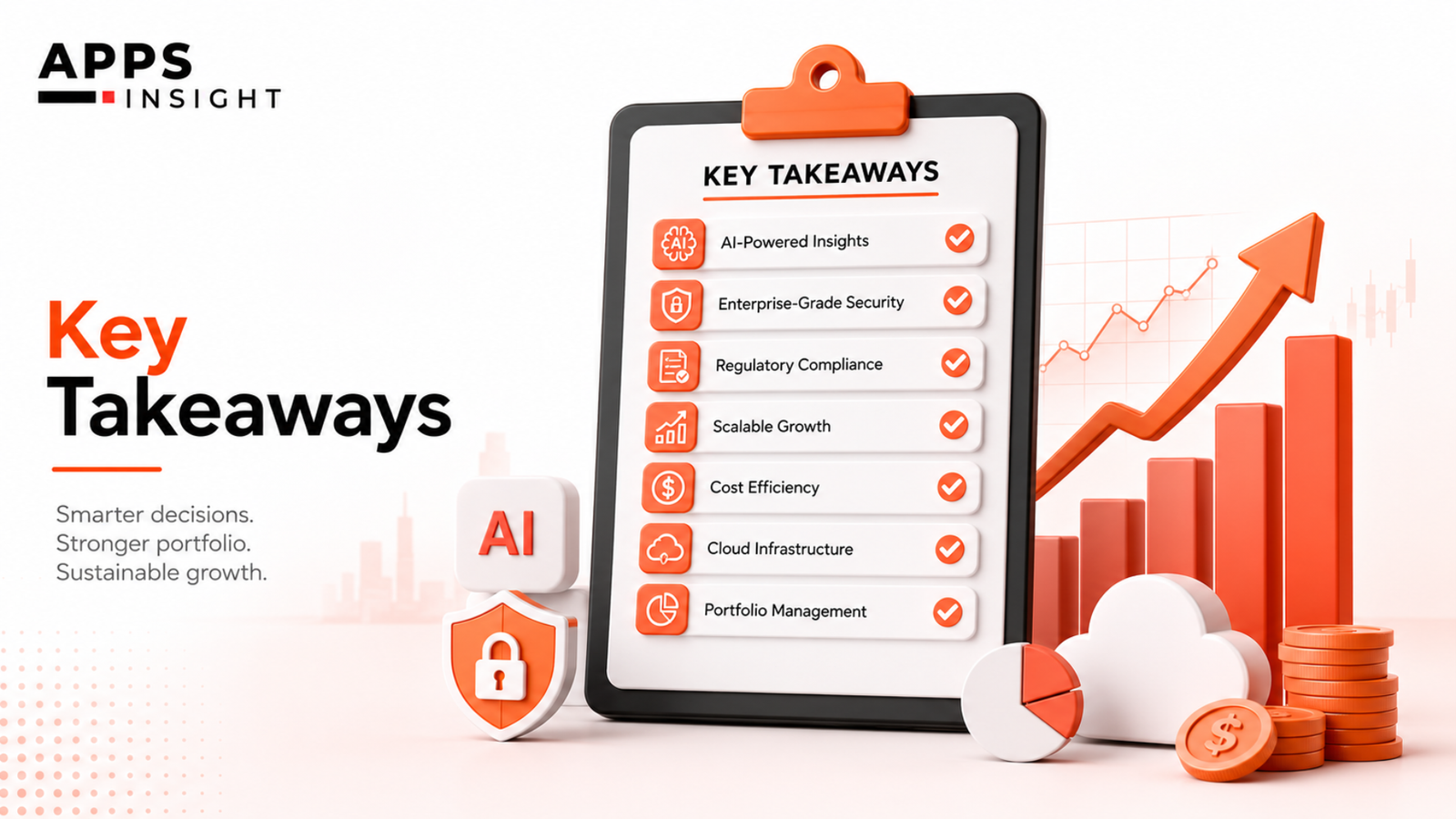
Key Takeaways (Related Statistics)
- The global wealth management software market is projected to reach $6.82 billion in 2026 and grow to $11.82 billion by 2031, expanding at a compound annual growth rate (CAGR) of 11.63%. This rapid growth is fueled by AI innovation, digital transformation, and the anticipated $84 trillion intergenerational wealth transfer, making modern wealth management platforms a strategic necessity rather than a competitive advantage.
- Wealth management software development costs typically range from $80,000 to more than $500,000, depending on platform complexity. While many businesses focus on user interface design, the largest investments usually come from custodian integrations, regulatory compliance, security architecture, and enterprise-level scalability.
- Choosing between custom development, off-the-shelf software, or a hybrid approach is one of the most critical technology decisions for wealth management firms. Each option has unique benefits, limitations, and long-term implications for cost, flexibility, and future growth.
- Regulatory compliance should be built into the platform from the very beginning. Essential requirements such as KYC, AML, SEC Rule 17a-4, GDPR, and SOC 2 Type II must be incorporated during the development phase to reduce legal risks, simplify audits, and ensure long-term operational stability.
- Seamless integrations with leading custodians like Charles Schwab, Fidelity, Pershing, and Orion are indispensable for delivering a unified client experience. These integrations significantly impact both the project budget and development timeline, yet they are often underestimated during planning.
- Artificial intelligence has become a major competitive differentiator in wealth management. Today, 45% of wealth management firms leverage AI-powered analytics, while organizations adopting automation have reported up to a 30% increase in advisor productivity, enabling faster decision-making, personalized investment recommendations, and improved client engagement.
Wealth Management Software Development: Quick Overview
As digital transformation continues to reshape the financial services industry, wealth management software has become an essential investment for financial advisors, private banks, broker-dealers, and family offices. Modern platforms combine advanced analytics, AI-powered automation, regulatory compliance, and seamless third-party integrations to deliver personalized investment experiences while improving operational efficiency.
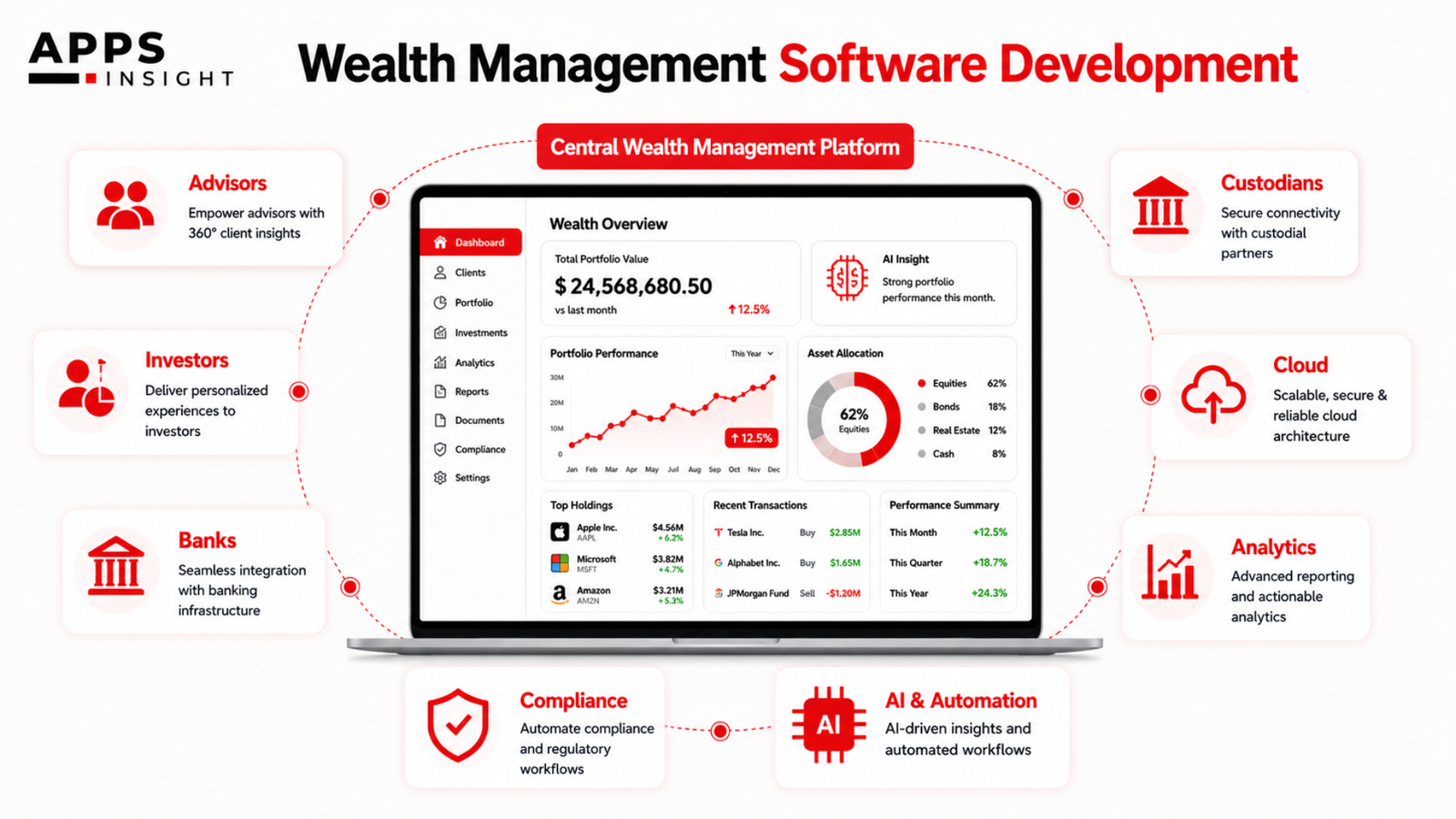
The table below provides a snapshot of the current wealth management software market, estimated development costs, timelines, essential technologies, and key compliance requirements.
| Aspect | Overview |
|---|---|
| Global Market Value (2026) | $6.82 billion, reflecting the growing demand for digital wealth management platforms. |
| Expected Market Value (2031) | Forecasted to reach $11.82 billion, expanding at a CAGR of 11.63%. |
| Estimated Development Cost | Typically ranges from $80,000 to $500,000+, depending on platform complexity, integrations, and regulatory requirements. |
| Average Development Timeline | Around 6 to 18 months, from developing an MVP to launching a fully featured enterprise solution. |
| Primary Users | Registered Investment Advisors (RIAs), private banks, family offices, broker-dealers, and financial institutions. |
| Essential Third-Party Integrations | Charles Schwab, Fidelity, Pershing, Plaid, Bloomberg, Refinitiv, and other financial data providers. |
| Regulatory & Compliance Standards | SEC Rule 17a-4, FINRA Rule 3310, KYC/AML regulations, SOC 2 Type II, GDPR, and CCPA. |
| Preferred Technology Stack | Cloud-native infrastructure (AWS or Microsoft Azure), React or Angular for frontend, Python or Node.js for backend, and API-first architecture. |
| AI-Powered Capabilities | Intelligent portfolio analytics, personalized investment recommendations, automated portfolio rebalancing, predictive insights, and AI-generated financial reporting using NLP. |
| Deployment Strategy | A hybrid development approach remains the preferred choice for established financial organizations looking to modernize legacy systems while retaining existing infrastructure. |
Sources: Mordor Intelligence (2026), Emerline (2026), 360 Research Reports (2025), Grand View Research (2024).
What Does Wealth Management Software Do?
Wealth management software is a comprehensive digital platform designed to help financial advisors, wealth managers, investment firms, and financial institutions manage every aspect of client wealth from a single, centralized system. It streamlines portfolio management, financial planning, client relationship management (CRM), regulatory compliance, reporting, and communication, allowing firms to deliver more personalized and efficient financial services.

Rather than functioning as just another reporting tool, modern wealth management software acts as the core technology foundation of a wealth advisory business. It consolidates client data, investment portfolios, financial plans, and compliance processes into one intelligent platform, eliminating the need to switch between multiple disconnected applications.
For advisors, it automates routine tasks, improves operational efficiency, and provides deeper insights into client portfolios. For clients, it offers secure, real-time access to investments, financial goals, performance reports, and important documents, creating greater transparency and trust throughout the advisory relationship.
One of the biggest advantages of a dedicated wealth management platform is its ability to integrate critical business functions into a unified ecosystem. Instead of relying on separate tools for CRM, portfolio management, financial planning, compliance, and reporting, firms can manage everything from a single source of truth. This reduces manual work, minimizes errors, improves collaboration, and enables advisors to focus more on strategic client relationships rather than administrative tasks.
For established wealth management firms, the difference is significant. A disconnected collection of software tools often leads to data silos, duplicated work, operational inefficiencies, and inconsistent client experiences. In contrast, a purpose-built wealth management platform becomes the firm’s central operating system, providing scalability, automation, and a competitive advantage in an increasingly digital financial landscape.
Understanding the capabilities of wealth management software is only the first step. The more important question for many firms is whether their existing technology can support future growth. As client expectations evolve, regulatory requirements become more complex, and AI-driven financial services continue to reshape the industry, 2026 is emerging as the turning point when modernizing wealth management technology is no longer optional but a strategic necessity.
Why 2026 Marks a Turning Point for Wealth Management Firms
The wealth management industry is entering one of the biggest transformations in its history. Client expectations are evolving, digital technologies are advancing rapidly, and competition is intensifying. Firms that continue relying on legacy systems risk losing clients, reducing advisor productivity, and falling behind more innovative competitors.
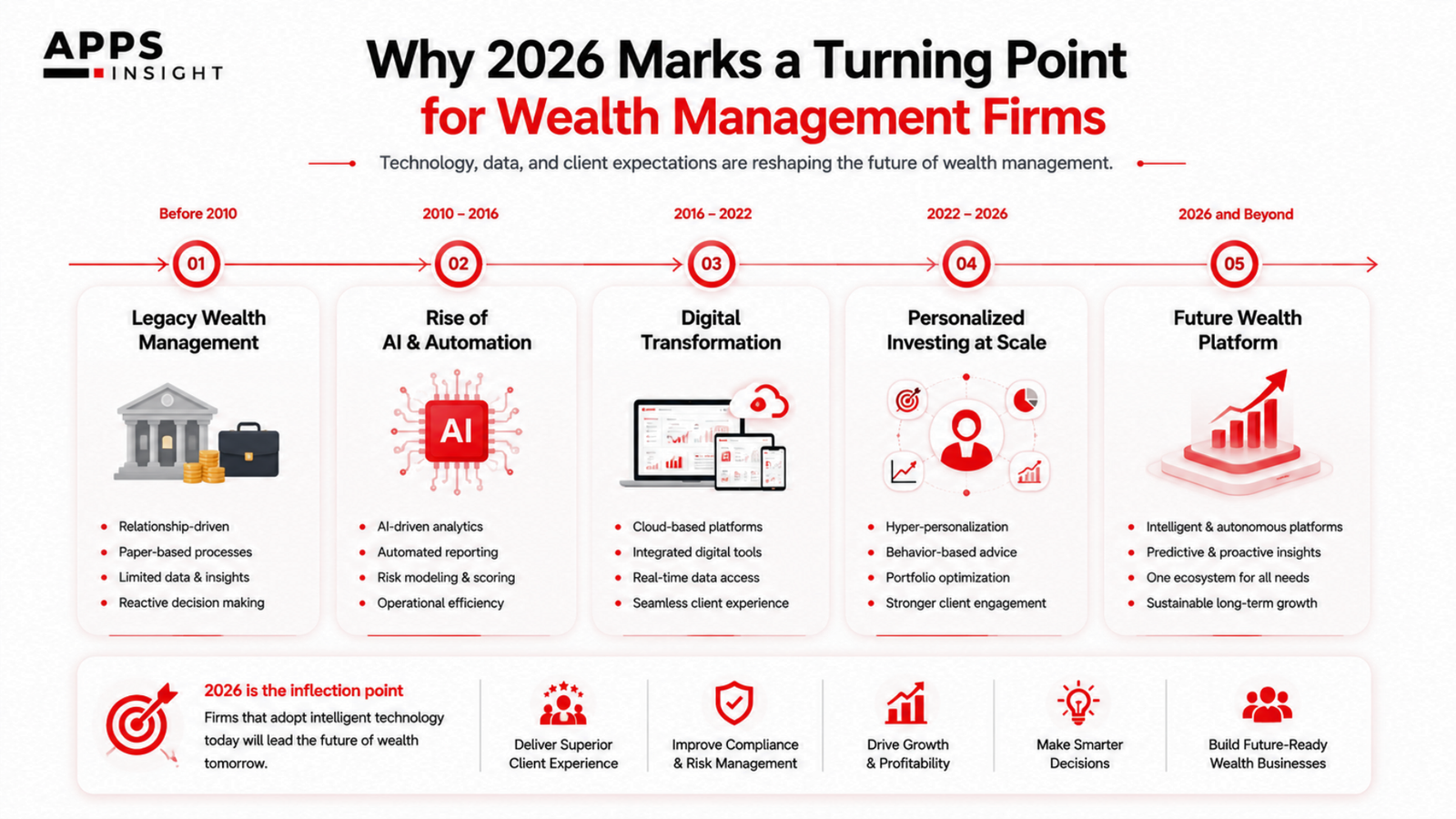
Here are the key reasons why 2026 represents a defining moment for wealth management firms.
1) The $84 Trillion Wealth Transfer Is Reshaping the Industry
A historic transfer of wealth is already underway. According to 360 Research Reports, nearly $84 trillion in assets is expected to change hands over the next two decades. Much of this wealth will move to younger generations who have grown up in a digital-first world.
Unlike previous generations, these investors expect fast, intuitive, and personalized digital experiences. They compare their wealth management platform with the mobile apps they already use for banking, investing, and financial planning. Slow, outdated systems no longer meet these expectations.
As this new generation of investors becomes the primary client base, wealth management firms must modernize their digital offerings to remain competitive and retain long-term relationships.
2) Client Retention Has Become a Technology Challenge
Building trust through financial advice remains essential, but technology now plays an equally important role in retaining clients.
Research from PwC reveals that nearly 50% of high-net-worth individuals under the age of 45 would consider switching to providers offering superior digital experiences, including robo-advisory platforms and AI-powered investment services.
Today’s investors expect seamless onboarding, real-time portfolio insights, secure communication, and personalized recommendations. If a firm’s technology cannot deliver these capabilities, even the strongest advisor-client relationship may not be enough to prevent client attrition.
In today’s market, outstanding advisors need equally outstanding digital platforms to support client satisfaction and loyalty.
3) Financial Institutions Are Accelerating Technology Investments
Leading financial organizations are not waiting to embrace digital transformation.
Industry reports from 2025-2026 indicate that 68% of financial institutions have increased their technology budgets to improve digital capabilities and meet the growing expectations of modern investors.
These investments include AI-powered analytics, cloud infrastructure, cybersecurity, automation, digital onboarding, and enhanced client engagement tools.
Firms that postpone modernization are not simply maintaining the status quo. They are steadily losing ground to competitors that continue investing in innovation and delivering better client experiences.
4) The Advisor Productivity Gap Continues to Grow
Technology is also transforming how financial advisors work.
According to The Wealth Mosaic, approximately 45% of wealth managers now use AI-driven analytics to improve investment decisions and client servicing. Firms implementing intelligent automation also report up to a 30% increase in advisor productivity by reducing manual administrative work and streamlining routine processes.
Automation allows advisors to spend less time on repetitive tasks and more time building client relationships, providing strategic guidance, and identifying new business opportunities.
As AI adoption accelerates, the productivity gap between digitally advanced firms and those relying on manual workflows continues to widen. Every quarter without modernization makes it increasingly difficult for traditional firms to catch up.
The evidence is clear. Massive generational wealth transfer, rising client expectations, increased technology investment, and AI-driven operational efficiency are fundamentally changing the wealth management landscape.
Understanding these industry shifts is only the first step. The real opportunity lies in building a modern wealth management platform that delivers exceptional client experiences, empowers advisors, and positions firms for sustainable growth.
The convergence of multiple industry trends is creating an unprecedented opportunity for forward-thinking firms.
A historic $84 trillion wealth transfer, rising demand for personalized digital experiences, rapid AI adoption, and increasing technology investments are collectively reshaping the wealth management landscape.
Success in 2026 will no longer depend solely on investment expertise. It will also depend on a firm’s ability to deliver secure, intelligent, and highly personalized digital experiences that meet the expectations of modern investors.
Organizations that embrace innovation today will strengthen advisor productivity, deepen client relationships, and build a sustainable competitive advantage for the future. Those that delay digital transformation risk becoming increasingly disconnected from the evolving needs of both clients and advisors. The firms leading the next generation of wealth management are not simply investing in technology. They are investing in a better client experience, smarter operations, and long-term growth.
Types of Wealth Management Software Development Platforms
The wealth management technology landscape has evolved far beyond basic portfolio tracking. Modern firms need specialized platforms that support investment management, financial planning, compliance, client engagement, and multi-asset reporting. Choosing the right software depends on your business model, target clients, and operational requirements.
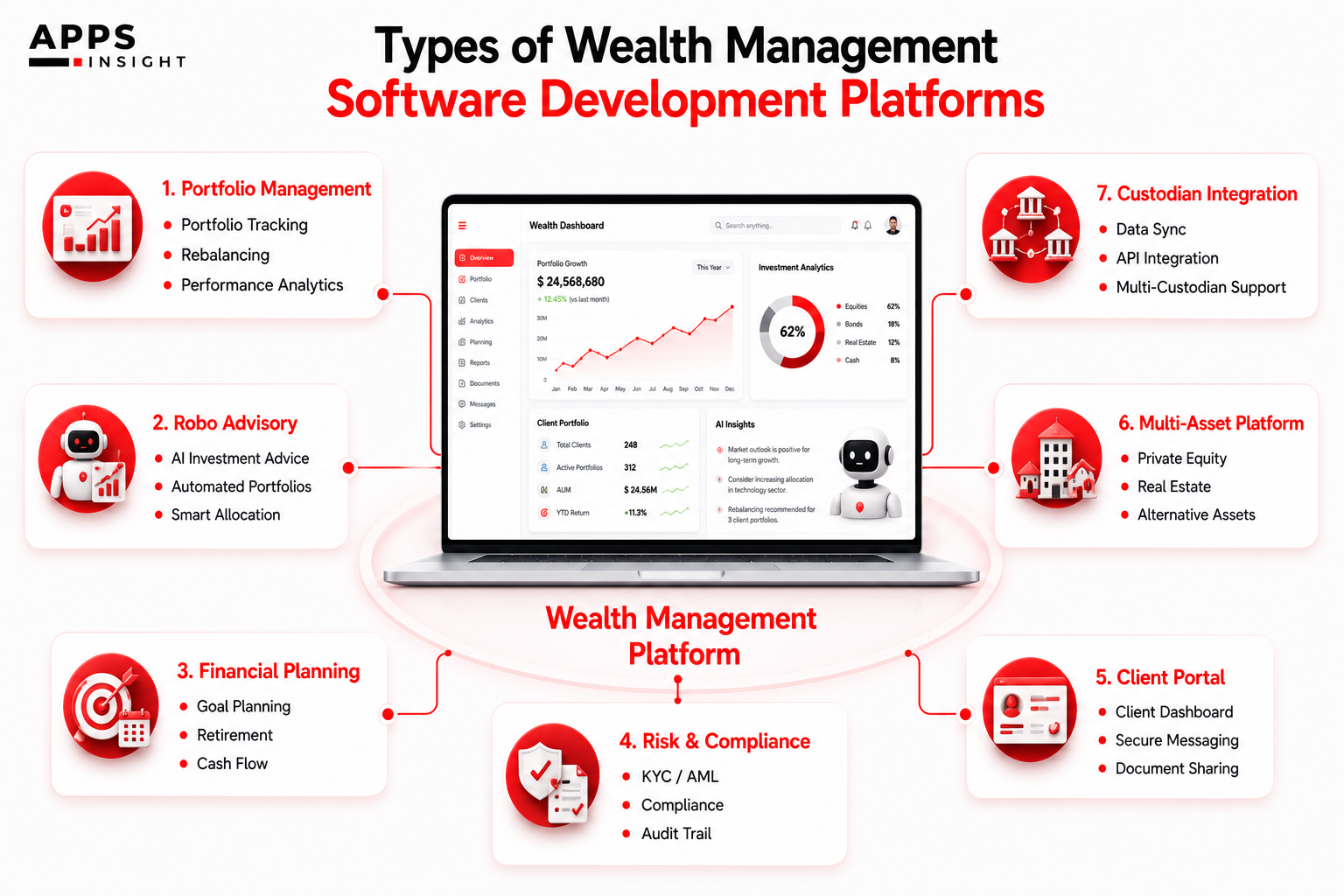
The table below highlights the most common types of wealth management software platforms, their primary use cases, ideal buyers, and leading examples.
| Platform Type | Primary Purpose | Ideal Users | Popular Solutions |
|---|---|---|---|
| Portfolio Management Software | Monitors investment portfolios, automates portfolio rebalancing, and provides performance reporting and analytics. | Registered Investment Advisors (RIAs), wealth managers, asset management firms | Orion, Tamarac, Black Diamond |
| Robo-Advisory Platforms | Uses AI-powered algorithms to automate portfolio recommendations, investment allocation, and ongoing portfolio management. | Digital wealth platforms, fintech startups, neobanks | Betterment for Advisors, SigFig |
| Financial Planning Software | Supports retirement planning, goal-based investing, cash flow forecasting, tax planning, and scenario modeling. | Financial advisors, private banks, wealth planning firms | eMoney Advisor, MoneyGuidePro |
| Risk & Compliance Management Systems | Automates KYC, AML verification, regulatory reporting, audit trails, and compliance monitoring to reduce operational risk. | Banks, brokerages, investment firms, and all regulated financial institutions | Fenergo, NICE Actimize, Compliance Solutions |
| Client Portal & Communication Platforms | Provides secure client dashboards, document sharing, portfolio access, messaging, and appointment scheduling. | Wealth management firms, financial advisors, family offices | Orion, Envestnet, Custom-Built Portals |
| Multi-Asset & Family Office Platforms | Manages diverse asset classes such as private equity, real estate, hedge funds, collectibles, and alternative investments from a single platform. | Family offices, Ultra-High-Net-Worth Individuals (UHNWIs), institutional investors | Addepar, Archway, Enterprise Solutions |
| Custodian Integration Middleware | Connects multiple custodians to centralize financial data, automate synchronization, and improve reporting accuracy. | Multi-custodian investment firms and enterprise wealth management companies | Plaid, Yodlee, Proprietary API Integrations |
Which Platform Is Right for Your Business?
The ideal wealth management software depends on the services your organization provides.
- Investment advisory firms typically benefit most from portfolio management software.
- Fintech companies and digital investment platforms often choose robo-advisory solutions to automate investment decisions.
- Private banks and financial advisors rely on comprehensive financial planning software to deliver personalized advice.
- Regulated financial institutions require robust compliance and risk management systems to meet industry regulations.
- Family offices need multi-asset platforms capable of tracking both traditional and alternative investments.
- Enterprise wealth management firms frequently integrate multiple custodians through middleware to streamline operations and provide a unified client experience.
By understanding these platform categories, businesses can invest in technology that aligns with their long-term goals, improves operational efficiency, enhances client satisfaction, and supports scalable growth.
Top Features Every Wealth Management Software Should Have
A successful wealth management platform is much more than a portfolio tracking tool. It is a comprehensive digital ecosystem that brings together financial advisors, investors, and business operations in one secure and intelligent environment. Each component plays a specific role, but together they streamline wealth management, improve client experiences, and support better financial decisions.
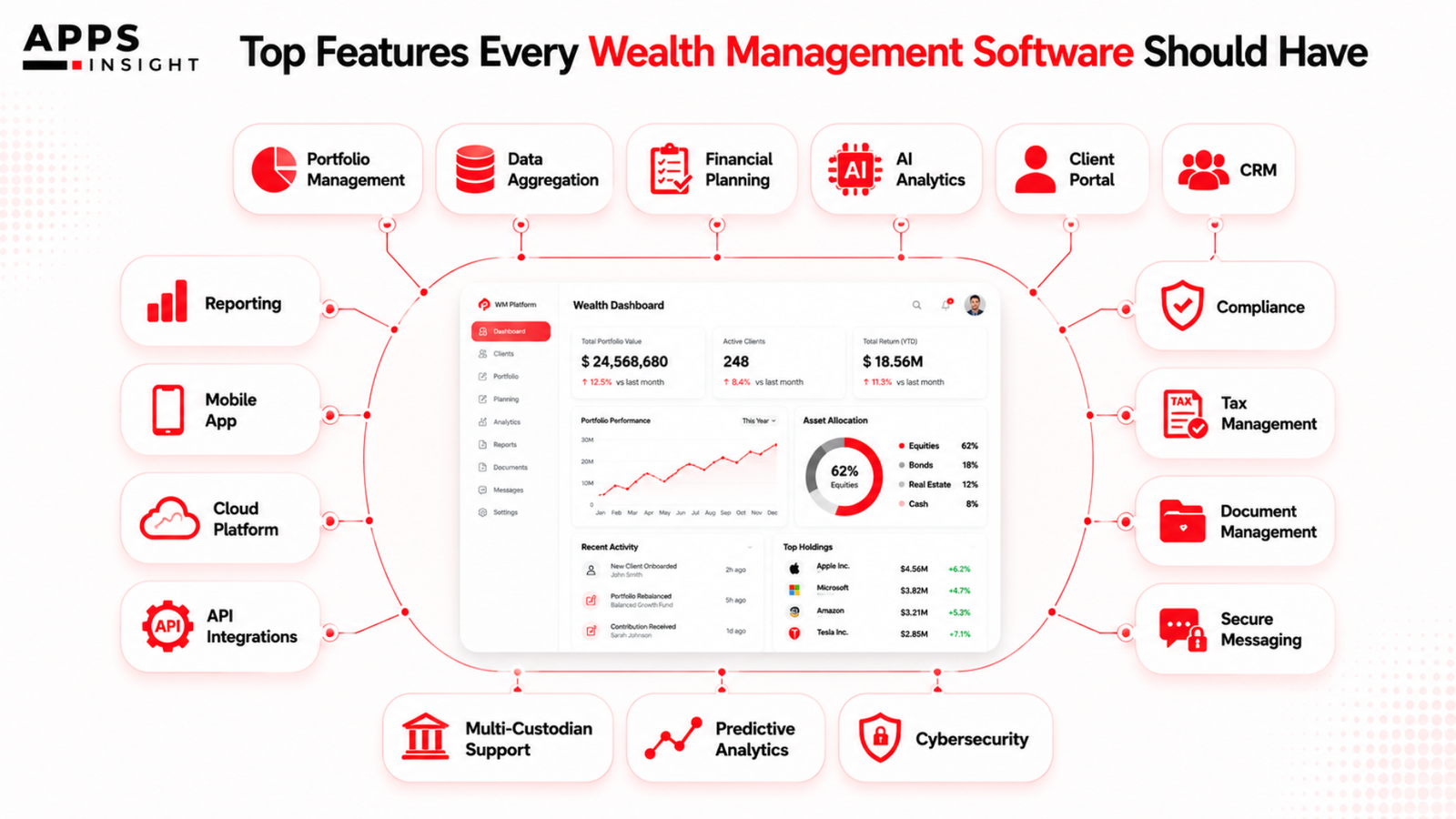
Here are the six essential features every modern wealth management software solution should include.
1. Unified Data Aggregation
The foundation of any wealth management platform is its ability to collect and unify financial data from multiple sources. This includes banks, custodians, investment platforms, brokerage accounts, and third-party financial service providers.
By consolidating information into a single dashboard, advisors gain a real-time view of every client’s financial portfolio. This eliminates manual data collection, reduces inconsistencies, and ensures that investment decisions are based on the most accurate and up-to-date information available.
Without centralized data aggregation, other features within the platform cannot perform efficiently because they rely on incomplete or outdated information.
2. Portfolio Management and Investment Analytics
Portfolio management is the core functionality of any wealth management solution. It enables advisors to monitor investments, build diversified portfolios, and optimize asset allocation based on client goals and market conditions.
A modern portfolio management engine should support:
- Portfolio construction
- Automated portfolio rebalancing
- Performance tracking and attribution
- Risk analysis
- Tax-loss harvesting
- Real-time investment monitoring
Since financial advisors use this module throughout their daily workflow, it must provide fast processing, accurate analytics, and seamless integration with live custodian and brokerage data.
3. Financial Planning and Goal-Based Forecasting
Clients expect more than investment advice. They want personalized financial guidance that helps them achieve long-term objectives.
Financial planning tools allow advisors to create customized strategies by modeling various life scenarios, including retirement planning, education funding, wealth preservation, estate planning, and major investments.
Interactive “what-if” simulations help clients understand how different financial decisions impact their future. These visual planning capabilities also strengthen client relationships by making complex financial concepts easier to understand.
Additionally, a robust financial planning module encourages long-term client retention by continuously demonstrating measurable financial progress.
4. Compliance and Regulatory Management
Regulatory compliance is one of the most critical components of wealth management software. Financial institutions operate under strict regulations, making automated compliance workflows essential for reducing operational risks.
An effective compliance module should include:
- Know Your Customer (KYC) verification
- Anti-Money Laundering (AML) screening
- Client suitability assessments
- Audit trail management
- Regulatory reporting
- Document verification
Many organizations make the mistake of treating compliance as an afterthought. In reality, compliance should be built into the software architecture from the beginning. Incorporating these capabilities during the initial development phase minimizes future compliance risks, avoids costly redesigns, and helps organizations maintain regulatory standards from day one.
5. Client Portal and Communication Center
Today’s investors expect convenient digital access to their financial information anytime and from anywhere.
A secure client portal allows users to:
- Monitor portfolio performance in real time
- Access financial reports and documents
- Exchange secure messages with advisors
- Review investment recommendations
- Upload and download important files
- Schedule meetings
By reducing dependency on phone calls and emails, a self-service client portal improves operational efficiency while significantly enhancing the overall customer experience.
For many prospective clients, the client portal serves as the first impression of a firm’s digital capabilities, making it a crucial feature for attracting and retaining investors.
6. AI-Powered Personalization and Intelligent Automation
Artificial intelligence is transforming wealth management by making financial services smarter, faster, and more personalized.
AI-powered wealth management software can analyze massive volumes of financial data to generate personalized investment recommendations, forecast cash flow, identify investment opportunities, and assist advisors with data-driven decision-making.
Key AI capabilities include:
- Personalized investment recommendations
- Predictive cash flow forecasting
- Next-best-action suggestions for advisors
- Automated portfolio insights
- Intelligent risk analysis
- Meeting note generation
- Automated portfolio rebalancing recommendations
According to Mordor Intelligence (2026), generative AI copilots can now prepare meeting summaries and portfolio rebalancing recommendations within seconds, helping financial firms reduce administrative workloads by approximately 20% to 30%. This allows advisors to dedicate more time to client relationships, strategic financial planning, and business growth instead of repetitive administrative tasks.
Organizations that invest in these essential capabilities can improve operational efficiency, deliver highly personalized financial services, strengthen regulatory compliance, and build long-lasting relationships with their clients in an increasingly competitive financial landscape.
We have listed! Top AI-Powered App Features Every Business Will Use
Essential Features Every Wealth Management Software Needs in 2026
Building wealth management software isn’t just about adding a long list of features. Success comes from implementing capabilities that deliver exceptional client experiences, improve advisor productivity, and ensure regulatory compliance. As investor expectations continue to evolve, firms need intelligent, scalable, and future-ready platforms that go far beyond traditional portfolio management.
Here are the essential features every modern wealth management software solution should include in 2026.
1) Custodian & Multi-Source Data Aggregation
One of the most critical components of wealth management software is the ability to aggregate financial data from multiple custodians and investment platforms. Leading firms typically rely on providers such as Charles Schwab, Fidelity, Pershing, and Orion, making seamless API integrations a necessity rather than a luxury.
Real-time data synchronization enables advisors to access consolidated portfolio information, generate accurate reports, and provide clients with a complete financial picture from a single dashboard.
Since custodian integrations involve extensive API development, data mapping, testing, and security validation, businesses should allocate 20% to 30% of their overall development budget specifically for this functionality.
2) AI-Powered Personalization & Predictive Analytics
Artificial intelligence is rapidly transforming how wealth management firms engage with clients. Investors now expect financial recommendations tailored to their individual goals, ESG preferences, lifestyle, and risk tolerance rather than generic investment advice.
Modern AI engines analyze dozens of behavioral and financial data points during every client interaction to generate personalized recommendations, identify investment opportunities, and predict future financial outcomes.
By leveraging predictive analytics, advisors can:
- Deliver personalized portfolio recommendations
- Identify potential investment risks earlier
- Improve client engagement
- Increase long-term client retention
- Offer proactive financial guidance
AI-driven personalization has become a competitive advantage that leading wealth management firms can no longer ignore.
3) Interactive Financial Planning & Scenario Modeling
Today’s investors want more than static reports. They expect interactive tools that allow them to visualize their financial future and make informed decisions.
Modern wealth management platforms should include scenario modeling capabilities such as:
- Retirement planning simulations
- Estate planning visualizations
- Tax impact projections
- Education funding calculators
- “What-if” investment scenarios
Interactive planning tools encourage clients to actively participate in financial decision-making, strengthening advisor relationships and improving retention. When users can explore different financial outcomes themselves, they are far more likely to remain engaged with the platform.
4) Automated Portfolio Rebalancing & Tax-Loss Harvesting
Managing investment portfolios manually becomes increasingly difficult as client assets grow. Automated portfolio rebalancing ensures portfolios consistently align with each client’s investment objectives without requiring constant advisor intervention.
In addition, automated tax-loss harvesting helps investors reduce taxable gains while improving after-tax returns.
The benefits include:
- Consistent portfolio allocation
- Reduced manual workload
- Better tax efficiency
- Improved investment performance
- Higher client satisfaction
These automation capabilities not only increase operational efficiency but also provide measurable value that clients can clearly see in their investment performance.
5) Compliance-Ready Audit Trails & Regulatory Reporting
Regulatory compliance remains one of the most important aspects of wealth management software development.
Every recommendation, communication, transaction, and portfolio adjustment must be securely recorded in accordance with regulations established by organizations such as the SEC and FINRA.
A robust audit trail should include:
- Complete activity logs
- Time-stamped transaction history
- Advisor communication records
- Portfolio modification tracking
- Regulatory reporting tools
Rather than treating compliance as an additional feature, developers should build it directly into the platform’s architecture from the beginning to minimize legal risks and simplify future audits.
6) Open API Architecture for Seamless Integrations
Modern wealth management firms use numerous third-party applications to support client onboarding, CRM, financial planning, analytics, document management, and compliance workflows.
For this reason, today’s platforms should be designed using an open API architecture that allows effortless integration with existing and future business tools.
An API-first approach enables organizations to:
- Connect multiple financial applications
- Integrate CRM and accounting software
- Synchronize client data automatically
- Expand platform functionality over time
- Avoid dependence on a single technology vendor
Flexible integration capabilities make wealth management software significantly more scalable and adaptable as business requirements evolve.
7) Multi-Asset & Multi-Currency Portfolio Management
High-net-worth individuals, family offices, and international investors often manage highly diversified portfolios that extend well beyond traditional stocks and bonds.
A future-ready wealth management platform should support multiple asset classes, including:
- Public equities
- Private equity
- Real estate investments
- Fixed income securities
- Alternative investments
- Collectibles
- Digital assets
- Multiple global currencies
Supporting multi-asset and multi-currency portfolios enables advisors to deliver a unified investment experience for clients with complex financial holdings while expanding opportunities to serve international markets.
Platforms limited to traditional public market investments may struggle to meet the needs of today’s sophisticated investors, many of whom control substantial assets under management (AUM).
Build vs. Buy vs. Hybrid: Choosing the Right Development Strategy for Wealth Management Software
When planning wealth management software, many firms assume they have only two choices: build a custom platform from scratch or purchase an off-the-shelf solution. In reality, this decision is much more strategic than it appears.
Instead of asking “Should we build or buy?”, firms should ask:
Which parts of our technology give us a competitive advantage, and which functions are simply standard business requirements?
The answer to this question shapes the most effective technology strategy. Custom development should focus on areas that differentiate your business, while standardized capabilities can often be purchased or integrated through trusted third-party solutions. This balanced approach allows firms to innovate without reinventing every component.
Build vs. Buy vs. Hybrid: A Comparison for Wealth Management Firms
| Criteria | Build Custom | Buy Off-the-Shelf | Hybrid (Build Core, Buy Modules) |
|---|---|---|---|
| Best For | Firms with proprietary investment strategies and unique advisory services | Organizations seeking rapid implementation with minimal internal IT resources | Mid-sized and enterprise wealth firms modernizing existing technology |
| Time to Market | 12 to 24 months | 2 to 6 months | 6 to 12 months |
| Initial Investment | $200,000 to $500,000+ | $50,000 to $150,000 per year (licensing) | $120,000 to $300,000+ |
| Customization | Complete flexibility | Limited to vendor capabilities | Extensive customization for core functions with pre-built modules |
| Compliance Management | Full control over compliance processes | Managed according to vendor standards | Shared responsibility that requires clear governance |
| Custodian Integrations | Fully customized integrations | Depends on vendor support | Best implemented within the custom-built core platform |
| Scalability | Designed specifically for business growth | Limited by vendor pricing and architecture | Highly scalable with the flexibility to replace modules when needed |
| Vendor Lock-In | None | High | Low to moderate |
| Ideal Use Case | Private banks and family offices with specialized investment models | RIAs looking for fast digital transformation | Most established wealth management firms |
Why the Hybrid Approach Is Becoming the Preferred Choice
For many established wealth management firms, a hybrid development strategy offers the best balance between flexibility, speed, and cost.
Critical systems such as compliance management, client data aggregation, portfolio intelligence, and operational workflows often reflect a firm’s unique business processes. These core capabilities are difficult to standardize and are better developed in-house or through custom software development.
On the other hand, customer-facing features such as financial planning tools, client portals, reporting dashboards, and digital experience modules are widely available as mature third-party solutions. Integrating these proven applications reduces development time while maintaining a high-quality user experience.
By combining custom-built strategic capabilities with best-in-class software modules, firms can create a modern technology ecosystem that is easier to scale, maintain, and enhance over time.
After determining which components to build and which to purchase, the next step is implementing your technology roadmap in a way that maintains regulatory compliance, minimizes operational risk, and supports long-term business growth.
Essential Integrations Every Wealth Management Software Should Include
The success of wealth management software depends not only on its features but also on how well it integrates with third-party financial systems. Even the most advanced platform can fall short if it cannot communicate seamlessly with custodians, banking networks, market data providers, and trading systems.
Choosing the right integrations during the planning stage helps improve operational efficiency, ensures data accuracy, and delivers a better client experience. Below are the most important integrations every wealth management platform should consider.
1. Custodian Integrations (Schwab, Fidelity, Pershing, Orion)
Custodian integration forms the foundation of any modern wealth management platform. Since custodians hold and safeguard client assets, your software must communicate with them continuously to retrieve portfolio data, transaction history, account balances, and investment activity.
Leading custodians such as Schwab, Fidelity, Pershing, and Orion manage a significant share of Registered Investment Advisor (RIA) assets across the United States. Integrating with these providers involves much more than connecting an API. It requires extensive data mapping, normalization, synchronization, and reconciliation to ensure portfolio information remains accurate across systems.
If your platform supports multiple custodians, expect this integration to consume 20% to 30% of the overall development budget. Although it represents a substantial investment, it is a critical requirement for any scalable wealth management solution.
2. Market Data Integrations (Bloomberg, Refinitiv, Morningstar)
Reliable market data is essential for delivering accurate portfolio insights and investment recommendations. Integrating premium financial data providers such as Bloomberg, Refinitiv, and Morningstar enables your platform to access:
- Real-time stock prices
- Market indices
- Security reference data
- Historical market information
- Alternative investment datasets
This information powers essential features including portfolio tracking, investment performance reporting, financial planning, risk analysis, and AI-driven recommendations.
Most market data providers operate on subscription-based licensing models and expose data through APIs. Because these APIs often include request limits and availability restrictions, developers must implement proper rate-limit handling, caching strategies, and failover mechanisms. Without these safeguards, outdated market information can lead to inaccurate reporting and reduced client confidence.
3. Banking and Payment Integrations (Plaid, FDX API, Open Banking)
Modern wealth management platforms increasingly offer services beyond investment management, including cash management, direct indexing, automated funding, and alternative investment access. To support these capabilities, seamless banking integration is essential.
Popular technologies include:
- Plaid
- FDX API
- Open Banking APIs
These integrations allow users to securely connect bank accounts, transfer funds, verify financial information, and synchronize banking activity with investment accounts.
As the FDX API continues to emerge as the standard for open banking in the United States, businesses developing wealth management software should include it in their long-term integration strategy. Planning for banking connectivity early in the development lifecycle helps avoid costly architectural changes later.
4. Authentication and Identity Verification (OAuth, SAML, Biometric Verification)
Security and user experience are equally important in financial software. Modern wealth management platforms rely on robust authentication technologies to protect sensitive financial information while simplifying client onboarding.
Common authentication technologies include:
- OAuth 2.0 for secure third-party integrations
- SAML for enterprise single sign-on (SSO)
- Biometric authentication
- OCR-based document verification
- Liveness detection
These technologies streamline identity verification, reduce fraud risks, and significantly shorten the account opening process. Industry research indicates that combining biometric verification with automated document recognition can reduce onboarding time from several days to just a few minutes.
Beyond improving security, a faster onboarding experience helps firms acquire and retain more clients by removing unnecessary friction during registration.
5. FIX Protocol Integration for Institutional Trading
For enterprise-grade wealth management platforms serving institutional investors, hedge funds, or broker-dealers, FIX (Financial Information eXchange) Protocol integration is often indispensable.
FIX is the global messaging standard used for electronic trading between financial institutions. It enables secure, high-speed communication for:
- Order routing
- Trade execution
- Trade confirmations
- Market connectivity
- Prime broker communication
Because FIX integration affects the core architecture of a trading platform, it should be planned during the initial solution design phase. Attempting to introduce FIX support later in development often results in expensive redesigns, additional testing, and increased implementation time.
Third-party integrations determine how powerful, scalable, and reliable your wealth management software becomes. Whether it’s custodian connectivity, real-time market intelligence, secure banking infrastructure, identity verification, or institutional trading support, each integration plays a vital role in creating a seamless experience for advisors and investors.
By identifying and prioritizing these integrations early in the development process, businesses can reduce technical risks, improve operational efficiency, and build a future-ready wealth management platform capable of supporting long-term growth.
How to Ensure Wealth Management Software Meets Regulatory Compliance
Compliance is one of the most critical aspects of wealth management software development. Financial institutions manage highly sensitive client information, execute regulated transactions, and must comply with strict legal frameworks. Ignoring compliance during development can result in costly redesigns, regulatory penalties, and loss of customer trust.
Industry experts recommend allocating 15% to 25% of the total development budget specifically for compliance architecture, including legal requirements, security controls, and regulatory technologies. Investing in compliance from the beginning is significantly more cost-effective than attempting to retrofit a platform later, which can increase costs by three to five times.
Below are the essential compliance standards every wealth management platform should address.
Build Secure KYC and AML Workflows
An effective Know Your Customer (KYC) and Anti-Money Laundering (AML) framework is fundamental to any wealth management solution. Beyond meeting regulatory requirements, it also creates a seamless onboarding experience for clients.
Modern platforms use technologies such as OCR-based document verification, biometric identity verification, and liveness detection to validate users quickly while reducing fraud risks. Low-risk customers can often complete onboarding within minutes through automated verification.
However, automation alone is not enough. The software should also:
- Automatically assess customer risk levels
- Flag suspicious or incomplete applications
- Route high-risk cases for manual review
- Maintain a complete audit trail for continuous compliance monitoring
These capabilities should be integrated into the platform architecture from the start rather than added after deployment.
Design for SEC Rule 17a-4 Compliance
Organizations operating as broker-dealers or registered investment advisers must comply with SEC Rule 17a-4, which establishes strict requirements for electronic record retention.
One of the most important requirements is storing records in WORM (Write Once, Read Many) storage, ensuring information cannot be modified or deleted during the mandatory retention period.
Since this regulation directly impacts the platform’s storage infrastructure, WORM architecture should be planned during the initial system design. Attempting to implement it later often requires significant architectural changes and additional development costs.
Implement FINRA Rule 3310 AML Requirements
Financial firms must establish a comprehensive Anti-Money Laundering (AML) Program to comply with FINRA Rule 3310.
A wealth management platform should automatically monitor financial transactions and identify unusual activities that may indicate fraud or money laundering. The system should also support automated workflows for generating Suspicious Activity Reports (SARs) whenever regulatory thresholds are met.
Instead of relying on manual compliance processes, modern platforms should include these monitoring capabilities as built-in system functions, improving both efficiency and regulatory accuracy.
Prepare for SOC 2 Type II Certification
For companies serving enterprise clients, SOC 2 Type II has become one of the most requested security certifications.
Enterprise customers want assurance that their financial and personal data is protected through well-defined security controls and operational processes. Building the platform with SOC 2 requirements in mind from the beginning simplifies future certification efforts.
Early SOC 2 readiness offers several advantages:
- Reduces future compliance expenses
- Speeds up enterprise onboarding
- Builds customer confidence
- Strengthens your competitive position
- Demonstrates a commitment to data security
Rather than treating SOC 2 as an afterthought, it should be considered part of the overall product strategy.
Support GDPR, CCPA, and Global Data Privacy Regulations
If your wealth management software serves customers across multiple regions, complying with international privacy regulations is essential.
Frameworks such as the General Data Protection Regulation (GDPR) and the California Consumer Privacy Act (CCPA) require businesses to give users greater control over their personal information.
To remain compliant, your platform should be designed with features such as:
- Data residency management
- User consent tracking
- Right-to-access requests
- Right-to-erasure (Right to be Forgotten)
- Secure handling of personally identifiable information (PII)
These privacy requirements influence database structure, user permissions, and data architecture. Because of this, they should be incorporated during the planning and design stages instead of being introduced after development.
Prioritize Compliance from Day One
Regulatory compliance is not simply another feature on a development checklist. It forms the foundation of a secure, scalable, and trustworthy wealth management platform.
By integrating KYC and AML workflows, SEC and FINRA requirements, SOC 2 security standards, and global privacy regulations into the software architecture from the outset, businesses can reduce long-term development costs, minimize regulatory risks, and deliver a platform that financial institutions and investors can trust with confidence.
How to Build Wealth Management Software: A Step-by-Step Development Process
Building wealth management software is far more complex than creating a traditional SaaS application. These platforms handle highly sensitive financial information, integrate with multiple banking and investment systems, and must comply with strict regulatory standards. Every stage of development directly impacts security, compliance, scalability, and long-term operational success.
A well-planned development process minimizes risks, controls costs, and ensures your platform is ready for financial advisors, wealth managers, and clients from day one.
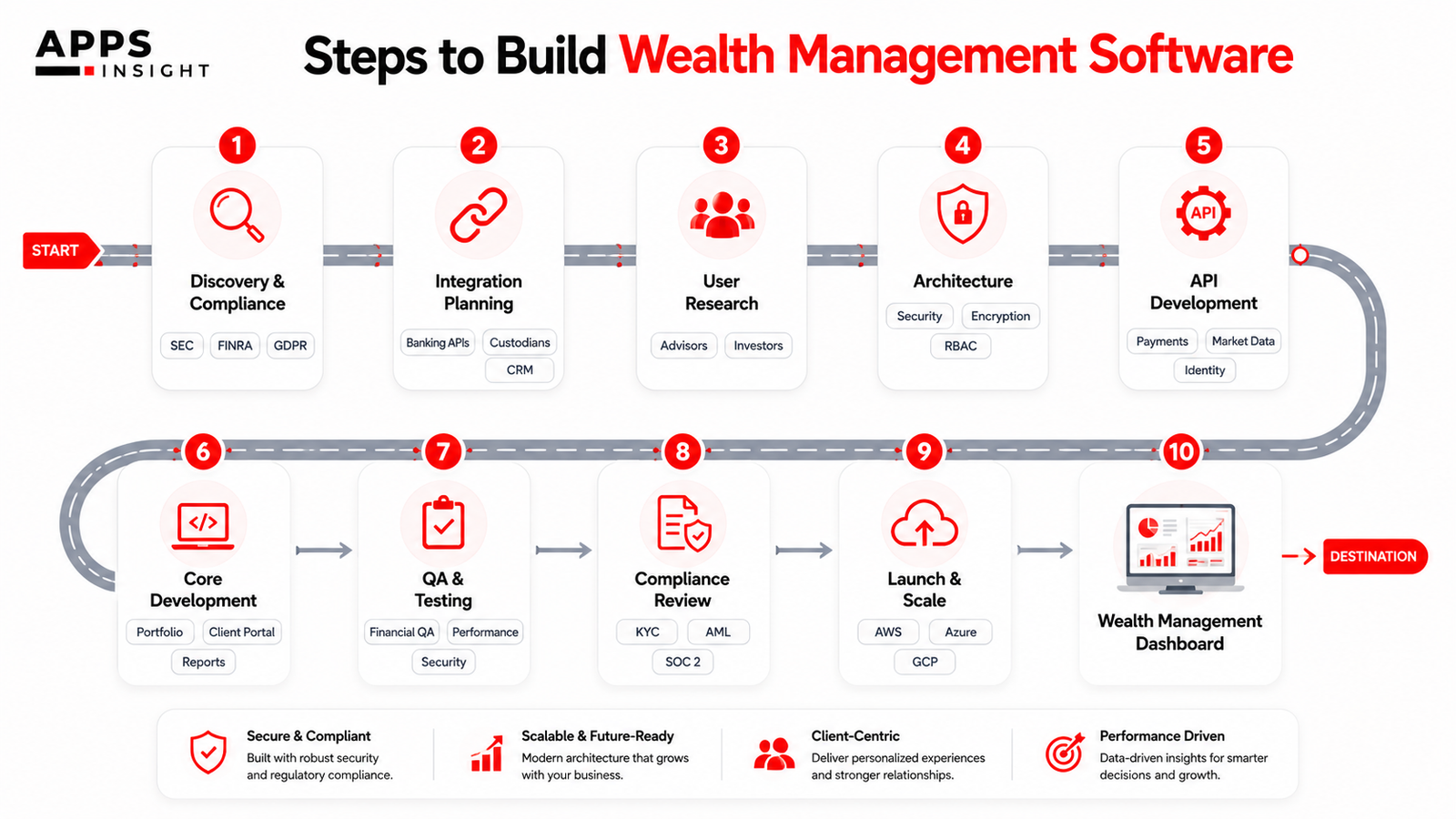
Step 1: Start with Discovery and Regulatory Planning
Estimated Timeline: 4 to 6 Weeks
Budget Allocation: Around 5%
Every successful wealth management platform begins with thorough planning. Before defining features or writing technical requirements, identify all regulatory standards your software must comply with.
Depending on your target market, these may include:
- SEC & FINRA regulations
- FCA compliance
- MiFID II
- GDPR
- Local financial regulations
These compliance requirements influence your platform architecture, data storage, security framework, and audit capabilities from the very beginning.
Skipping this phase often results in expensive redesigns later in the project, making it one of the most critical steps in the entire development lifecycle.
Step 2: Identify Every Integration Requirement
Estimated Timeline: 2 to 4 Weeks
Modern wealth management platforms rarely operate independently. They typically connect with multiple third-party systems, including:
- Custodian platforms
- Banking APIs
- Market data providers
- Payment gateways
- CRM platforms
- Legacy financial systems
Before estimating development costs, create a complete inventory of every required integration.
Since integrations consume a significant portion of development time and budget, understanding this complexity early allows for more accurate project planning and resource allocation.
Step 3: Research Users and Design the Right Experience
Estimated Timeline: 3 to 5 Weeks
Budget Allocation: Around 8%
Wealth management software serves two very different user groups:
- Financial advisors
- Clients or investors
Both have unique expectations.
Advisors prioritize speed, productivity, portfolio management, and workflow automation. Clients expect intuitive dashboards, investment transparency, and secure self-service capabilities.
Understanding both user journeys helps create an information architecture that balances advisor efficiency with an exceptional client experience.
Rather than treating UX as a visual exercise, it should become a strategic foundation for the entire product.
Step 4: Build a Compliance-First Architecture
Estimated Timeline: 4 to 6 Weeks
Budget Allocation: 15% to 25%
Before building the interface, establish the platform’s technical foundation.
This includes designing:
- Secure data models
- Audit trail architecture
- WORM (Write Once Read Many) storage
- Permission structures
- Role-based access control
- Encryption standards
Many businesses attempt to add compliance after development is complete.
Unfortunately, retrofitting regulatory controls can increase development costs by three to five times compared to implementing them during the architecture phase.
Getting the foundation right saves both time and money.
Step 5: Develop APIs and Third-Party Integrations
Estimated Timeline: 8 to 16 Weeks
Budget Allocation: 25% to 30%
The integration layer connects your platform with the broader financial ecosystem.
During this stage, developers build:
- Custodian integrations
- Market data feeds
- Banking connections
- Identity verification services
- Authentication systems
- Financial data synchronization
Since nearly every platform feature depends on these integrations, they become the project’s critical path.
Any delay here can impact the entire development schedule.
Step 6: Build Core Features Using Agile Development
Estimated Timeline: 12 to 20 Weeks
Budget Allocation: Around 30%
Once the platform architecture and integrations are ready, development moves into iterative Agile sprints.
Core modules typically include:
- Portfolio management
- Financial planning tools
- Client portal
- Advisor dashboard
- Compliance management
- Reporting and analytics
Instead of building isolated features across multiple modules, focus on delivering one complete advisor workflow from beginning to end.
This creates a functional MVP that delivers real business value while allowing continuous improvement based on user feedback.
Step 7: Perform Financial QA and Performance Testing
Estimated Timeline: 4 to 6 Weeks
Budget Allocation: Around 10%
Testing wealth management software goes beyond identifying software bugs.
The platform must also verify:
- Financial calculations
- Investment performance reports
- Portfolio allocations
- Tax calculations
- Risk assessment models
Every calculation should be validated against trusted financial benchmarks.
Additionally, conduct stress testing under high-load scenarios to ensure the platform remains stable during periods of heavy market activity, when advisors depend on the system the most.
Step 8: Complete Regulatory Review Before Launch
Estimated Timeline: 3 to 5 Weeks
Before deployment, perform a comprehensive legal and compliance assessment.
This typically includes:
- KYC workflow validation
- AML compliance verification
- WORM storage validation
- Security assessment
- SOC 2 Type II audit preparation
- Legal approval for production release
Avoid rushing this stage to meet launch deadlines.
Launching without proper compliance certification can expose the business to legal risks, regulatory penalties, and costly remediation efforts.
Step 9: Launch Gradually and Maintain the Platform
Timeline: Ongoing
Annual Budget Allocation: 15% to 20%
A successful launch doesn’t happen overnight.
Most financial organizations follow a phased deployment strategy:
- Launch with a small pilot group of advisors
- Expand across the organization
- Roll out to multiple offices and client groups
Deploying on cloud platforms such as AWS, Microsoft Azure, or Google Cloud Platform (GCP) provides the scalability, security, and performance required for enterprise financial applications.
After launch, ongoing maintenance remains essential and typically includes:
- Continuous system monitoring
- Security updates
- Performance optimization
- Compliance updates
- Infrastructure scaling
- Feature enhancements
Regular maintenance ensures the platform stays secure, compliant, and capable of supporting future business growth.
Developing wealth management software requires far more than coding features. Success depends on careful planning, regulatory compliance, secure architecture, seamless integrations, and continuous optimization after launch.
How Much Does It Cost to Build Wealth Management Software?
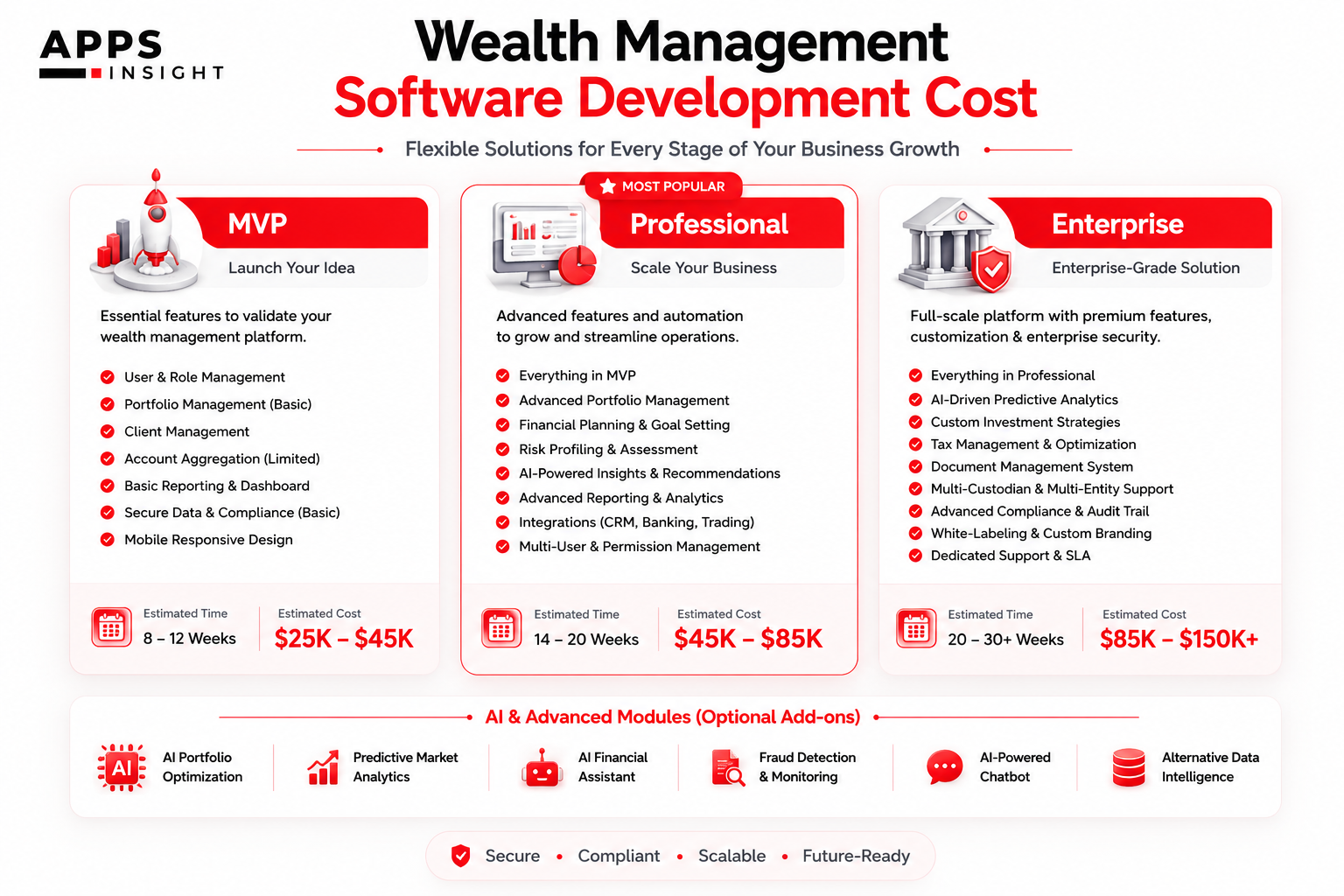
The cost of developing wealth management software depends on far more than just the size of the project. While many sources estimate a broad range of $40,000 to over $600,000, that figure alone provides very little practical insight. The actual investment is determined by the platform’s functionality, compliance requirements, integrations, AI capabilities, deployment strategy, and data migration complexity.
A simple MVP designed for startups or independent financial advisors requires significantly less investment than an enterprise-grade wealth management platform built for banks, investment firms, or global financial institutions. The more advanced the platform becomes, the higher the development effort, security standards, and long-term maintenance costs.
Wealth Management Software Development Cost Breakdown
| Cost Driver | Basic / MVP | Mid-Scale Platform | Enterprise Solution |
|---|---|---|---|
| Custodian Integrations | 1 to 2 custodians | 2 to 4 custodians (+$30K–$60K per integration) | 5+ custodians (+$80K–$150K per integration) |
| Compliance Requirements | Basic KYC & GDPR | SEC Rule 17a-4 + FINRA 3310 | SOC 2 Type II + Multi-Jurisdiction Compliance |
| Compliance Budget | 8%–12% of total development cost | 15%–20% | 20%–25% of the total project budget |
| AI Capabilities | Rule-based portfolio rebalancing | Predictive analytics | NLP-powered personalization & Generative AI Copilot |
| Deployment Model | Cloud-based SaaS | Hybrid Cloud + On-Premise | Private Cloud with Multi-Region Infrastructure |
| Legacy System Migration | No migration | Partial data migration | Complete legacy platform replacement |
| Estimated Development Cost | $80,000–$150,000 | $200,000–$350,000 | $400,000–$600,000+ |
| Estimated Timeline | 6–9 Months | 10–14 Months | 15–24 Months |
Source: Industry estimates based on Emerline (2026) and Fortune Business Insights (2026).
Key Factors That Increase Development Costs
Several technical and business decisions can significantly impact the final development budget.
- Third-party integrations: Connecting with multiple custodians, brokerage platforms, banking APIs, and financial data providers increases both development time and testing requirements.
- Regulatory compliance: Implementing standards such as KYC, GDPR, SEC Rule 17a-4, FINRA 3310, and SOC 2 requires additional security architecture, audit logging, encryption, and documentation.
- Artificial Intelligence: Features like predictive portfolio analytics, AI-powered investment recommendations, conversational assistants, and automated financial planning require advanced machine learning models and larger development teams.
- Infrastructure choices: Enterprise organizations often require private cloud environments, hybrid deployments, disaster recovery systems, and multi-region hosting, all of which add to infrastructure and engineering costs.
- Legacy system migration: Replacing outdated wealth management systems involves complex data migration, API development, validation, and user transition planning, making it one of the most expensive phases of the project.
Cost Optimization Opportunity
Although the estimates above represent U.S. market pricing, businesses can substantially reduce development expenses by partnering with experienced offshore development companies. With the right project management, quality assurance, and communication processes, offshore teams can lower total development costs by 30% to 50% while maintaining enterprise-level quality and security standards.
Ultimately, the total cost of wealth management software depends on your business goals, compliance obligations, feature set, and scalability requirements. Defining these requirements early allows organizations to estimate budgets more accurately and avoid unexpected development expenses later in the project.
Technology Trends Transforming Wealth Management Software in 2026
The wealth management industry is entering a new era where technology is no longer a competitive advantage, it is the foundation of success. As investor expectations evolve and regulatory requirements become more demanding, financial institutions must adopt technologies that improve efficiency, strengthen compliance, and deliver highly personalized client experiences.
The following technology trends are not future predictions. They represent strategic decisions that wealth management firms should prioritize today to remain competitive in 2026 and beyond.
1) AI Is Becoming the Core Infrastructure
Artificial intelligence has moved far beyond being a standalone feature. It is now the backbone of modern wealth management platforms.
According to Forbes’ “72-Hour Rule,” AI-powered features can be replicated by competitors within just a few days of launch. This means businesses can no longer rely on chatbot interfaces or AI assistants as their primary differentiator.
Instead, long-term competitive advantage comes from building robust infrastructure supported by:
- High-quality proprietary data
- Intelligent automation
- Advanced analytics
- Secure data architecture
- Personalized financial insights
Organizations investing in AI-powered infrastructure rather than isolated AI features will be better positioned for long-term growth and innovation.
2) API-First Platforms Are Replacing Traditional Systems
Wealth management firms are rapidly moving away from rigid, all-in-one software suites in favor of flexible ecosystems built around APIs.
According to The Wealth Mosaic (2026), 63% of wealth management firms are increasing their investment in cloud technologies, making API-first architecture one of the biggest technology priorities in the industry.
Modern wealth management platforms are expected to integrate seamlessly with:
- CRM solutions
- Portfolio management systems
- Banking platforms
- Financial planning software
- Compliance tools
- Third-party investment services
An API-first approach enables organizations to select the best technology for every business function while ensuring all systems communicate efficiently. Today, this is not simply an IT decision, it is a long-term business strategy that supports scalability, innovation, and operational flexibility.
3) Hyper-Personalization Is Redefining Client Experience
Modern investors expect financial advice tailored specifically to their goals, investment behavior, and life circumstances.
Powered by Natural Language Processing (NLP) and AI, today’s wealth management platforms analyze more than 50 data points during every client interaction to generate personalized recommendations and proactive financial guidance.
This level of intelligent personalization allows advisors to:
- Deliver customized investment strategies
- Improve client engagement
- Strengthen long-term relationships
- Serve two to three times more clients without compromising service quality
Firms that fail to deliver personalized digital experiences risk losing high-net-worth individuals (HNWIs) to competitors offering more intelligent advisory services.
4) Generative AI Is Streamlining Advisory Operations
Generative AI has become a valuable productivity tool for wealth advisors by automating routine administrative tasks.
Instead of spending hours preparing documentation, advisors can now generate essential business documents within seconds, including:
- Meeting summaries
- Investment policy statements
- Portfolio recommendations
- Rebalancing instructions
- Client communication drafts
According to Mordor Intelligence (2026), firms adopting generative AI are improving advisor productivity while maintaining exceptional client service standards. These efficiencies enable advisors to manage larger client portfolios without sacrificing the quality of financial guidance.
5) The Great Wealth Transfer Is Shaping Product Development
One of the most significant opportunities in wealth management is the ongoing transfer of wealth from older generations to Millennials and Generation Z.
These new investors have fundamentally different expectations from financial platforms. They prefer digital-first experiences that are:
- Mobile-first
- Real-time and notification-driven
- Simple and intuitive
- Highly personalized
- Connected to alternative investment opportunities
At the same time, 62% of single-family offices plan to replace spreadsheet-based reporting with modern wealth management platforms by 2026, according to Mordor Intelligence.
This shift creates enormous demand for software that offers centralized reporting, real-time portfolio visibility, and intelligent investment management. Companies building wealth management solutions today must design products that meet these evolving digital expectations.
6) Compliance Architecture Has a Major Impact on Development Costs
Compliance is one of the most critical considerations when building wealth management software, and it significantly influences the overall project budget.
Choosing between a basic Know Your Customer (KYC) implementation and a fully compliant enterprise-grade platform can dramatically change development costs.
Implementing advanced compliance standards such as:
- SOC 2 Type II
- FINRA compliance
- Enhanced security controls
- Audit trails
- Regulatory reporting
typically increases the overall development investment by $60,000 to $120,000.
For organizations serving clients in regulated markets like the United States, these compliance requirements are not optional. Investing in a secure and regulation-ready architecture from the beginning reduces legal risks, improves client trust, and prevents costly system redesigns in the future.
Technology is fundamentally changing how wealth management firms operate, compete, and deliver value to clients. Artificial intelligence, cloud-native platforms, API-first ecosystems, hyper-personalization, generative AI, and modern compliance frameworks are becoming the foundation of next-generation wealth management software.
Firms that embrace these innovations today will be better equipped to scale their operations, improve advisor productivity, deliver superior client experiences, and adapt to the rapidly evolving financial services landscape in 2026 and beyond.
What Are the Biggest Challenges of Wealth Management Software Development?
Developing wealth management software is far more than building an intuitive interface or integrating financial tools. Financial institutions must balance security, compliance, data accuracy, scalability, and user experience, all while working with legacy infrastructure. Even the most experienced development teams encounter several common challenges that can impact timelines, budgets, and long-term success.
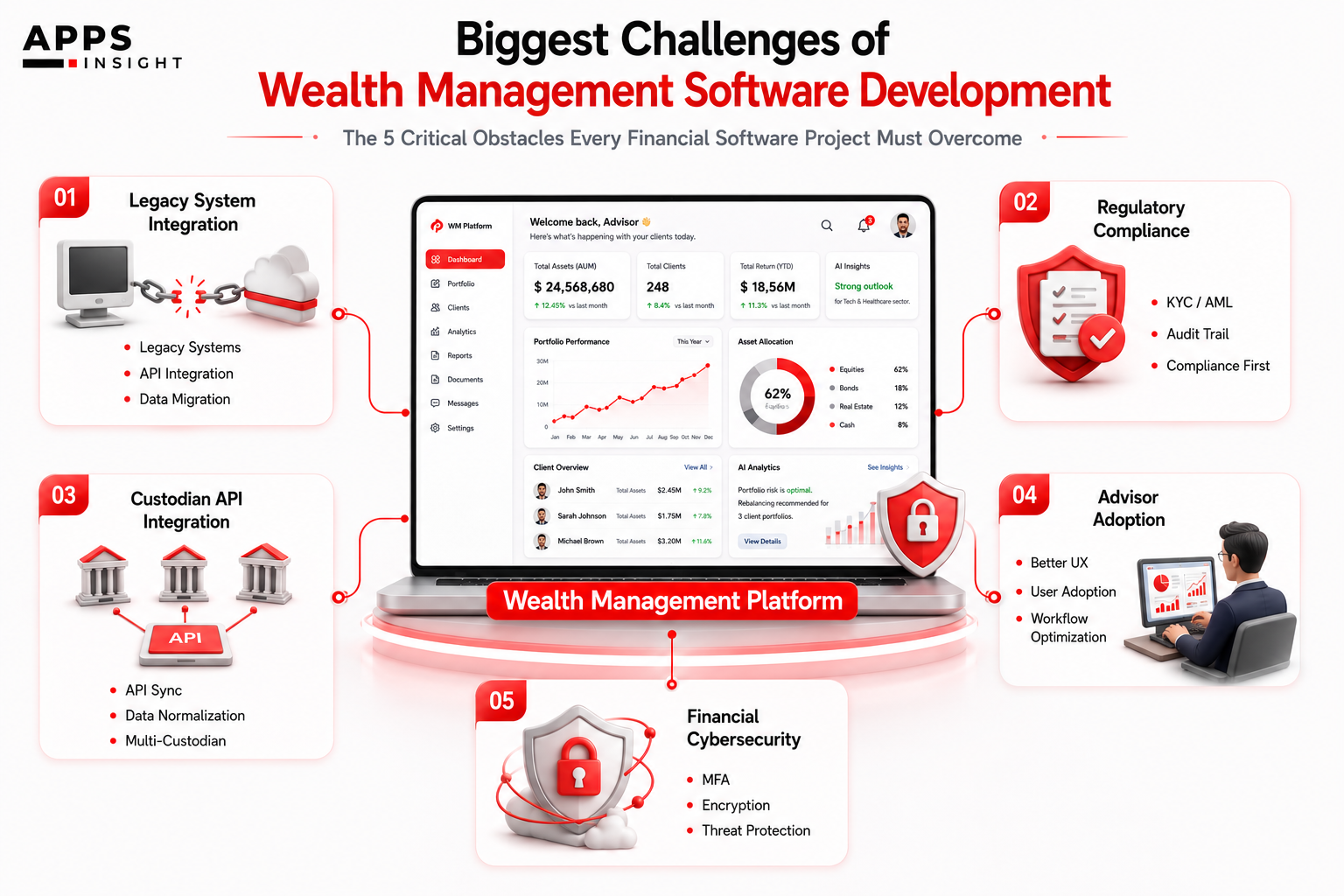
Understanding these obstacles early allows organizations to plan effectively, reduce risks, and build a platform that delivers lasting value.
1. Integrating Legacy Systems
Many wealth management firms still rely on legacy software built years or even decades ago. These systems often operate independently, store data in different formats, and lack modern APIs, making integration a significant technical challenge.
Creating a centralized platform that connects portfolio management, CRM systems, accounting software, and client databases requires careful planning and architecture. In fact, legacy system integration can account for 25% to 35% of the total development effort, making it one of the largest portions of the project.
To avoid unexpected delays and budget overruns, identify every integration requirement during the discovery phase before development begins. A detailed integration roadmap helps minimize technical surprises later in the project.
2. Treating Compliance as an Afterthought
Compliance is not something that should be added after development is complete. Financial regulations affect every aspect of wealth management software, from data storage and reporting to authentication and audit trails.
When compliance requirements are discovered late in the development process, businesses often face expensive redesigns, extended timelines, and additional testing costs.
The most effective approach is to build the platform using a compliance-first architecture from day one. Regulations should influence software design from the initial planning stage rather than being addressed during the final review. A compliance audit at the end of development cannot replace a well-planned compliance strategy integrated throughout the project lifecycle.
3. Managing Custodian APIs and Data Normalization
Modern wealth management platforms typically connect with multiple custodians and financial institutions to retrieve portfolio information, account balances, investment performance, and transaction history.
The challenge is that every custodian provides data differently. API structures, response times, authentication methods, rate limits, and data formats vary significantly between providers.
To deliver a seamless experience, developers must build a dedicated data normalization layer that converts information from multiple sources into a consistent structure. This process requires specialized expertise and should never be treated as a secondary development task.
Assigning an experienced integration engineer specifically for custodian API management helps ensure reliable data synchronization and long-term platform stability.
4. Driving Advisor Adoption and Managing Change
Launching technically advanced software does not automatically guarantee that financial advisors will use it.
Many advisors are comfortable with their existing workflows and may resist switching to a new platform if it adds complexity or slows down daily operations. Even feature-rich software can fail if it doesn’t improve productivity for the people using it every day.
Successful adoption starts by involving advisors early in the development process. Instead of waiting until User Acceptance Testing (UAT), gather feedback during user research, interface design, and prototype development. Building software around real advisor workflows creates a more intuitive experience and significantly increases adoption rates after launch.
5. Meeting Financial-Grade Cybersecurity Standards
Cybersecurity remains one of the highest priorities for wealth management software. Financial institutions handle highly sensitive client information and are among the most targeted industries for cybercrime.
According to KnowBe4, financial services organizations experience approximately 300 times more cyberattacks than businesses in many other industries. As a result, organizations continue increasing investments in advanced security protocols, with annual cybersecurity spending in wealth software development rising by around 15%.
Protecting client data requires more than standard security practices. Modern wealth management platforms should incorporate end-to-end encryption, multi-factor authentication (MFA), role-based access control, continuous monitoring, intrusion detection, automated threat response, and secure cloud infrastructure.
Additionally, obtaining SOC 2 Type II certification provides more than regulatory compliance. It demonstrates a strong commitment to data security, builds client confidence, and serves as a competitive advantage when working with enterprise clients and institutional investors.
Building wealth management software involves much more than writing code. Organizations must overcome challenges related to legacy integrations, regulatory compliance, third-party financial data, user adoption, and enterprise-grade cybersecurity.
Addressing these challenges during the planning stage instead of reacting to them later reduces development costs, minimizes project risks, and creates a scalable platform capable of supporting future business growth. Companies that invest in proper architecture, compliance, and user-centered design from the beginning are far more likely to deliver secure, reliable, and successful wealth management solutions.
How AppsInsight Helps You Find the Top Wealth Management Software Development Companies
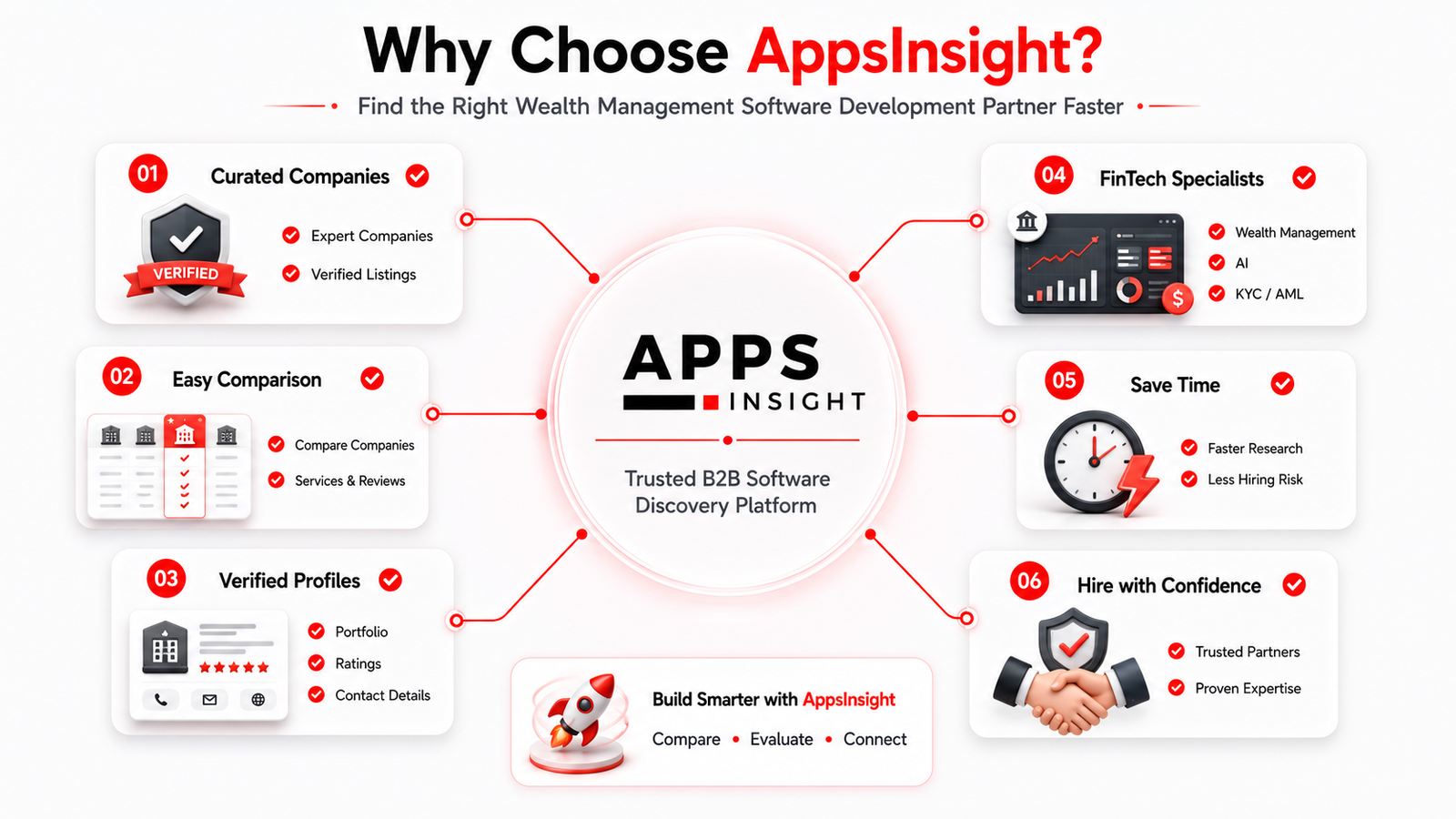
Choosing the right technology partner for your wealth management software project can significantly impact your business’s success. With hundreds of software development firms claiming expertise in fintech, identifying the right one can be both time-consuming and challenging. That’s where AppsInsight simplifies the process.
AppsInsight is a trusted B2B platform that helps businesses discover, compare, and connect with the best software development companies based on proven expertise, industry experience, and service quality.
Carefully Curated Company Listings
Every company featured on AppsInsight is evaluated using multiple quality parameters, including technical capabilities, industry specialization, client portfolio, years of experience, project success, and market reputation. This ensures you receive a reliable shortlist of companies with real-world experience in building secure financial software.
Compare Leading Companies in One Place
Instead of visiting dozens of websites, AppsInsight allows you to compare top wealth management software development companies side by side. You can review their services, technology stack, industry expertise, client reviews, locations, and company profiles to make a confident decision.
Verified Company Profiles
Each company profile provides valuable information, including:
- Company overview
- Core services
- Industry expertise
- Technology capabilities
- Client reviews and ratings
- Portfolio highlights
- Contact details
This makes it easier to evaluate potential development partners before reaching out.
Find Specialists in FinTech Development
Not every software company understands the complexities of wealth management platforms. AppsInsight helps you discover companies experienced in developing solutions with advanced features such as portfolio management, financial planning, AI-powered analytics, regulatory compliance, client portals, KYC/AML workflows, and third-party financial integrations.
Save Time and Reduce Hiring Risk
Researching software vendors manually can take weeks. AppsInsight streamlines the entire selection process by presenting only reputable companies, helping you reduce risk, save valuable time, and connect with trusted development partners faster.
Start Your Wealth Management Software Project with Confidence
Whether you’re building a new wealth management platform, modernizing legacy systems, or integrating AI-driven financial tools, AppsInsight helps you find experienced software development companies that match your business goals, technical requirements, and budget.
With comprehensive company profiles, transparent comparisons, and curated rankings, AppsInsight makes finding the ideal wealth management software development partner simple, reliable, and efficient.
How AI Is Reshaping Wealth Management Platforms
Artificial Intelligence (AI) is transforming the wealth management industry by making financial services more intelligent, efficient, and personalized. Traditional wealth management platforms primarily relied on manual analysis and standardized investment strategies. Today, AI enables financial advisors and institutions to automate complex tasks, deliver tailored investment recommendations, and make faster, data-driven decisions.
As client expectations continue to evolve, AI-powered wealth management platforms are becoming essential for firms that want to remain competitive and improve operational efficiency.
Personalized Investment Recommendations
AI analyzes vast amounts of client data, including financial goals, spending habits, investment history, and risk tolerance, to deliver highly personalized investment strategies. Instead of offering generic portfolios, AI continuously adjusts recommendations based on changing market conditions and client behavior.
This level of personalization helps advisors strengthen client relationships while improving investment outcomes.
Intelligent Portfolio Management
Modern wealth management platforms use AI to automate portfolio monitoring and optimization. Machine learning algorithms track market fluctuations, identify risks, and recommend portfolio rebalancing whenever asset allocations drift from predefined investment goals.
This automation allows financial advisors to focus on strategic planning rather than repetitive portfolio management tasks.
Predictive Financial Analytics
AI-powered predictive analytics helps firms anticipate market trends and client needs before they occur. By analyzing historical data alongside real-time financial information, AI can forecast investment opportunities, cash flow requirements, and potential market risks.
These insights enable wealth managers to make proactive decisions that improve long-term portfolio performance.
AI-Powered Client Assistants
Virtual assistants and AI chatbots are improving customer engagement by providing instant support around the clock. Clients can access portfolio information, receive market updates, schedule meetings, or get answers to common financial questions without waiting for an advisor.
This enhances customer satisfaction while reducing the workload on support teams.
Automated Compliance and Risk Monitoring
Compliance is one of the biggest challenges in wealth management. AI simplifies regulatory compliance by continuously monitoring transactions, identifying suspicious activities, and flagging potential policy violations.
AI can also automate Know Your Customer (KYC), Anti-Money Laundering (AML), and fraud detection processes, helping firms reduce compliance risks while meeting strict regulatory requirements.
Smarter Financial Planning
AI assists advisors in creating comprehensive financial plans by evaluating multiple variables such as income, expenses, tax obligations, retirement goals, and market conditions. Instead of spending hours preparing financial reports, advisors receive AI-generated insights that support faster and more accurate planning.
This enables wealth managers to deliver better financial advice while improving productivity.
Enhanced Data Security
AI strengthens cybersecurity by detecting unusual user behavior, preventing unauthorized access, and identifying potential cyber threats in real time. Intelligent monitoring systems continuously analyze login patterns, device activity, and transaction behavior to protect sensitive financial information.
As cyberattacks become more sophisticated, AI-driven security has become a critical component of modern wealth management platforms.
Document Automation and Meeting Summaries
Generative AI is streamlining administrative tasks by automatically creating investment reports, meeting summaries, client communications, and financial documentation. Advisors spend less time on paperwork and more time building client relationships.
This automation improves efficiency while ensuring documentation remains accurate and compliant.
Improved Client Retention
AI helps firms identify clients who may be at risk of leaving by analyzing engagement patterns, communication history, and investment behavior. Wealth managers can proactively engage these clients with personalized recommendations, educational content, or tailored financial strategies to improve satisfaction and retention.
The Future of AI in Wealth Management
The future of wealth management lies in the collaboration between human expertise and artificial intelligence. Rather than replacing financial advisors, AI serves as a powerful decision-support tool that enhances productivity, reduces operational costs, and delivers more personalized financial experiences.
As technologies such as Generative AI, predictive analytics, and intelligent automation continue to advance, wealth management platforms will become increasingly proactive, secure, and client-focused. Firms that embrace AI today will be better positioned to deliver superior financial services, improve client trust, and achieve sustainable growth in the years ahead.
Frequently Asked Questions
What is Wealth Management Software Development?
Wealth management software development is the process of creating a secure digital platform that helps financial advisors, investment firms, and wealth management companies manage client assets more efficiently. It combines portfolio management, financial planning, compliance automation, investment tracking, and reporting into a single solution.
Modern wealth management platforms also provide clients with real-time access to their portfolios, personalized financial insights, performance reports, and secure communication tools. By automating manual processes and ensuring regulatory compliance, these platforms improve operational efficiency while delivering a better client experience.
How Much Does It Cost to Develop Wealth Management Software?
The cost of developing wealth management software depends on the platform’s complexity, features, integrations, security standards, and compliance requirements.
- Basic MVP: Around $80,000 with essential portfolio management features, compliance workflows, and a single custodian integration.
- Mid-Level Platform: Between $150,000 and $350,000, including multiple integrations, advanced reporting, financial planning tools, and enhanced security.
- Enterprise Solution: $400,000 to $600,000+, featuring multi-custodian connectivity, AI-powered personalization, enterprise-grade infrastructure, SOC 2 Type II compliance, and scalable cloud architecture.
The final investment varies based on custom functionality, third-party integrations, regulatory requirements, and long-term scalability.
How Long Does It Take to Build Wealth Management Software?
The development timeline varies according to the project’s size and technical requirements.
- Minimum Viable Product (MVP): Typically 6 to 9 months
- Mid-Scale Wealth Management Platform: Around 10 to 14 months
- Enterprise-Level Platform: Approximately 15 to 24 months
Enterprise projects usually require additional time for legacy system migration, AI implementation, regulatory validation, multi-region deployment, and extensive security testing before launch.
Should You Build Custom Wealth Management Software or Buy an Off-the-Shelf Solution?
For most established wealth management firms, a hybrid approach offers the greatest value.
Custom development allows organizations to build critical components such as data aggregation, compliance management, reporting, and proprietary investment workflows while maintaining complete control over security and regulatory requirements.
At the same time, integrating proven third-party modules for financial planning, client portals, or CRM functionality can significantly reduce development time and cost.
A fully custom platform is typically recommended only when your advisory process, investment strategy, or operational model provides a unique competitive advantage.
What Integrations Are Essential for Wealth Management Software?
A modern wealth management platform relies on multiple integrations to deliver accurate financial data, automate workflows, and ensure regulatory compliance.
Some of the most important integrations include:
- Custodian Platforms: Schwab, Fidelity, Pershing, Orion
- Market Data Providers: Bloomberg, Refinitiv, Morningstar
- KYC & AML Providers: Fenergo, Compliancely, NICE Actimize
- Open Banking APIs: Plaid, FDX API
- Authentication Services: OAuth 2.0 and SAML
- Trading Infrastructure: FIX Protocol for broker-dealer order routing
These integrations enable seamless portfolio management, secure authentication, faster onboarding, and reliable investment execution.
Which Compliance Standards Must Wealth Management Software Meet?
Compliance is one of the most critical aspects of wealth management software development. The platform must be designed to satisfy industry regulations while protecting sensitive financial information.
For organizations operating in the United States, common requirements include:
- SEC Rule 17a-4 for WORM-compliant record retention
- FINRA Rule 3310 for Anti-Money Laundering (AML) programs
- KYC and AML verification during client onboarding
- SOC 2 Type II certification for security and operational controls
Companies serving European or UK markets must also comply with MiFID II and GDPR regulations.
Businesses operating across multiple regions should build data residency, consent management, and privacy controls into the software architecture from the beginning to simplify compliance and future expansion.
What AI Features Should Wealth Management Software Include?
Artificial intelligence is rapidly transforming wealth management by improving decision-making, operational efficiency, and client engagement.
Some of the most valuable AI capabilities for modern wealth management platforms include:
- AI-powered portfolio rebalancing and investment optimization
- Personalized financial recommendations using natural language processing (NLP)
- Predictive cash flow forecasting and financial planning
- Generative AI assistants for meeting summaries and investment documentation
- Intelligent compliance monitoring and anomaly detection
To satisfy regulatory standards, every AI-generated recommendation should maintain a complete audit trail that records inputs, outputs, and human approvals, ensuring transparency, accountability, and compliance throughout the decision-making process.